I’ve been using Fi collars on Lucy and Shelby since late 2022. Between them, my two coonhounds have now logged more than 100 million real-world steps on Fi. We’ve owned the Series 2, upgraded both dogs to Series 3, had one replacement device for Lucy, bought multiple Fi-compatible collars, and Lucy is now wearing the newer Series 3+.
Shelby isn’t.
Her Series 3 still works, and I couldn’t see a compelling reason to replace two perfectly functional trackers just because Fi released a newer one. That probably tells you quite a lot about how I approach reviews like this.
This isn’t a review based on wearing a GPS collar around the neighbourhood for a fortnight. It’s what Fi is actually like to own long-term: through mud, woods, ageing batteries, app updates, hardware changes and several very real coonhound escapes.
Would I buy Fi again? Yes — for Lucy and Shelby. Indie still doesn’t need one.
I own three dogs, but only two of them wear Fi collars. Indie, my German Shepherd, does not. That is not because I trust the product less on him, or because I care less about where he is. It is simply because he is a very different dog. Indie has a reliable recall, he naturally checks in with me, and even if something exciting appears in front of him, I know his instincts are still tied fairly closely to me. He might look at a deer, he might even think about it for a second, but I would expect him to come back pretty quickly.
Lucy and Shelby are coonhounds, which is an entirely different proposition. They were bred to follow scent, cover distance and make decisions away from their handler, which is exactly why training a coonhound has to work with those instincts rather than pretend they do not exist. They are not being difficult when they disappear after something interesting. They are doing exactly what generations of selective breeding prepared them to do, and they are very comfortable with that arrangement. They do not see leaving the yard as a crisis. They see it as an unexpected enrichment opportunity.
That is why I use Fi on the hounds and not on Indie. I do not put GPS collars on my dogs because I do not trust them. I put GPS collars on the dogs whose instincts I understand well enough to know they may occasionally take them several fields away from me.

We first started using Fi in late 2022, although the decision to buy the collars really began before that. Lucy and Shelby had already had one enormous escape after a tree came down across our fence. They were missing for seven days and were eventually found a few miles from home, in the snow. They were fine, thankfully, but I do not think I will ever forget that week. Anyone who has had a dog go missing, even for a few hours, will understand the feeling. Every phone call makes your stomach drop. Every notification makes you stop what you are doing. You are constantly replaying what happened and trying not to imagine everything that could have gone wrong.
Then I moved in with them and discovered just how quickly hounds will capitalise on ordinary human error. I was not used to living with dogs who were quite so committed to leaving whenever an opportunity presented itself. I did rookie things, like not quite shutting a gate properly, leaving it open while carrying something in, or assuming that a latch was secure enough when it was not. Friends would visit and not realise that a gate being mostly closed is not the same as a gate being closed when Lucy can push it open with her nose.
There were also the less preventable incidents, like deer crashing through fencing and trees coming down in storms. Apparently I should have anticipated the deer breaking into the yard and then breaking back out again with Shelby following behind it. Very careless of me.
That is the reality of living with dogs, though. Things happen. Gates are left open, fences break, visitors make mistakes, and sometimes your own brain simply fails to participate because you are sick, distracted or trying to carry too many things at once. With hounds, those moments can turn into a proper disappearance remarkably quickly.
Buying GPS collars stopped feeling like an admission that I had failed to train my dogs and started feeling like sensible management. I still train recall. I still maintain the fencing. I still check the gates. Fi is not there instead of those things; it is there because none of those things can guarantee that a dog will never get loose.
Why We Chose Fi
Fi was not the only tracker available when we started looking, and since then I have also tested Whistle and Tractive. I have not tested Garmin, so I am not going to pretend I can compare it fairly. Of the trackers I have used, Fi has consistently produced the best results for us and for our particular property.
That last part matters because GPS trackers do not behave exactly the same everywhere. Cellular coverage, Wi-Fi coverage, terrain and even how your dog uses the property can all affect performance. We have very good internet coverage across our yard because we use a mesh Wi-Fi system, and I am sure that helps both the reliability and battery life. If you have a large yard with patchy Wi-Fi, I would honestly fix that anyway. It makes a noticeable difference to far more than just the dog tracker.
For us, Fi produces very few false alerts. I can remember perhaps one across both dogs in the last year, which is excellent. With other trackers I have found myself second-guessing notifications more often, and that quickly becomes frustrating because you do not want to reach the point where you start ignoring an alert that might be real.
Our Fi Timeline: Series 2 → Series 3 → Series 3+
We started with the Series 2 and upgraded both dogs to Series 3. The improvements were not difficult to notice: the Series 3 device was smaller, the signal was more reliable, and battery performance was significantly better than our ageing Series 2 units.
We’ve also had one replacement device for Lucy during our time with Fi. I think that’s important context in a long-term review: I don’t want to imply the same two pieces of hardware have survived nearly four years without incident.
Lucy is now on the Series 3+. Shelby is still on Series 3. I wanted to test the newer generation, but Shelby’s existing tracker still works and I couldn’t see enough reason to replace both devices purely because a newer model exists. In some ways, having one of each is more useful: I can see what actually feels different rather than relying on a spec sheet.
Shelby’s older Series 3 has held up surprisingly well. Even after years of daily wear through mud, rain, woods and rough play, we’ve continued to get useful battery life from it. Battery life has faded with age, as you’d expect, but the tracker remains perfectly usable.
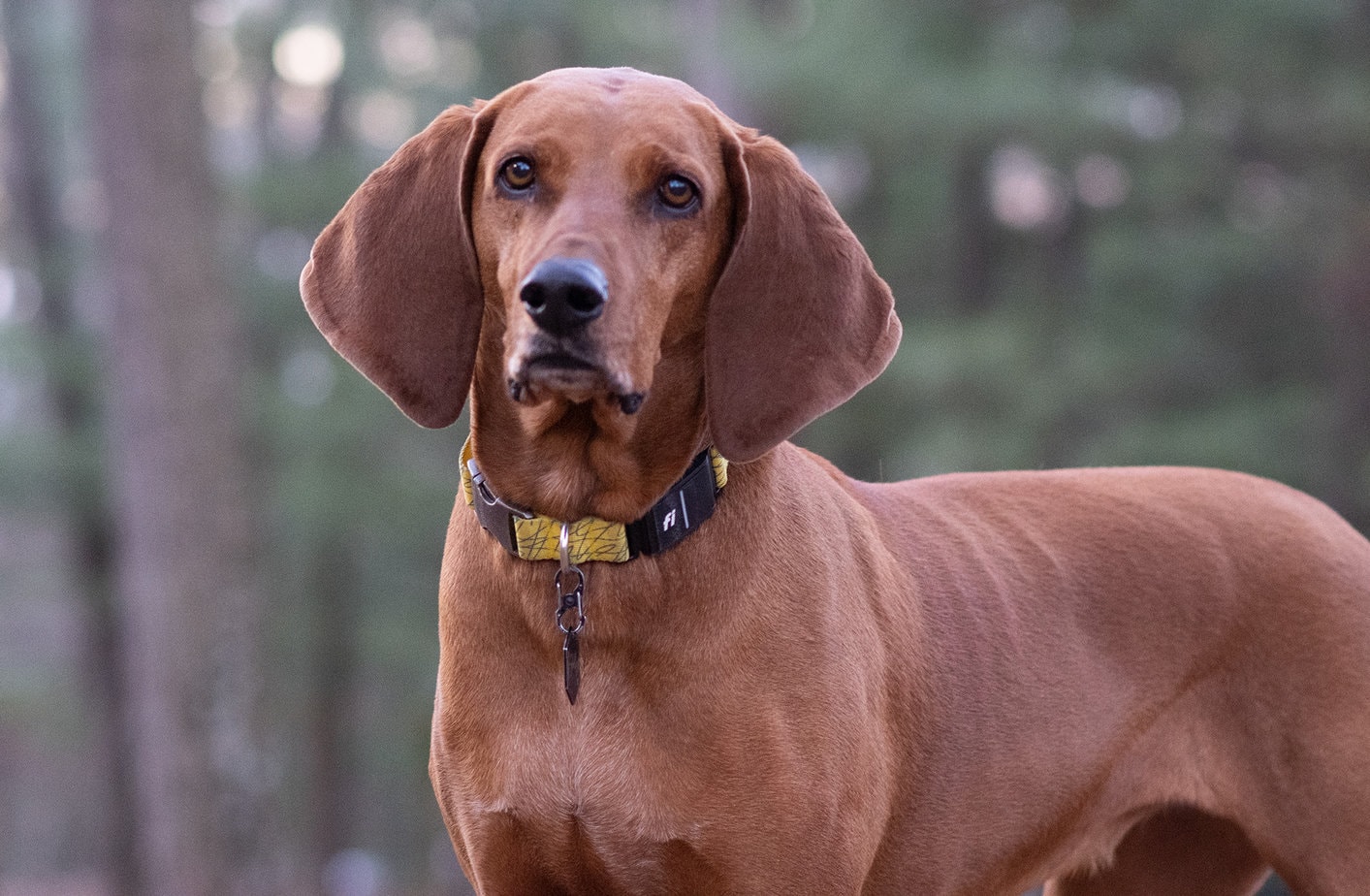
The collars have improved too. Over the years I’ve bought multiple Fi-compatible collars rather than treating the supplied collar as the only option. We currently use Tactipup collars that cover and protect the device, and honestly, I forget the dogs are wearing trackers most of the time. The module feels secure, it does not flop around, and the dogs do not seem aware of it. That is exactly what I want from something they wear every day.

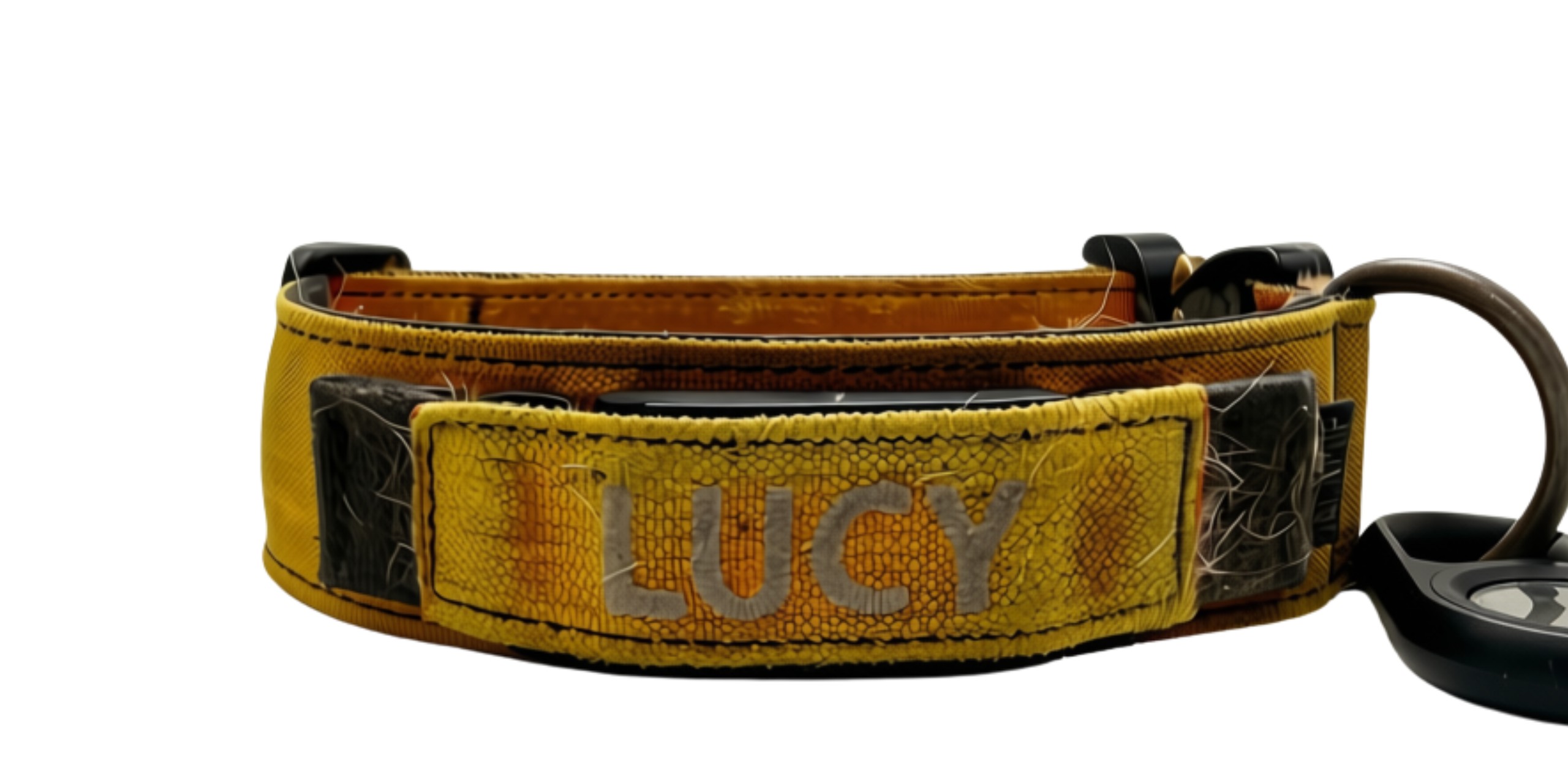
Fi does require you to use compatible collar hardware, which is one of its limitations. You cannot simply clip the tracker onto anything you already own in the way you can with some competitors. I have found a setup I like, so it does not bother me much now, but it is worth knowing before you buy.
The charging dock can also be a bit of a dick to get going. Sometimes the device sits exactly where it should, and nothing happens. Then you shift it half a millimetre, glare at it and suddenly it decides to charge. It is not a serious enough issue to make me stop using the collar, but it is one of those small annoyances that becomes very familiar over several years of ownership.
What Fi Has Become for Us
When the collars were new, I used the app much more than I do now. I checked the sleep scores, looked at step counts, watched the maps and enjoyed comparing the dogs against others in their breed and age groups. Over time, that changed, not because the data stopped being useful, but because I had already done a lot of the baseline work.
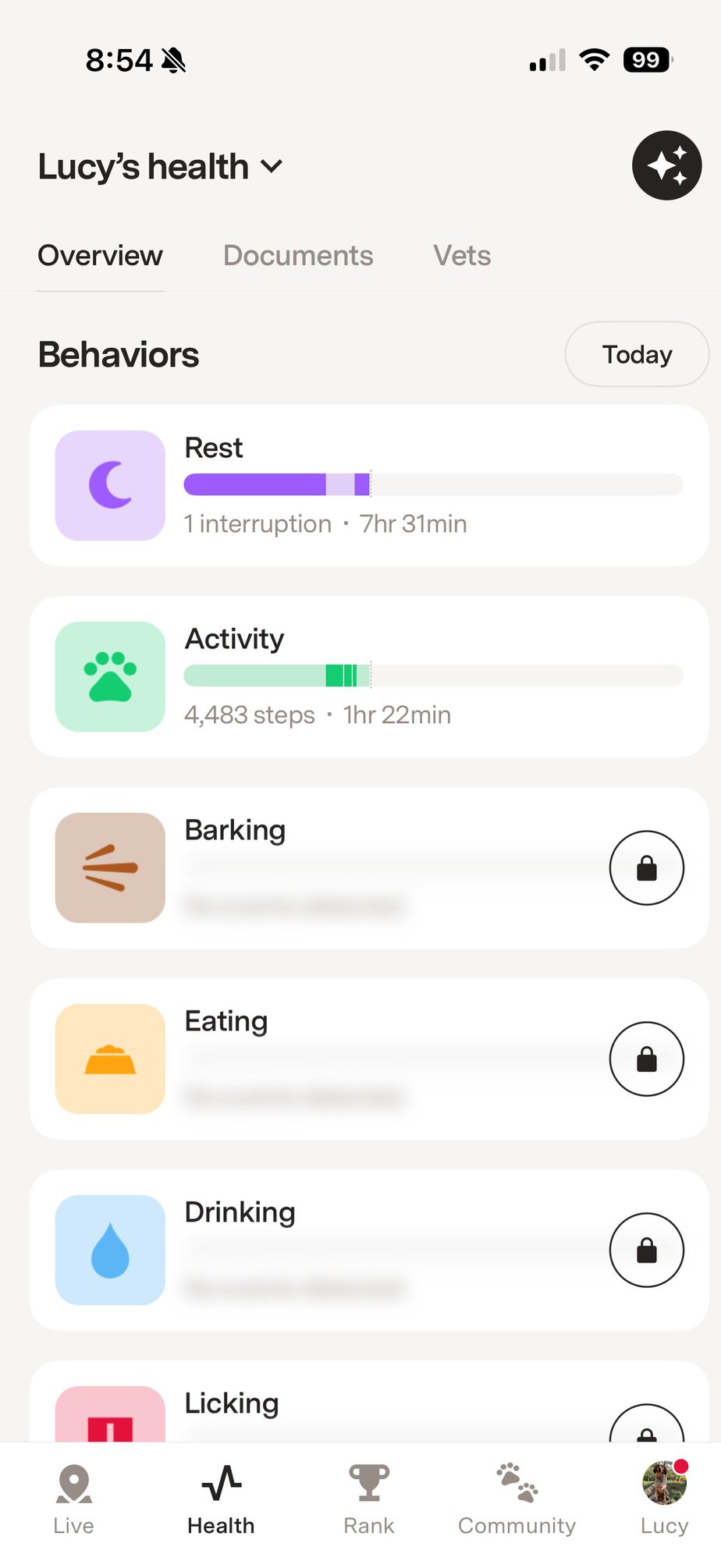
As a behaviour consultant, I think sleep and activity data can be incredibly valuable. Changes in sleep, movement and routine can tell you a great deal about stress, pain, recovery, medication and general wellbeing. If I were making behavioural adjustments, monitoring a senior dog more closely or trying to understand whether something had changed, I would absolutely use those trends.
Now, because we have had trackers for years, I already know what normal looks like for Lucy and Shelby. I do not need to log in every morning to discover that Shelby has slept for most of the day. I can usually work that out by looking at the large, motionless hound taking up the sofa.
More Than 100 Million Steps of Real-World Use
That does not mean I have stopped enjoying the data. Lucy alone has logged more than 54 million lifetime steps on Fi and reached Diamond. Across Lucy and Shelby, we’ve now put Fi through more than 100 million tracked steps of real-world use. That matters to me far more than testing a tracker for a few weeks and extrapolating from it.
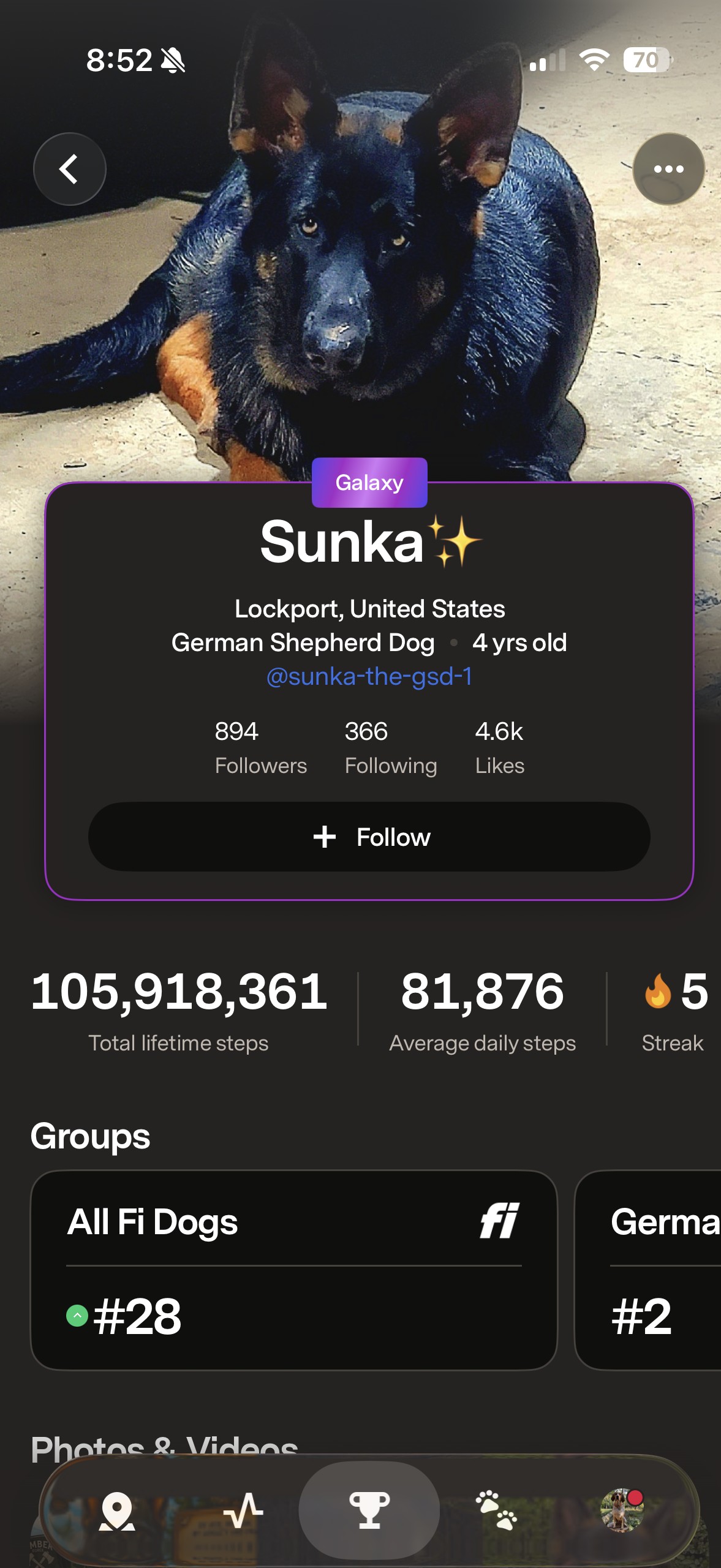
I also still love seeing Lucy, at ten years old and probably one of the older dogs on the platform, regularly placing in the top ten for her breed and senior category. It makes me absurdly proud of her.
The leaderboards do need to be treated carefully, though. I am in a Facebook group where people get genuinely competitive about them, and it is a little shocking. Some owners start pushing dogs, including young puppies, to do more exercise simply to climb the rankings. That should never be the point. Your dog’s activity score is information, not an achievement badge, and it should be compared against that dog’s own baseline rather than somebody else’s much younger, larger or more active dog.
These days Fi mostly sits quietly in the background for us. I do not spend much time in the app unless something has happened. It has become our emergency support rather than a gadget I interact with every day, and I actually think that says more about its value than constantly opening it would.
When everything is going well, I forget about it.
When a hound gets out, it suddenly becomes the most important app on my phone.
What Fi Actually Does
At its simplest, Fi is a GPS dog collar, and it is one of the products included in my broader guide to the best pet tech for dogs. It uses GPS, cellular service, Wi-Fi and Bluetooth to keep track of where your dog is and to reduce battery use when they are safely at home. You can create a safe zone around your property, and if the dog leaves that area without a recognised owner, Fi sends an app alert and a text message.
If the dog is genuinely missing, you can open the app and activate Lost Dog Mode. The location then refreshes much more frequently, showing you where the dog is moving, which direction they are travelling and roughly how quickly they are covering ground. That does not magically retrieve your dog for you, but it gives you somewhere to go and a much better chance of getting close enough for your recall training to matter.
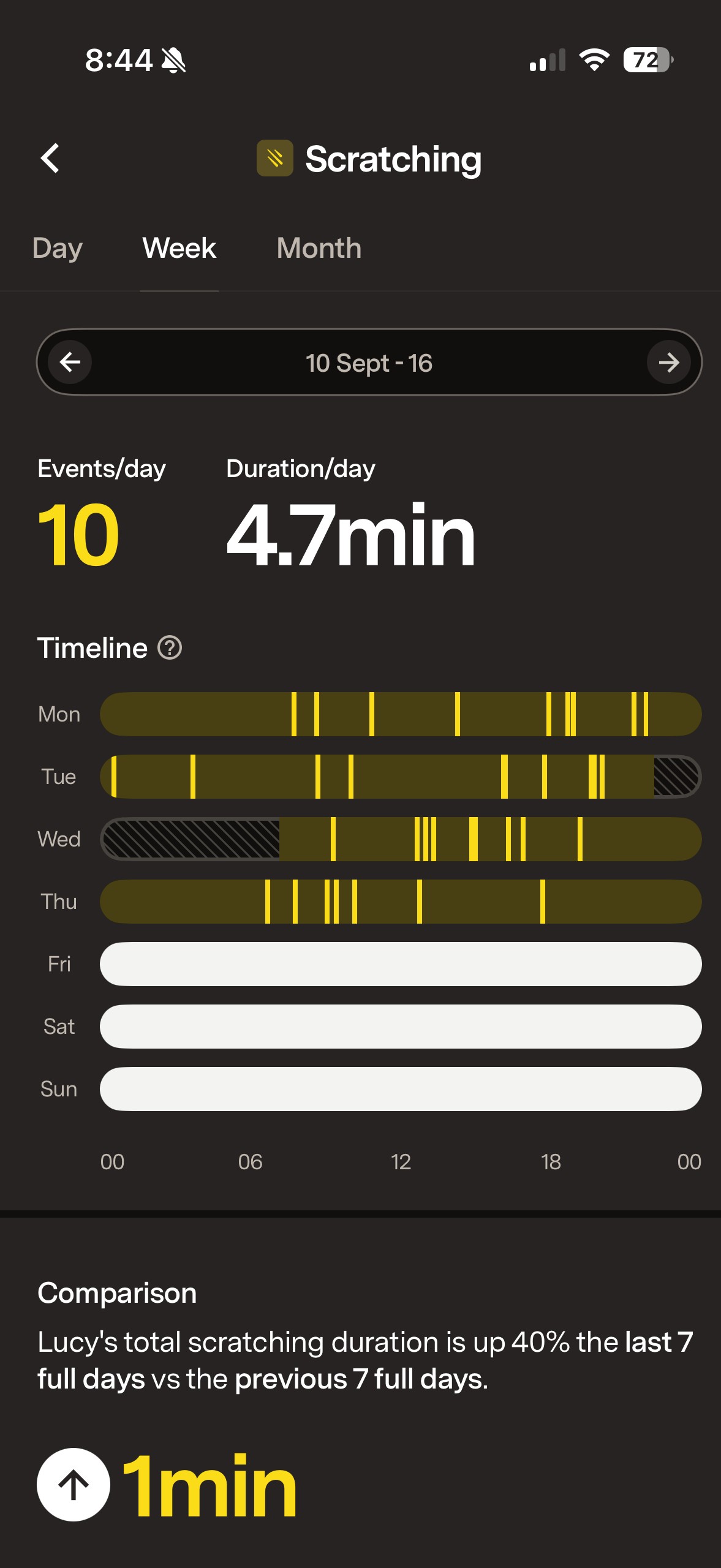
Fi also tracks activity, sleep and longer-term health patterns. The newer health tracking has become much more specific than it was when we first bought the collars: I can now see behaviours including Lucy’s licking and scratching, the number of events, how long they lasted and whether that behaviour has changed against her recent baseline.

I don’t treat any of that as a diagnosis. Fi cannot tell me why Lucy is scratching or licking, and a wearable isn’t a substitute for a vet. What it can do is make a change easier to notice, which is where I think passive health monitoring becomes genuinely useful.
It also includes breed and age-based leaderboards, lets multiple family members access the dogs, and has improved its multi-dog experience considerably since we first started using it. Early on, managing more than one dog in the app felt awkward. It is much smoother now, and switching between Lucy and Shelby is no longer something I have to think about.
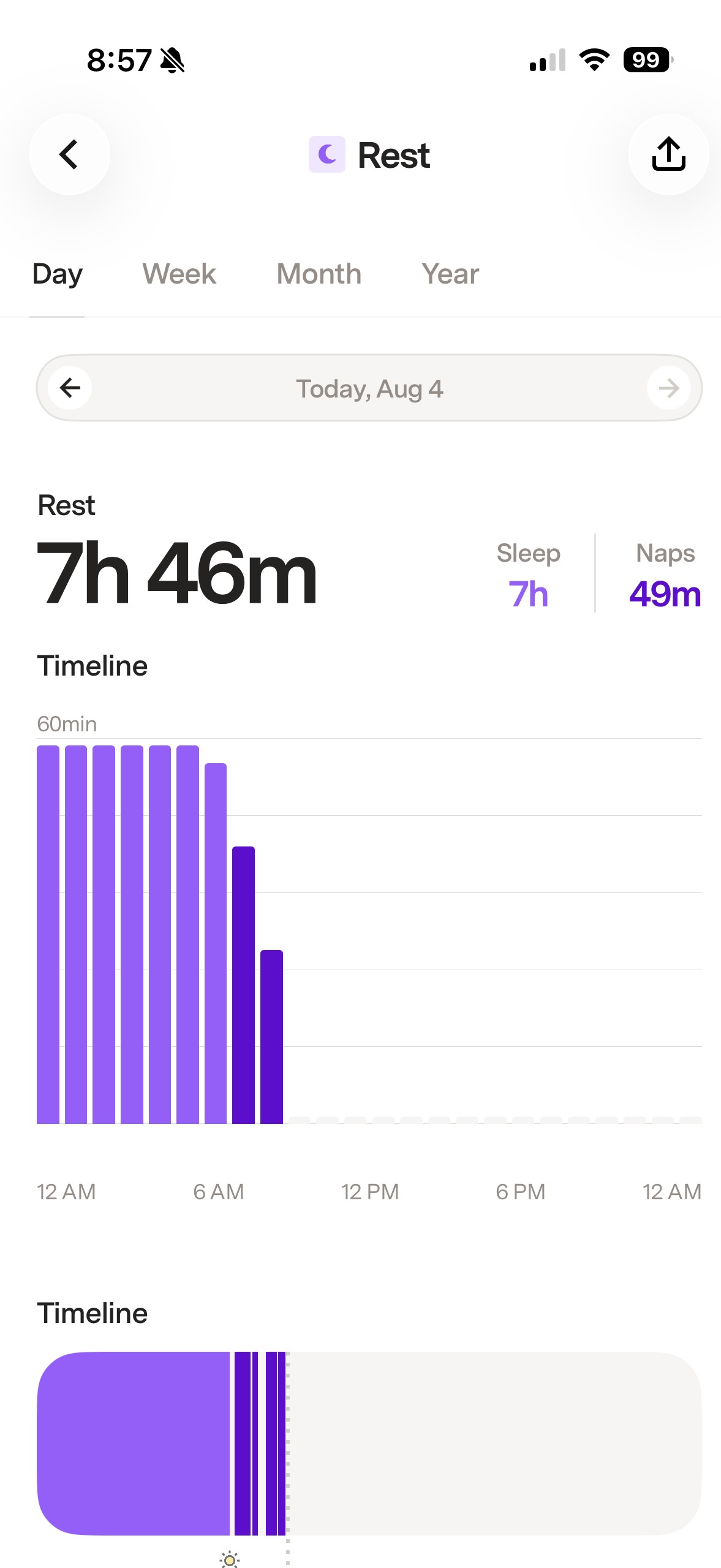
There is also an AI feature, which I think is interesting but currently underused. I asked it how much Shelby sleeps each day, and it told me she averages somewhere around twenty to twenty-three hours. That sounds entirely plausible because Shelby is deeply committed to rest unless a deer appears.
When I asked whether that amount of sleep was normal, though, the answer was essentially that older dogs often sleep more. That is not wrong, but it is not really using the data Fi already has. The app knows Shelby’s age, breed, historic sleep patterns and activity levels. It should be able to compare her against similar dogs and tell me whether she is sleeping more than usual for her, whether the change is significant and whether it sits within a reasonable range for dogs like her.
That is where I think Fi’s AI could become genuinely useful. It already has years of individual data. It should be helping owners understand their dog’s baseline rather than giving broad information that could have come from any generic search result.
There is another feature I would love Fi to add, and I am genuinely surprised it has not happened yet: an NFC tag built into the collar. If somebody finds your dog, they should be able to tap the collar with their phone and immediately access the owner’s contact information. A GPS tracker is incredibly useful when you are trying to find the dog, but sometimes somebody else finds them first. Making the collar instantly scannable feels like an obvious next step.
For all the extra features, though, the main reason my hounds wear Fi has never changed. It is there for the moment a gate is left ajar, a fence gives way or one of them decides the scent disappearing into the woods is more important than whatever I had planned for the afternoon.
And unfortunately, we have had enough real escapes since buying the Series 3 to know exactly how much difference that can make.
What Happens When One of the Dogs Actually Escapes?
One of the things I wanted to know before buying a GPS tracker was what actually happens when your dog gets out. Not the polished product demo version, but the real version. Do you get the alert quickly enough? Does the map make sense when you are panicking? Can you tell which direction they are moving? Does it genuinely help, or does it just give you one more app to stare at while your dog disappears into the distance?
Since moving onto the Series 3, we have had three or four genuine escapes, and thankfully none of them have turned into anything like the seven-day disappearance that made us buy trackers in the first place. Fi has not prevented every escape, because no tracker can do that, but it has changed what happens immediately afterwards. Instead of standing in the yard guessing which way the dogs went, we can start with an actual location and a direction of travel.
The Time Lucy Nosed the Gate Open
The most recent escape happened when a friend came to visit and left the gate slightly ajar on the way out. That would probably be fine in a lot of homes, but Lucy is very good at noticing an opportunity. She pushed it open with her nose and took herself off into the woods behind our neighbour’s property.
We got the Fi alert almost immediately. I grabbed a leash and cookies and was out of the door within a couple of minutes. Ironically, I could not take my own phone because it was upstairs playing lullabies for the baby, so my husband used his phone to track Lucy while I called for her. That division of labour actually worked well because he is better at watching the map and I am the person Lucy is most likely to recall to.
One of the only useful things about owning coonhounds in this situation is that they are loud. Our method is usually to call for a while, stop and listen, then repeat. Before long, I could hear Lucy moving back towards me through the woods. Once we saw her, we cheered her in, rewarded her heavily and brought her home. She was probably out for no more than ten minutes.
That is where the tracker makes the biggest difference for me. It does not remove the stress, but it removes a lot of the uncertainty. We knew she had left. We knew roughly where she was. We knew which direction to move in. Without Fi, I would have been calling into the woods and hoping I had chosen the right side of the property.
The Escape That Was Entirely My Fault
My most human moment happened when I had a sinus infection and my brain simply was not functioning properly. I came home from work, brought things in, left the gate open and then let the dogs outside.
Indie, my German Shepherd, stayed in the yard because he is reliable and apparently had no interest in joining the nonsense. Lucy and Shelby saw the open gate and took themselves on a run.
My husband was already on his way home from work. He pulled up the Fi app, saw where they were moving and intercepted them in the car. He pulled over, called them over, loaded them up and brought them home.
That one would almost certainly have become a much bigger search without the trackers. By the time I realised what had happened, they had already covered enough distance that guessing which road, field or patch of woods they had chosen would have been pointless. Fi gave my husband the information he needed to get ahead of them instead of following behind.
It also proved something I had not really thought about before. A GPS tracker is not only useful to the person standing at home. If several people in the household have access to the account, the person in the best position to help can act immediately. In that case, my husband was already moving towards them and could use the map to turn a potential disaster into a very short detour.
The Time Shelby Followed a Deer
Then there was the deer incident, which was every bit as ridiculous as it sounds. A deer got into the yard, then got back out again, and Shelby decided she should follow it.
I got in the car and started tracking her while trying to work out where a deer and a coonhound might go next. There was driving, running across fields and some very confused people watching me appear in places I probably had no business being. At one point I ended up near police lines because I was concentrating more on the blue dot than on what was happening around me.
It became very Benny Hill very quickly.
In the end, Shelby brought herself home before I did.
That story is funny now, but it also shows the limit of the technology. Fi told me where she was and helped me follow the route she was taking, but it could not stop her chasing the deer. It could not call her back, make her turn around or convince her that coming home was the better option. It gave me information, and that information was valuable, but I still had to do the rest.
How the Escape Alerts and Lost Dog Mode Work
When one of the dogs leaves the geo-fenced safe area, Fi sends an app notification and a text message. I really appreciate the text because I do not live in the app anymore. Most days I do not open it at all, so relying only on a push notification would make it easier to miss something.
The first thing we do is sense-check the alert. False alarms are rare for us, but they can happen, so we confirm that the dogs are not with one of us, in another part of the property or already being walked. If nobody can see them and they are not where they should be, we assume they are out.
Then we open the app and switch on Lost Dog Mode. The location starts updating much more frequently, which lets you build a picture of what the dog is actually doing. You can see whether they are continuing away from home, circling back, following a road, moving quickly through fields or stopping in one place.
That directional information is one of the most useful parts. A single location pin tells you where your dog was. A sequence of updates tells you where they are likely to be next. That can help you decide whether to go on foot, get in the car, stay near home or move to a road where you may be able to intercept them.
Fi Is Not a Replacement for Recall
This is the caveat I want to make very clear because GPS collars can create a false sense of security. Owning a tracker does not mean you can neglect recall training.
Fi can tell me that Lucy is two hundred yards into the woods. It cannot make her leave the scent she is following. The tracker helps us get close enough for our recall training to matter, but that training is still doing the final, life-saving part.
Every time we have successfully brought one of the hounds home, the process has been the same. Fi gives us the direction, we get close enough to call, and then the dog’s reinforcement history takes over. Without that recall training, we would simply know the exact location where our dog was ignoring us.
That is still better than not knowing where they are, but it is not enough.
A reliable recall saves lives. A tracker can support that, especially with dogs whose genetics make wandering more likely, but it should never replace the work. GPS helps you find your dog. Recall helps you bring them home.
Living With Fi Every Day
The funny thing about owning Fi for several years is that it stops feeling like a gadget.
When the collars first arrived, I was in the app constantly. I wanted to know where the dogs had walked, how many steps they’d done, whether the sleep tracking actually worked and what all the graphs meant. Like most people buying a new bit of tech, I was determined to explore every feature.
That phase does pass.
Not because the features stop being useful, but because they become familiar. These days I probably don’t open the app unless I’ve had a notification, I’m curious about something specific or one of the dogs has decided to make questionable life choices.
For me, Fi has quietly become emergency equipment. It sits in the background doing exactly what I need it to do and asks very little of me until something happens.
Oddly, I think that’s one of the nicest things I can say about it.
The Health Tracking Is Better Than I Expected
When I first bought Fi, I assumed the GPS would be the star of the show and everything else would be a nice extra.
I was wrong.
As a behaviour consultant, I’ve ended up appreciating the health data far more than I expected. Activity levels and sleep aren’t just interesting numbers on a graph; they give you objective information about your dog over time. If you’re working through a behaviour modification plan, recovering from surgery, changing medication or trying to understand whether an older dog is slowing down, having that historical data is genuinely useful.
I don’t religiously check Lucy and Shelby’s activity every morning anymore because, after several years, I already know what normal looks like for them.
If Lucy has a lazy day, I know it’s because she’s had a busy one beforehand.
If Shelby sleeps twenty hours, I know that’s because she’s Shelby.
The value isn’t in checking the graphs every day. It’s in having the data there when something changes.

One thing I still enjoy, though, is the leaderboard.
Lucy is ten years old now and still manages to sneak into the top ten for senior Redbone Coonhounds most weeks. I won’t pretend I don’t smile when I see that.
The leaderboard is fun, but I do think it’s important to remember what it’s actually for.
I’ve seen people become surprisingly competitive about it. There’s a Facebook group where owners compare rankings, and occasionally you see people talking about getting extra walks in purely to climb a few places. More worryingly, I’ve seen people wondering whether they should exercise young puppies more because other dogs are doing higher step counts.
Please don’t.
Your dog’s activity isn’t a competition.
The leaderboard is interesting because it gives context, not because it’s something to win. I’d much rather use it to notice that one of my own dogs is doing significantly less than normal than worry about whether another dog somewhere in the country has climbed above Lucy this week.
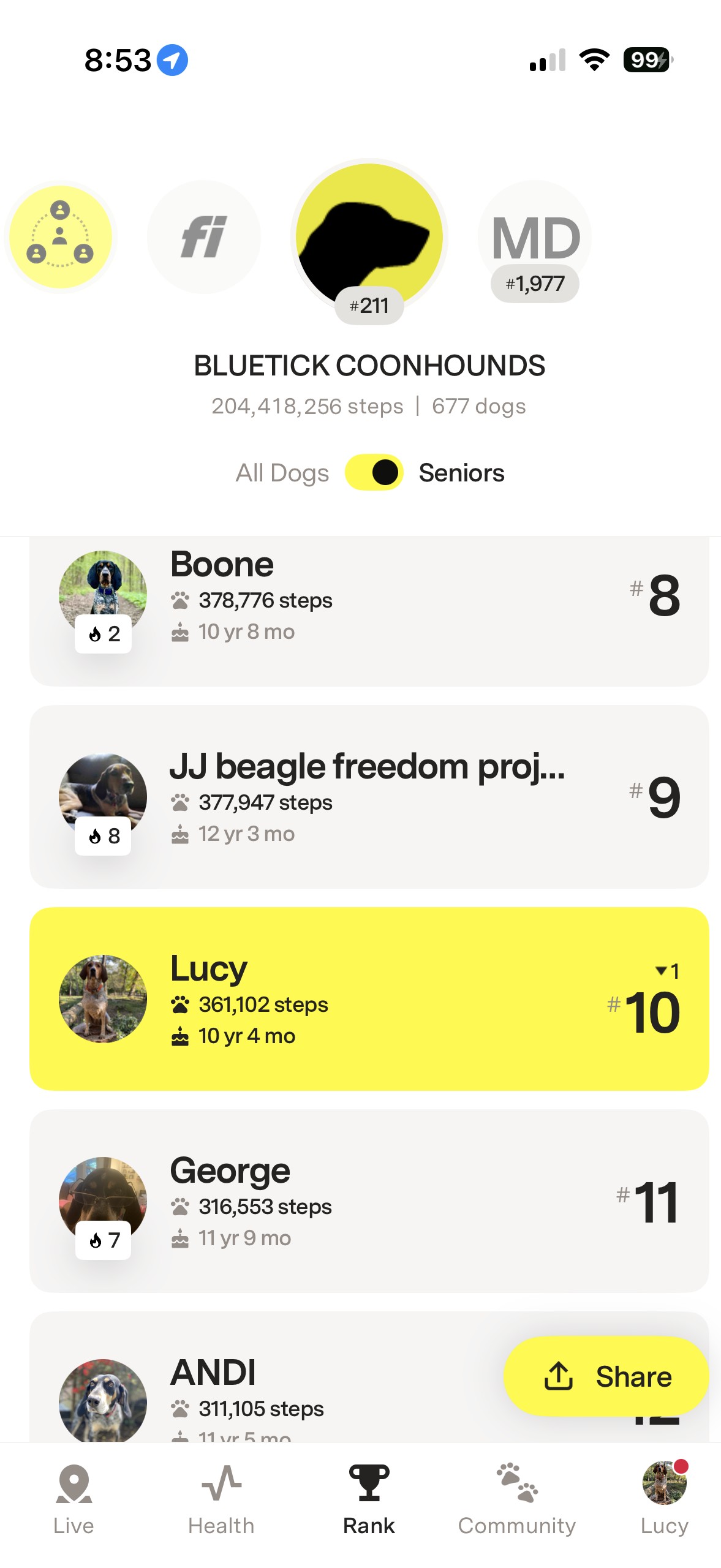

Trainer note: I enjoy the leaderboard. I do not recommend exercising a dog simply to climb it. Your dog’s own baseline matters more.
The AI feels like it’s just getting started
The AI Feels Like It’s Just Getting Started
Fi has also started introducing AI into the app.
I think there’s a lot of potential here, but at the moment it feels like the beginning of the journey rather than the finished product.
Out of curiosity, I asked it how much sleep Shelby gets in an average day.
It told me around twenty to twenty-three hours.
That sounded entirely believable because, unless something exciting is happening, Shelby has elevated lounging into an art form.
Then I asked whether that amount of sleep was normal.
The response was essentially that older dogs tend to sleep more.
Which… yes. That’s true.
But it also isn’t particularly useful.
The thing that makes Fi different from asking ChatGPT or searching Google is that Fi has years of data about my dog. It knows Shelby’s age, her breed, her normal activity levels and what her sleep has looked like over months and years. That’s the information I want it to use.
Instead of telling me that senior dogs often sleep more, I’d love it to say something like, “Shelby’s average sleep has increased by eight percent over the last month but is still within the expected range for dogs of her age,” or, “Lucy’s activity has been steadily decreasing over the last two weeks. It might be worth keeping an eye on her.”
That would be genuinely powerful.
The data is already there.
It just feels like the AI hasn’t quite learned how to make the most of it yet.

Managing Multiple Dogs Has Improved Massively
One thing Fi deserves credit for is how much the app has improved over the last few years.
When we first started using it, managing multiple dogs worked, but it definitely felt as though the app had been designed around someone owning one dog. Switching between dogs wasn’t difficult, but it wasn’t especially elegant either.
That’s changed.
Managing Lucy and Shelby is straightforward now. It’s obvious who’s where, it’s easy to switch between them and the whole experience feels much more polished than it did when we first started.
It’s one of those improvements that probably goes unnoticed by new customers because they’ve never seen the old version, but if you’ve been around for a while it’s obvious that the app has matured.
Things I’d Still Love to See
No product is perfect, and after using Fi for this long I’ve naturally built up a little wishlist.
The biggest one is actually incredibly simple.
I’d love every Fi collar to include an NFC tag.
Imagine one of my dogs gets picked up by somebody before I reach them. They tap the collar with their phone and immediately see my contact details, the dog’s name and perhaps a message saying they’re friendly or need medication.
No special app.
No searching for a tiny engraved phone number.
Just tap and call.
It feels like such a natural extension of what Fi is already trying to achieve that I’m slightly surprised it isn’t there already.
I’d also like to see the AI become much more personal, because I think that’s where Fi has the opportunity to pull away from the competition over the next few years.
Finally—and this is much smaller—I still occasionally have a wrestling match with the charging dock. Most of the time it behaves perfectly. Occasionally it decides the collar isn’t sitting quite right, even though it clearly is, and needs a tiny adjustment before it starts charging.
It’s not enough to annoy me every week, but it has happened often enough over the years that it feels worth mentioning.
None of those things stop me recommending the collar.
They’re just the sort of observations that only really appear after you’ve lived with something for several years rather than borrowed it for a fortnight.
Who I Think Fi Is Really For
One of the reasons I wanted to write this review is because I think a lot of GPS tracker reviews make it sound as though every dog should be wearing one. I don’t agree with that at all.
I have three dogs. Lucy and Shelby both wear Fi collars. Indie doesn’t, and that’s entirely intentional.
Indie has a solid recall, naturally checks back in with me and simply isn’t a dog I worry about disappearing over the horizon. Could he get loose? Of course. Any dog can. Gates get left open, fences break and accidents happen. But when I think about the realistic risks in my own household, Lucy and Shelby are the dogs that are likely to follow a scent into the next county. Indie isn’t.
That’s not because he’s a “better” dog. It’s because he’s a different dog.
Hounds have been bred for generations to work independently from people. Their job wasn’t to stay close to their handler. Their job was to follow scent, often over huge distances, and let everyone know where they were by making as much noise as possible. That’s exactly what Lucy and Shelby still want to do.
Understanding that changes the conversation completely.
I don’t use Fi because I don’t trust my dogs.
I use it because I trust their genetics.
If you own a scent hound, a husky, a pointer or another breed that’s been developed to range over large areas, I think a GPS tracker is well worth considering. The same applies if you’ve got a dog that’s escaped before, a dog with unreliable recall, or a dog whose prey drive regularly overrides their common sense. If you’re weighing up containment versus recovery, my guide to GPS dog fences versus GPS trackers explains where each one fits.
I’d also seriously think about one for some senior dogs. As dogs develop cognitive decline or become more prone to wandering, having a way to locate them quickly could be invaluable.
On the other hand, if your dog naturally sticks close, has a genuinely reliable recall and has never shown any inclination to leave, I don’t think you should feel pressured into buying one simply because they’re popular.
That’s exactly why Indie doesn’t wear one.
Let’s Talk About the Subscription
The elephant in the room is the subscription.
It’s expensive.
If you’ve got multiple dogs, it’s really expensive.
I don’t think there’s any point pretending otherwise because it’s probably the biggest deciding factor for most people reading this review.
There have absolutely been times over the last few years when money was tighter and I questioned whether renewing two subscriptions was really sensible. Like everyone else, we’ve looked through household expenses and asked ourselves what was actually worth keeping.
Fi was one of those conversations.
Every single time, though, I found myself coming back to exactly the same place.
I remembered the week Lucy and Shelby spent missing before we owned GPS collars.
I remembered my husband intercepting both hounds after I’d accidentally left the gate open while ill.
I remembered Lucy disappearing into the woods because somebody had left a gate just slightly ajar.
Suddenly the renewal looked very different.
That’s why I think of Fi less as a technology subscription and more as insurance. Hopefully you’ll barely think about it for months at a time, but if one day your dog disappears, it’s the sort of thing you’re incredibly grateful to have.
Whether that’s worth the ongoing cost depends entirely on your dog and your circumstances, but for us it’s a cost we’ve continued to justify year after year.
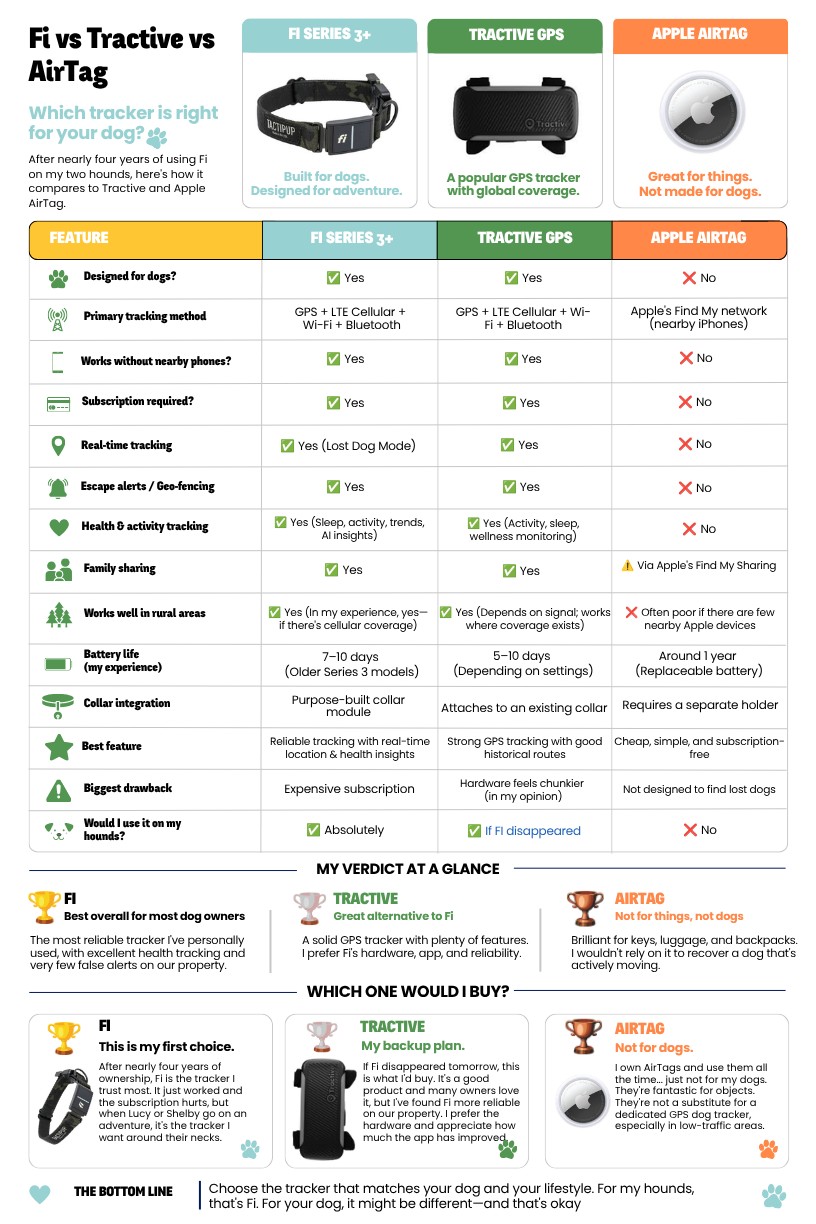
Fi vs Tractive vs AirTag: Which Would I Choose?
Fi isn’t the only way to keep tabs on your dog, and the two alternatives I’m asked about most are Tractive and Apple’s AirTag.
Fi and Tractive are the real comparison. I’ve used both on my own dogs. They’re purpose-built pet GPS trackers with cellular connectivity, live tracking and escape alerts, and both now offer activity and health-related monitoring too. For us, Fi has been the better fit: I’ve found its tracking more reliable on our wooded property, I prefer the collar-integrated design and its battery has lasted longer in real-world use. Tractive still has some genuine advantages, particularly if you want a tracker that clips onto an existing collar, very fast LIVE tracking updates or broader international coverage.
An AirTag is different. I own and use AirTags too, but I think of them as inexpensive backup tags rather than substitutes for a proper GPS dog tracker. They rely on Apple’s Find My network and nearby Apple devices to report their location. That can be surprisingly useful in a busy town or city; on our rural, wooded property it was pretty much useless for following an escaped hound.
So for me, the decision is less Fi vs AirTag and more Fi vs Tractive, with an AirTag potentially added as backup.
If you’re deciding between them, I’ve done the much nerdier version of this comparison too. Read my full Fi vs Tractive comparison, or my Fi vs AirTag comparison for the real-world differences in tracking, battery, subscriptions and escape use.
The Little Things That Matter
There are a few things I haven’t really known where to mention throughout the review, but they’ve all contributed to why I’ve stayed with Fi for so long.
The first is reliability.
Technology doesn’t have to be exciting to be good. In fact, I think the best technology often becomes a bit boring because it simply does what it’s supposed to do. That’s very much where Fi sits for me now. I don’t spend my evenings opening the app just because I can. It quietly does its job until I need it, and then it becomes one of the most useful things I own.
I also appreciate that Fi hasn’t stood still. The app today is noticeably better than the one we started using in 2022. Managing multiple dogs is smoother, the interface feels more polished and the company has continued adding features rather than abandoning the product after launch.
Not every new feature has landed perfectly. I still think the AI has a long way to go before it’s genuinely making the most of the data it already has, and I’d still love to see an NFC tag built into the collar so somebody finding a lost dog could simply tap it with their phone and contact the owner immediately.
Those aren’t reasons not to buy Fi.
If anything, they’re signs that the platform has matured enough that I’m now thinking about what I’d like to see next rather than worrying about whether the basics work.
So… Would I Buy It Again?
Without hesitation.
That doesn’t mean I think it’s perfect, because I don’t.
The charging dock still occasionally decides it’s in a mood.
The subscription still makes me wince every time it renews.
I still think there’s huge untapped potential in the AI features.
And I still think an NFC contact tag should be built into every collar.
Despite all of that, if both of my Fi collars disappeared tomorrow, I’d order replacements.
Not because I’m loyal to the brand.
Not because I think there aren’t other decent GPS trackers available.
I’d buy them because they’ve earned my trust.
Over the last four years they’ve helped us recover dogs quickly, they’ve quietly collected useful health data in the background and, perhaps most importantly, they’ve given me confidence that if Lucy or Shelby decide to take themselves on another adventure, I’m not starting from zero.
That’s really what I’ve paid for all these years.
Not a map.
Not a step counter.
Not a sleep graph.
Peace of mind.
For my hounds, that’s worth it.
For Indie, it isn’t necessary.
And I think that’s probably the most honest recommendation I can give.
A Few Questions I Get Asked All the Time
By this point, you’ve probably realised I like Fi.
You’ve also probably realised I don’t think it’s perfect.
After using it for almost four years, there are a handful of questions I get asked over and over again, so rather than trying to squeeze the answers into the review above, I thought I’d answer them properly here.
Does Fi work without a subscription?
Not really.
The collar itself is only part of what you’re paying for. The subscription covers the cellular connection that allows the tracker to work away from your home Wi-Fi, along with the location history, health tracking, activity monitoring and the rest of the connected features.
I know the subscription puts some people off, and I completely understand why. It isn’t cheap, especially if you’re buying collars for multiple dogs.
For us, though, it’s become one of those expenses that quietly earns its place every year. Hopefully you’ll barely think about it for months at a time, but if your dog disappears one afternoon, it’s suddenly the most worthwhile subscription you have.
How accurate is the GPS?
In my experience, very good.
No consumer GPS tracker is accurate to the inch, and if any company tells you otherwise I’d be sceptical. GPS simply doesn’t work like that.
What Fi has consistently done well for us is get us into the right area quickly and keep updating often enough that we can work out where the dogs are actually heading.
On our property we’ve also experienced very few false escape alerts. I can only remember one across both dogs in the last year, which is genuinely impressive.
It’s worth remembering, though, that your experience may differ depending on where you live. Cellular coverage, Wi-Fi coverage and even the terrain around your home all influence how any GPS tracker performs.
How long does the battery really last?
This is probably the answer that surprised me most.
Our current collars are older Series 3 units. They’re no longer brand new, they’ve been worn every day, they’ve been through rain, mud, woods, rough play and everything else two coonhounds can throw at them.
We’re still getting around seven to ten days between charges.
Would I love a month-long battery?
Of course.
But considering the age of the hardware, I actually think that’s pretty impressive.
Does Fi work in rural areas?
It certainly has for us.
We live on a wooded property rather than in a city, and one of the reasons I think we’ve had such a good experience is because we invested in a proper mesh Wi-Fi system that covers the areas where the dogs spend most of their time.
I don’t think people realise how much difference good Wi-Fi can make to smart devices in general. If you’ve got patchy coverage around your home, I’d fix that regardless of which tracker you buy.
Beyond that, the cellular coverage in your area will always play a role, so it’s worth checking before deciding on any GPS tracker.
Can multiple people use the same collar?
Yes, and this is one of those features you don’t appreciate until you actually need it.
When I accidentally left the gate open while I was ill, my husband was driving home from work. Because he also had access to the dogs through the app, he could immediately see where they were heading, intercept them and bring them home before I even had a chance to start searching properly.
That’s not a feature I use every day, but it’s one I’m very glad exists.
Can Fi replace recall training?
Absolutely not.
If anything, I think using Fi has reinforced just how important recall training really is.
The tracker tells me where my dog is.
Recall is what gets my dog back.
Every successful recovery we’ve had has depended on both working together. Fi gets us close enough to call the dogs, but years of reinforcement are what convince them to turn around and come home.
If you’re choosing between buying a GPS tracker and investing in training, I’d still tell you to prioritise training first. A good long line is one of the best training tools you can own for building a reliable recall safely.
Ideally, you’ll have both.
Is Fi better than an AirTag?
For dogs, yes.
I actually own and use Apple AirTags, and they’re brilliant for plenty of things. Tracking luggage, keys or your wallet? Fantastic.
Tracking a dog that’s decided to follow a deer into the woods?
Not so much.
AirTags rely on nearby Apple devices to update their location. Fi is designed specifically for tracking dogs, and in my experience it’s a completely different category of product.
If you’re trying to decide between the two, I’ve written a separate Fi vs AirTag comparison that goes into much more detail.
So, Is Fi Worth It?
After nearly four years, I think my answer is probably as honest as it’s going to get.
If you own a dog like Indie, probably not.
I’d spend that money on training, enrichment or a really good long line instead.
If you own dogs like Lucy and Shelby, though, I’d buy Fi again tomorrow.
Not because I think it’s flawless.
Not because I think it’s the only GPS tracker worth considering.
Because it’s earned my trust.
I don’t think about Fi very often anymore, and strangely that’s become one of my favourite things about it. It quietly sits in the background while life carries on as normal, collecting data I occasionally find useful and waiting for the day I actually need it.
Most days, I don’t open the app.
Then somebody leaves a gate open.
Or a deer crashes through the fence.
Or one of my wonderfully ridiculous hounds decides the woods are calling.
That’s when I remember exactly why they’re wearing those collars.
And that’s why, after almost four years, they’re still wearing them.
0 Comments