
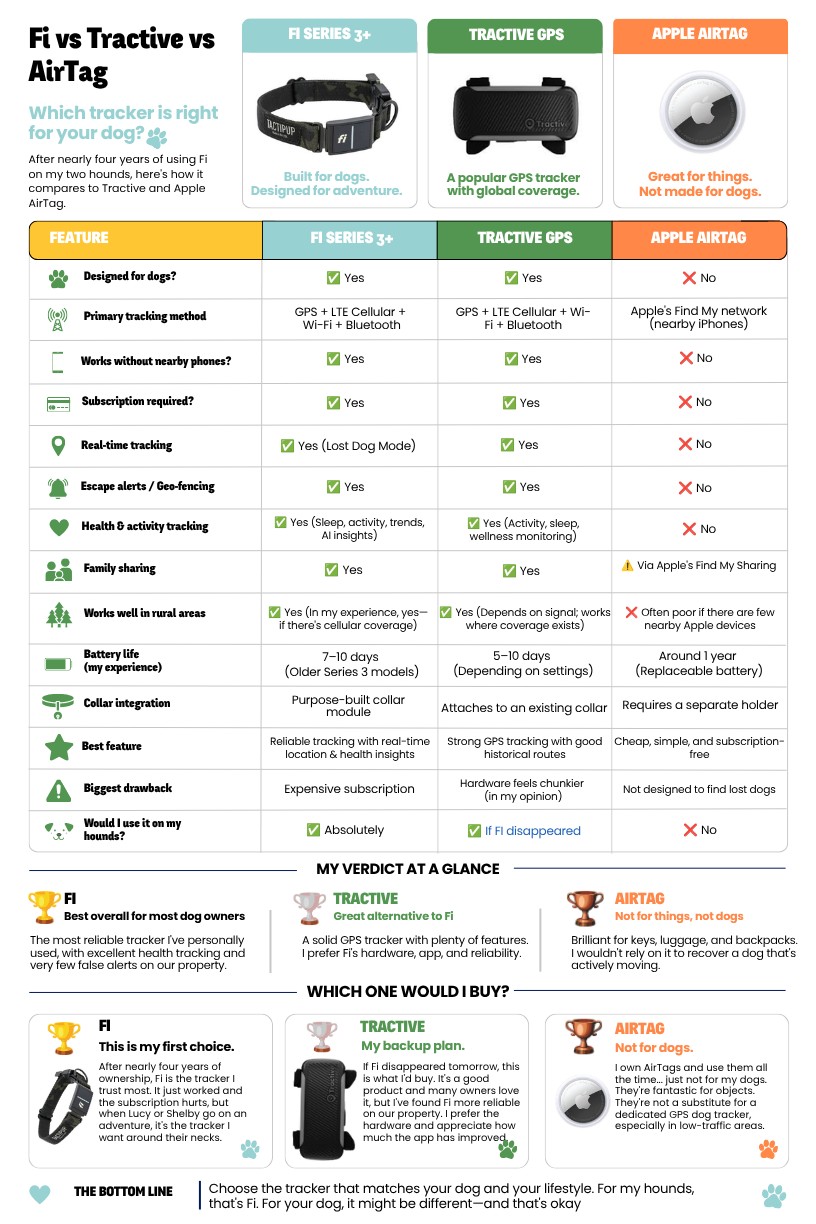
If you can buy an AirTag once, pop it onto your dog’s collar and avoid paying yet another monthly subscription, why wouldn’t you?
Honestly, I understand the appeal. I’ve used AirTags on my own dogs, and I currently pay for two Fi subscriptions. That’s around $36 a month to track Lucy and Shelby, my two senior coonhounds. An AirTag is considerably cheaper, its battery lasts more than a year, and there’s no monthly fee.
Unfortunately, an AirTag is not a GPS tracker.
I tested both on my dogs until one escaped and gave me the exact comparison I needed: Fi alerted me within seconds and showed me where she was. The AirTag didn’t ping at all.
That doesn’t mean AirTags are useless for dogs. It does mean you need to be very clear about what you’re buying—and whether you need something that might eventually help locate your dog or something designed to actively track them.
Fi vs AirTag for dogs: the quick answer
The Fi Series 3 is a purpose-built dog tracker. It uses GPS to calculate your dog’s location and a cellular connection to send that location to the Fi app. It can notify you when your dog leaves a designated safe zone and offers live tracking through Lost Mode.
An AirTag is a Bluetooth item finder. It has no GPS receiver and no cellular connection of its own. It broadcasts a Bluetooth signal that nearby Apple devices can detect and anonymously relay through the Find My network.
That distinction matters enormously when the “item” you’ve misplaced has four legs, a prey drive and absolutely no interest in waiting where you left it.
| Statistic | Fi Series 3 | Apple AirTag |
|---|---|---|
| Battery life | 3–6 weeks in my use; up to 3 months claimed | More than 1 year; replaceable CR2032 battery |
| Water and dust rating | IP68 + IP66K | IP67 |
| Ongoing cost | $17/month per dog on my six-month prepaid plan | $0/month; about $29 once, plus a holder |
| Signal source | GPS + cellular | Bluetooth + Apple Find My network |
| Escape alerts | Safe-zone alerts and live Lost Mode tracking | No equivalent dog escape alert |
| Rural limitation | Needs cellular service to report its GPS location | Needs a nearby Apple device to relay its location |
What actually happened when I tested an AirTag during an escape
I live fairly remotely on wooded land. We have excellent Wi-Fi coverage around the property, which is helpful for Fi’s battery life, but we do not have a steady stream of pedestrians carrying iPhones past the house.
One day, guests left our gate not quite closed. Lucy found the opportunity and disappeared into our neighbor’s woods.
She was wearing both an AirTag and her Fi.
Fi notified me within seconds of her leaving the safe zone. It was fast enough that Lucy had only reached the neighboring woods, and my recall still worked. She turned around and came back.
The AirTag gave me nothing. No useful location. No ping from a passing phone. Nothing.

That isn’t really the AirTag failing to work as designed. The problem is that it was never designed to do what I needed.
Apple’s Find My network is enormous, but the AirTag still needs to come within range of a compatible nearby device before its location can be relayed. There simply wasn’t another phone in those woods for it to use.
You will sometimes hear people describe AirTags as having “crowdsourced GPS.” They don’t. An AirTag has no GPS. Its location depends on other devices detecting its Bluetooth signal.
In a busy city, that network can be remarkably effective. In woodland, farmland or sparsely populated rural areas, your dog can travel a considerable distance without passing close enough to a compatible device to produce an update.
The second escape that justified the Fi subscriptions
We’ve also had a rather more dramatic demonstration of Fi’s value—and this one was entirely my fault.
I wasn’t well, wasn’t thinking properly, left the gate open and let the dogs outside as normal.
Both Lucy and Shelby ran through the woods. They are female coonhounds, both over ten years old and still wildly prey-driven. “Senior” does not necessarily mean sensible.
Fortunately, my husband was already on his way home. He used the Fi app to follow their locations, intercepted them roughly a mile from the house, loaded both eejits into his work vehicle and brought them home.

A normal ID tag or microchip could have helped someone contact us after finding them. An AirTag might have updated if they passed close enough to an Apple device. Fi let us actively follow where they were going and get ahead of them.
That is what I’m paying for.
How an AirTag actually finds a dog
The current second-generation AirTag sends out a secure Bluetooth signal. Nearby iPhones, iPads and Macs participating in the Find My network can detect that signal and anonymously send the AirTag’s location to iCloud. You then see that reported location in Find My.
If you are already close to the AirTag, compatible iPhones can use Precision Finding to guide you toward it. The second-generation AirTag has improved Precision Finding range and a louder speaker, which makes it better at finding keys under a sofa or luggage in a crowded airport.
None of those improvements turns it into a GPS dog tracker.
If your dog runs through a populated neighborhood, an AirTag may generate frequent location updates because there are plenty of compatible devices nearby. If the dog runs into empty woodland, the AirTag cannot independently calculate and transmit its location.
There is also no Fi-style safe zone watching the gate and notifying you that your dog has left without a guardian. AirTag’s separation and Find My notifications are designed around misplaced belongings, not a fast-moving escape.
Apple continues to market AirTag for personal items such as keys, bags and luggage. When Apple representatives have addressed pet use directly, their guidance has been that AirTag was designed for items rather than pets—and that a moving pet would need to come within range of a Find My network device to be located.
That is not Apple being overly cautious. It is an accurate description of the technology.
Sources: Apple AirTag and the Find My network and Apple’s current AirTag support guidance.
How Fi tracks a dog differently
Fi Series 3 contains actual GPS technology. When the collar is away from its base, saved Wi-Fi or a household phone running the Fi app, it can use GPS to calculate the dog’s position and cellular service to send that information back to the app.

Under normal conditions, Fi balances update frequency against battery life. When a dog is missing, activating Lost Mode increases the frequency and provides live location updates.
It is still important to understand that GPS and cellular are doing separate jobs:
- GPS determines where the tracker is.
- Cellular service transmits that location to you.
This means Fi Series 3 is not magic and it is not truly off-grid. If your dog enters an area without the cellular coverage needed by the tracker, Fi may know its position but be unable to send you a current update until it reconnects.
That is a legitimate limitation, especially for guardians who hike or hunt in genuinely off-grid areas. Fi now has other hardware aimed at more remote use, but Series 3 still relies on cellular connectivity when it is away from Wi-Fi, its base and connected household phones.
The difference is that Fi does not need your dog to happen across a stranger carrying an iPhone. In my location, that makes Fi dramatically more useful than an AirTag—and it has also worked more reliably for us than Tractive.
Sources: Fi’s explanation of GPS and cellular connectivity and Fi Lost Mode features.
Is Fi’s battery really as good as advertised?
Fi advertises up to three months of battery life for Series 3 and Series 3+, but that is the optimistic end of the range for a dog who spends most of their time within Wi-Fi or base coverage.
My real-world battery life is usually around three to six weeks.
That makes sense for my dogs. Lucy still does around six miles a day, and both dogs move between the house, yard and walks. They wear their Fi trackers around the clock on Tactipup collars.
Fi’s own estimates currently range from up to three months for a low-activity dog to around two weeks for a highly active dog spending much of the day away from home coverage. Lost Mode is much more battery-intensive and provides around two days of tracking on a full charge.
An AirTag wins battery life easily. Its replaceable coin-cell battery lasts more than a year. But it achieves that partly because it is not doing the same job.
Comparing their batteries without comparing their tracking technology is a little like congratulating a bicycle for using less fuel than an ambulance.
What else are you getting for the subscription?
At the moment, I primarily use Fi for location tracking and peace of mind.
The app also tracks activity and sleep. I’m not currently using that data to guide our daily lives, but I have used the sleep tracking during behavior work. It helped confirm that structured naps were needed because there was a noticeable change in the dogs’ behavior when they were tired.
That kind of data can be genuinely useful when you are trying to identify why a dog is having a more difficult day. It does not diagnose anything, and activity numbers should never replace watching the actual dog in front of you, but patterns can give you useful questions to investigate.
I also genuinely enjoy Fi’s app. It has more personality than many pet trackers, and I love receiving updates that Lucy—at more than ten years old—is still one of the top 20 coonhounds in the country for activity.
Do I need that leaderboard to keep her safe? No.
Do I enjoy the tiny competitive thrill of my senior hound casually embarrassing younger coonhounds? Absolutely.
For more detail on the app, construction and longer-term ownership, read my full Fi Series 3 review.
Can city dogs get away with an AirTag?
Some can.
If you live in a densely populated area, have a dog with good recall, have a secure household and primarily want an inexpensive additional way for someone to identify or eventually locate your dog, an AirTag may be enough for your budget and risk level.
But I would not recommend relying on one for a known escape artist—even in a city.
Dogs who escape are not necessarily going to approach strangers. Some will actively avoid people, particularly when frightened, overstimulated or having the absolute time of their lives chasing something. A nearby person carrying an iPhone might generate an AirTag update, but that does not give you the same continuous, purpose-built tracking experience as Fi’s Lost Mode.
A city makes the AirTag network better. It does not turn an AirTag into a GPS tracker.
Do all dogs need a paid GPS subscription?
No—and I’m not going to pretend they do just because this article contains an affiliate link.
A paid GPS tracker makes the most sense when one or more of these apply:
- Your dog has escaped before.
- They have unreliable recall.
- They are strongly prey-driven.
- Guests, children, contractors or multiple household members regularly use your doors or gates.
- You live near woods, farmland, busy roads or large open spaces.
- Your dog is fearful and unlikely to approach strangers.
- You travel, camp or visit unfamiliar places frequently.
- Not knowing where your dog is would cost critical time during an escape.
You may reasonably decide against the subscription if your dog has a very low escape risk, excellent recall, secure routines and a limited household budget—particularly in a well-populated area where an AirTag has plenty of Find My devices around it.
In that situation, I would still prioritize a properly fitted collar, visible ID, current contact details and a registered microchip. An AirTag can be an additional recovery tool. It should not replace identification or microchipping.
You can also compare other purpose-built options in my guide to the best GPS trackers for dogs.
Is it safe to put an AirTag on a dog?
An AirTag should be attached in a secure, properly fitted holder that does not create a dangling snag or obvious chew target.
The replaceable CR2032 battery is a serious ingestion hazard if the casing is damaged or swallowed. That does not mean every dog will immediately chew an AirTag off their collar—mine certainly didn’t—but dogs who chew equipment, play roughly with each other or wear loosely attached holders deserve extra consideration.
AirTag is rated IP67 for water and dust resistance. Fi Series 3 is built specifically for continual collar wear and has a higher water-resistance rating. Neither product replaces normal equipment checks. Inspect the tracker, holder and collar regularly, particularly after swimming, rough play or woodland adventures.
And remember: no tracker prevents an escape. Gates, fencing, recall training, sensible household routines, visible identification and microchipping remain the real safety system. A tracker is what helps when that system has a very human moment and fails.
My verdict: Fi or AirTag for dogs?
If you have a low-risk city dog and cannot justify another subscription, an AirTag is a reasonable additional layer of identification and occasional location help.
If you have an escape-prone dog, unreliable recall, significant prey drive or live remotely, buy a real GPS tracker.
For my dogs, Fi is unequivocally worth the subscription. Lucy and Shelby are senior hounds, but they remain active, prey-driven and fully capable of disappearing into the woods. Fi has alerted me within seconds, helped my recall succeed before Lucy traveled farther and enabled my husband to intercept both dogs about a mile from home.
The AirTag produced no location at all when I actually needed it.
I no longer keep AirTags on the dogs. I tested them until I had real escape data, and that data gave me no reason to continue. Fi already does the job I need done.
An AirTag may help you find a dog.
Fi is built to help you track one.
For dogs like mine, that difference is worth paying for.

0 Comments