A GPS dog tracker and a GPS dog fence may both sit in the “keep my dog safe” section of your budget, but they do fundamentally different jobs.
A tracker alerts you when your dog leaves a designated area and helps you find them. A GPS fence tries to discourage your dog from crossing a virtual boundary in the first place.
One tracks an escape. The other attempts to prevent one.
Neither physically contains your dog, and neither is something every dog parent needs.
I’ve tested Fi, Tractive and several other dog trackers, alongside SpotOn and Halo GPS fences. I also live with two senior coonhounds who remain extremely prey-driven despite being over 10. Lucy still covers around six miles on an average day, and both dogs will cheerfully follow their noses into another ZIP code if given the opportunity.
My short answer? For most dog parents, I would buy a long line and a reliable GPS tracker, then put the hundreds of dollars saved toward a physical fence.
GPS fencing has legitimate uses, particularly on some large rural properties and for people who travel or live nomadically. But it would not be my default recommendation—and it certainly isn’t a magic force field around your dog.
This article contains affiliate links. If you buy through one of these links, I may earn a commission at no additional cost to you. I only recommend products I have personally used or would genuinely consider using.
GPS tracker vs GPS fence at a glance
| Feature | GPS tracker | GPS fence | Physical fence |
|---|---|---|---|
| Main job | Finds your dog after an escape | Warns your dog at a boundary | Creates a real barrier |
| Physical barrier? | No | No | Yes |
| Tracks an escape? | Yes | Usually | No |
| Training required? | No | Minimum one month | Basic boundary habits |
| Best for | Escape-prone dogs | Selected large or mobile properties | Most homes |
What does a GPS dog tracker actually do?
A proper dog GPS tracker uses satellite positioning to establish your dog’s location and a cellular connection to send that location to your phone.
Most allow you to create a “safe zone” around your home. If your dog leaves it, you receive an alert and can switch to a faster live-tracking mode.
That safe zone is sometimes called a virtual fence, which is where the terminology becomes confusing. A tracker’s virtual fence is only a notification boundary. It does not give the dog any warning or attempt to turn them around.
That distinction matters:
A GPS tracker tells you that your dog has escaped. It does not contain them.
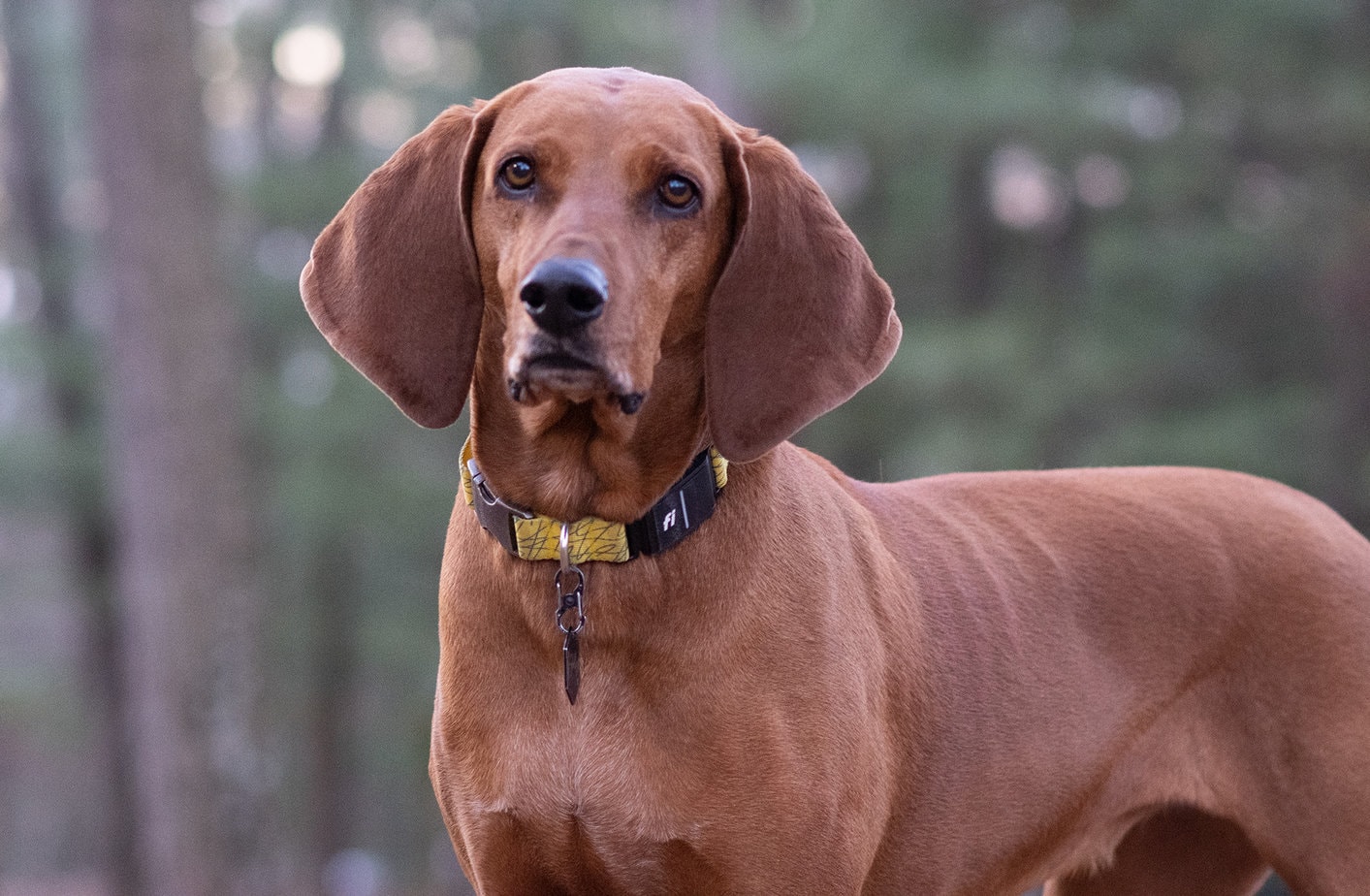
I use Fi GPS trackers on Lucy and Shelby. We live remotely on densely wooded land, and Fi has been reliable for us. It also proved its value when I accidentally left a gate open while unwell and both hounds disappeared into the woods.
My husband was already driving home. He used their locations in the Fi app to intercept them around a mile away, loaded the two eejits into his work vehicle and brought them home.
A tracker didn’t prevent that escape. It did, however, turn a potentially horrible situation into a relatively quick recovery.
You can read my full Fi Series 3 review or compare more options in my guide to the best GPS trackers for dogs.
Leading dog GPS trackers in 2026
Fi Series 3+
Fi is my current preference for everyday wear, particularly because its battery lasts dramatically longer than a GPS fence collar. Fi advertises up to three months, although real battery life depends heavily on GPS use, Wi-Fi coverage, cellular conditions and how often Lost Mode is activated.
I have used Fi continuously on two active senior coonhounds, including in a remote, heavily wooded location.
Tractive DOG 6
Tractive offers live tracking, escape alerts, location history and activity and health monitoring. Its “Virtual Fence” is an alert zone—not containment.
The standard DOG 6 is advertised with up to two weeks of battery life, while larger models can last considerably longer. Like Fi, it needs a subscription because its built-in SIM uses cellular networks to transmit location data.
Tractive is a strong tracker. It is not a fence.
What does a GPS dog fence do?
A GPS dog fence stores a virtual boundary on the collar. As the dog approaches that boundary, the collar gives a warning. Depending on the system and settings, this may progress through sounds, vibration and electrical stimulation if the dog continues forward.
The fence itself does not need to be visible, physically installed or connected to Wi-Fi. This makes it appealing for:
- Large or unusually shaped rural properties
- Land where installing a physical fence is genuinely impractical
- RV travellers and other nomadic households
- Temporary locations where a portable boundary is useful
Most current GPS fence collars also provide location tracking. SpotOn’s containment works without a cellular subscription, but live tracking, breach alerts and other connected features require its optional plan. Halo combines fencing and live location tracking through its membership service.
After testing them, I would trust the tracking built into a properly tested GPS fence collar. I would not normally put a separate Fi on the same dog as a backup. Paying for two devices and two subscriptions is usually unnecessary.
The important words there are properly tested. Before relying on any collar, you need to confirm that its location and tracking features work consistently on your property—not merely assume that they will.
SpotOn vs Halo: what I found during testing
I tested both SpotOn and Halo on our approximately one-acre property. This gave both systems enough room to establish a realistic boundary, while the dense tree cover created a more difficult GPS environment.
SpotOn performed better here.
Its boundary placement and warnings stayed materially more consistent through our wooded areas. Halo showed more boundary drift, delayed warnings and inconsistent alerts beneath tree cover.
That does not mean Halo will struggle on every property. Open suburban land and dense woodland are very different GPS environments. It does mean I would not buy any virtual fence based purely on the manufacturer’s coverage claims.
Your specific terrain matters.
SpotOn GPS Dog Fence
SpotOn’s current Nova Edition is designed for boundaries from approximately one-third of an acre upward. The company advises that the narrowest part of a fence should be at least 80 feet wide and that guardians leave a 15-foot buffer between the virtual boundary and hazards such as roads.
That buffer is crucial. GPS locations can drift, particularly around trees, tall buildings, metal structures and difficult terrain. The advertised minimum acreage is not automatically the smallest property on which I would personally consider the system sensible.
SpotOn currently costs around $999 before any optional tracking subscription. It offers approximately 33 hours of runtime with tracking enabled and does not require cellular coverage for the boundary itself. Cellular service is needed for live location tracking and breach notifications.
Check the current SpotOn price.
Halo Collar 5
Halo Collar 5 combines virtual boundaries with continuous location tracking and advertises up to 48 hours of battery life. It can provide sound, vibration or static feedback as a dog approaches and crosses a boundary.
Halo can create smaller boundaries than many early GPS fence systems, but “technically possible” and “a sensible safety choice” are not the same thing. On a typical suburban lot, limited space means there may be very little room between the warning zone, the property line and an actual hazard.
That is one reason I would not recommend a GPS fence for the average suburban household.
A GPS fence is not a physical fence

This sounds obvious, but the marketing around virtual fences can make it surprisingly easy to forget.
A physical fence creates a barrier. A GPS fence creates a consequence for crossing an invisible line.
A virtual fence cannot stop:
- A loose dog entering your property
- A predator approaching your dog
- A person walking onto the land
- A child approaching the dog
- A dog running into the road after crossing the boundary
- Someone stealing the dog
- GPS drift moving the effective boundary
- A depleted battery leaving the system unavailable
If a physical fence is practical, I would choose the physical fence.
That also applies to renters more often than people think. No-dig fencing can be an excellent removable option. It does not require traditional post holes or permanent landscaping changes, and the money saved by not buying a GPS fence can cover a meaningful portion of it.
Before spending around $1,000 on electronic containment, I would price up:
- A secure long line for supervised freedom
- A reliable GPS tracker for escape recovery
- No-dig or other renter-friendly physical fencing
- Improvements to gates, latches and vulnerable areas of an existing fence
For many households, that combination provides better protection and fewer welfare compromises.
What happens when prey drive overrides the boundary?
This is one of my biggest concerns.
A dog calmly investigating the edge of a familiar area is one thing. A coonhound spotting wildlife, a sighthound seeing a deer or a terrier finding something small and fast is another.
High arousal changes behavior. A sufficiently motivated dog may run through a warning or static stimulus during the chase. Once outside, the dog may then be reluctant to return across the same boundary.
You are left with a loose dog who has learned that approaching home may trigger something unpleasant.
I did not deliberately test this on Lucy or Shelby. We have a physical fence, and I was not going to manufacture a high-risk escape simply to see whether the collars could stop two extremely prey-driven hounds.

I tested everyday operation, collar fit, battery life, GPS accuracy, boundary stability and warning reliability. I did not apply the highest electrical stimulation to my dogs. Instead, I connected the collars to an oscilloscope to confirm that the electrical output worked and increased through the stated levels.
The systems functioned as advertised. That does not make deliberately testing their limits on a live dog sensible or ethical.
Are tone and vibration safer than static stimulation?
Not automatically.
Sound and vibration do not cause the same physical sensation as electrical stimulation, but they work as boundary warnings because the dog learns that they predict something they want to avoid.
That makes them potentially aversive too.
A vibration can be startling or frightening, particularly for a nervous or noise-sensitive dog. A warning tone may become associated with a location, wildlife, children, nearby dogs or anything else present when it occurs.
The American Veterinary Society of Animal Behavior recommends reward-based training and advises against aversive training methods. That aligns with how I ordinarily train and with the standards I use as a positive-reinforcement trainer and behavior consultant.
I can acknowledge that a device functions technically while still being uncomfortable with the learning method it uses. Those are not contradictory positions.
Dogs I would not put behind a GPS fence
I would not recommend relying on one for:
Highly prey-driven dogs in prey-heavy areas
The risk of a chase overpowering the learned boundary is too high. This is particularly concerning near roads or neighbouring livestock.
Nervous, fearful or noise-sensitive dogs
An unpredictable or poorly understood warning may worsen fear. A nervous dog may bolt forward rather than retreat, especially when already frightened.
Dogs with aggression or redirected-biting risks
Arousal or discomfort at the boundary may be redirected onto whoever or whatever is nearby.
This is why I would be particularly cautious in homes with children. A child may approach, touch or grab a dog at exactly the moment the collar gives a warning or stimulation. Redirected bites are a real safety consideration, and one that glossy product pages rarely discuss.
Dogs too small to wear the equipment comfortably
GPS fence collars are substantially bulkier than many trackers. SpotOn, for example, is intended for dogs weighing at least 15 pounds with necks of at least 10 inches.
Dogs who have not completed careful boundary training
A GPS fence is not something you charge, attach and switch on before letting the dog outside.
How long does GPS fence training take?
I would allow an absolute minimum of one month.
That does not mean every dog becomes reliable around wildlife after four weeks. It means I would want at least that long to teach the basic response: when the warning begins, calmly turn back toward the safe area.
Reliability around squirrels, deer, neighbouring dogs or other major distractions will often take much longer—and for some dogs, it may never be safe enough to trust.
Training should be gradual and supervised. The dog needs to demonstrate that they understand the warning boundary without panicking, freezing or rushing forward.
Even after training, I would regularly test:
- Whether the boundary is still where it should be
- Whether warnings arrive consistently
- How the system behaves under tree cover
- Whether the collar is adequately charged
- Whether cellular tracking works across the property
- Whether the dog still turns back promptly
- Whether seasonal changes affect signal or visibility
- Whether new distractions have appeared nearby
You cannot train the dog once and then stop checking the technology.
What happens during poor GPS coverage or technical failure?
A GPS fence depends on a charged collar receiving a reliable satellite signal and correctly calculating its location.
Potential failure points include:
- Dense tree cover
- Tall buildings or metal structures
- GPS drift
- A depleted or deteriorating battery
- Incorrectly saved boundaries
- Software or firmware problems
- Loss of cellular service for tracking and alerts
- Damage to the collar
- Poor fit or removed contact points
GPS containment may continue without power or internet at the house because the boundary is stored on the collar. However, a dead collar battery means no boundary. Lost cellular service may also mean you cannot see the dog’s live location or receive a breach alert, even if the containment system itself still operates.
A tracker has technical limitations too. Fi and Tractive both depend on cellular connectivity to send a remote location to your phone. Their advantage is that they are not being asked to make a split-second containment decision based on that location.
Rural vs suburban use
A large rural property is where a GPS fence makes the most sense.
The cost of physically fencing many acres may be prohibitive. The boundary can be positioned well away from roads, and there may be enough land to create generous buffers around areas where GPS accuracy is less predictable.
Even then, I would consider the individual dog, wildlife, terrain, road access and nearby people or livestock.
On a standard suburban property, I see very little justification. Lots are often too small, hazards are closer and there are more neighbours, children, dogs, delivery drivers and vehicles around the boundary.
If you have enough money for a premium GPS fence, you may be better served putting that sum toward physical fencing.
Does your dog need both a GPS tracker and GPS fence?
Usually not.
Most premium GPS fence collars now include tracking. Once I had tested that tracking under our real conditions, I was comfortable trusting it without adding a separate Fi collar.
Buying both might provide redundancy, but it also means:
- Two collars or devices
- Two charging schedules
- Potentially two subscriptions
- More weight around the dog’s neck
- More technology to maintain
For most households, it is unnecessary.
The more useful comparison is:
Long line + standalone GPS tracker + physical-fence fund
versus:
GPS fence collar with tracking
For the average dog parent, I would choose the first.
My verdict
If you can build a physical fence, build the physical fence.
While you save or wait for installation, use a secure long line and a proper GPS tracker. Fi is the tracker I use on my own hounds, and Tractive is another credible option.
A GPS dog fence is not my default recommendation. It may be defensible when physical fencing genuinely is not possible—particularly across a large rural property or for a nomadic lifestyle—and when the dog is emotionally and behaviorally suited to it.
Of the systems I tested, SpotOn handled our remote, heavily wooded terrain better than Halo. I would still want at least a month of careful training, generous safety buffers and extensive real-world signal testing before relying on it.
I would not use a GPS fence for a nervous dog, a dog with redirected-biting risks, or a highly prey-driven dog living among abundant wildlife. I would also not mistake a warning boundary for a barrier.
So, which does your dog actually need?
For most escape-prone dogs: a long line, a GPS tracker and better physical security.
For a small minority of suitable dogs on properties that genuinely cannot be fenced: a carefully tested GPS fence may be a workable compromise.
And for plenty of dogs who are already securely managed? Neither. You do not need to buy expensive technology merely because it exists.



0 Comments