Fi Collar Review (2026): 4 Years With Series 2, 3 & 3+
Nearly 4 years. Two hounds. 100M+ steps.
Real-world testing, real escapes, real data. Here’s what I love, what frustrates me, and whether I’d still buy it after almost four years.

Reviewed by Ali Smith
Professional dog trainer & founder of Rebarkable. Tested on my own coonhounds, Lucy and Shelby, since late 2022.
Updated October 2026 · Long-term independent review · Affiliate links are clearly marked.
I’ve been using Fi collars on Lucy and Shelby since late 2022. We’ve lived with them through ordinary walks, mud, woods, app updates, ageing batteries and several very real coonhound escapes.
This is not a two-week product test. I want this review to show what Fi is actually like to own for years — including the parts I love, the things that annoy me and the reasons I still pay for it. If you’re here specifically for a Fi Series 3+ review, I’m testing the 3+ on Lucy alongside Shelby’s still-working Series 3, so you’ll see what actually changed — and whether I think the upgrade is worth paying for.
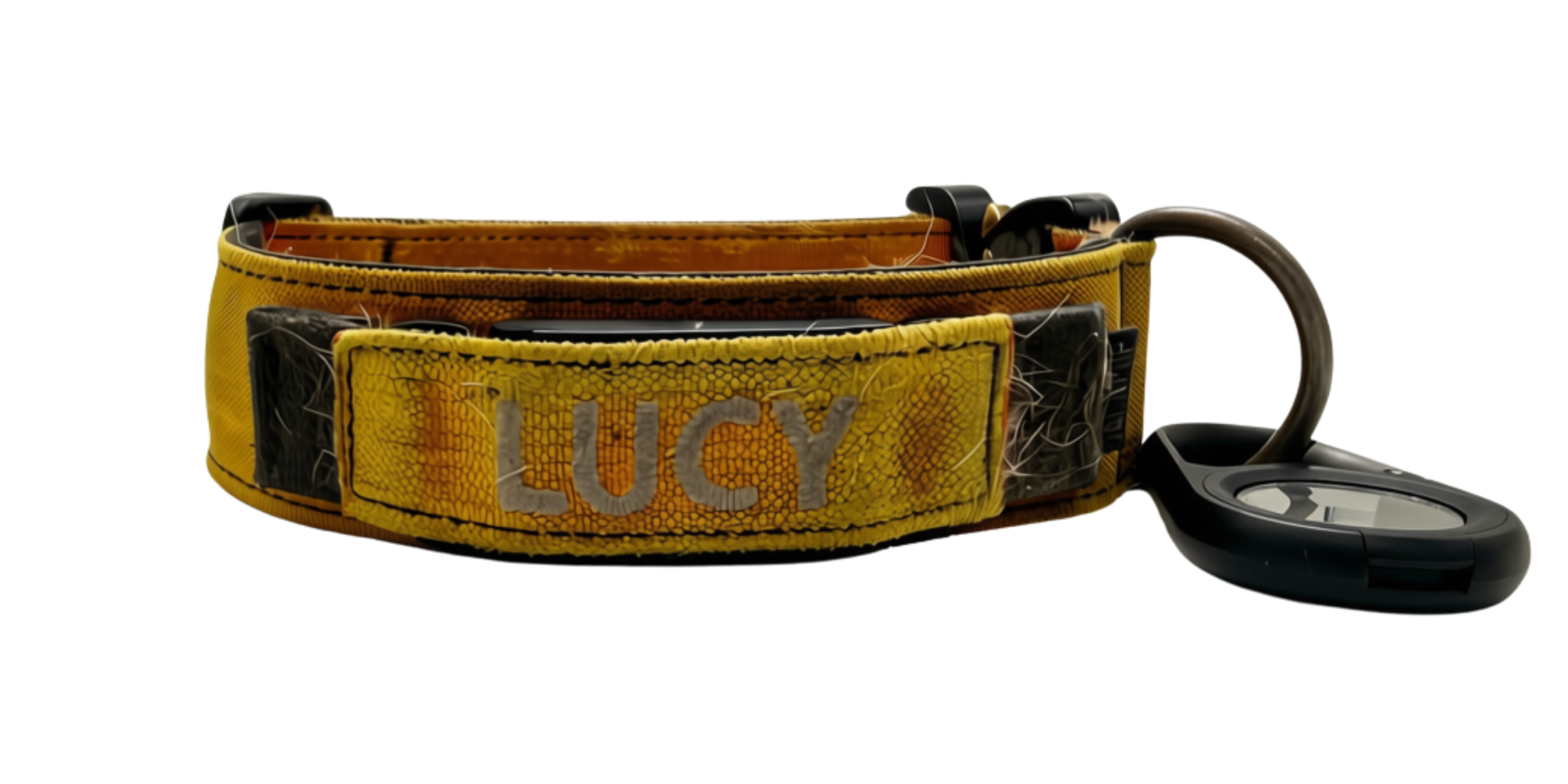
Fi Smart Dog Collar
Nearly 4 years · 2 hounds · 100M+ steps
I bought Fi because I needed to know where my scent hounds were if they got out. Nearly four years later, that is still the reason I pay for it. The newer health data is useful; the GPS is the bit I would replace tomorrow.
Escape-prone dogs, scent hounds and owners who genuinely need live GPS tracking.
Your dog is unlikely to roam, you hate subscriptions, or you only want an inexpensive backup location tag.
Four years later: Series 2 → Series 3 → Series 3+
We started with Series 2, upgraded both dogs to Series 3, had a couple of replacement units along the way, and Lucy is now testing Series 3+. Shelby is still on Series 3 because hers works — and I didn’t see a reason to replace two functioning trackers just because a newer one exists.

Three generations of Fi after nearly four years with my coonhounds. The Series 2 has, quite clearly, seen some things.
That wear is useful evidence. These trackers have not lived in a product-testing drawer. They’ve been on hounds through woods, weather, mud and the sort of adventures that make GPS tracking worth paying for. If you want the history, my Fi Series 2 review shows where we started.


Is the upgrade from Fi Series 3 to Series 3+ worth it?
That isn’t hypothetical advice. I upgraded Lucy to Series 3+. Shelby is still wearing Series 3. If I thought the 3+ were an essential upgrade, I’d have bought two.
And, truthfully, I upgraded Lucy because I wanted to test the newer health insights. I was particularly curious whether things like barking, licking and drinking data would actually tell me anything useful in real life. That made the upgrade worthwhile for me as someone who reviews this stuff; it does not mean I think every perfectly functional Series 3 needs replacing.
The exception is if the newer health monitoring answers a question you genuinely have about your dog. If scratching or allergies are an ongoing concern, you’re trying to keep an eye on changes in drinking, or you have a dog with separation-anxiety-related behaviours you want another source of data on, then the Series 3+ features may be genuinely useful. In that situation, fine — there is a reason for the upgrade.
But for most dogs? Series 3 is absolutely fine. I wouldn’t spend money replacing good hardware purely to have the newest model. If you’re buying rather than upgrading, you can check the current Fi options and price here.

Spot the difference? Series 3 and Series 3+ are remarkably similar from the outside. The meaningful question is what changed in everyday use.
Series 2 to Series 3 was an obvious physical redesign. Series 3 to Series 3+ is much less dramatic visually. For me, the upgrade decision comes down to whether the additional health monitoring answers a real question about your dog. My own household is currently running one of each.
| What changed? | Series 2 | Series 3 | Series 3+ |
|---|---|---|---|
| Design | Older, bulkier tracker | Much smaller, lower-profile redesign | Very similar externally to Series 3 |
| GPS & escape tracking | Yes | Yes | Yes |
| Health data | Core activity and sleep data | Expanded activity and wellness data | Newer health insights, including behaviours such as scratching, licking, barking and drinking |
| Battery in our use | By the end, ours was needing almost daily charging | Shelby’s 28-day dashboard estimates: 38.3 days in September and 23.8 in October; different connection patterns prevent a controlled model comparison | Lucy recorded two 21.6-day discharge cycles, ending at 10% and 8%; dashboard estimates: 21.9 days in September and 22.9 in October |
| Our dogs now | Retired | Shelby | Lucy |
| Would I upgrade? | Yes. I’d move from Series 2 to Series 3 or 3+. | Not automatically. A working Series 3 is still absolutely fine. | Worth considering if the newer health monitoring answers a real question about your dog. |
Battery figures above are our own real-world experience, not manufacturer battery-life claims. I’m collecting monthly telemetry so these can become rolling averages rather than one-off snapshots.
What Fi actually tracks
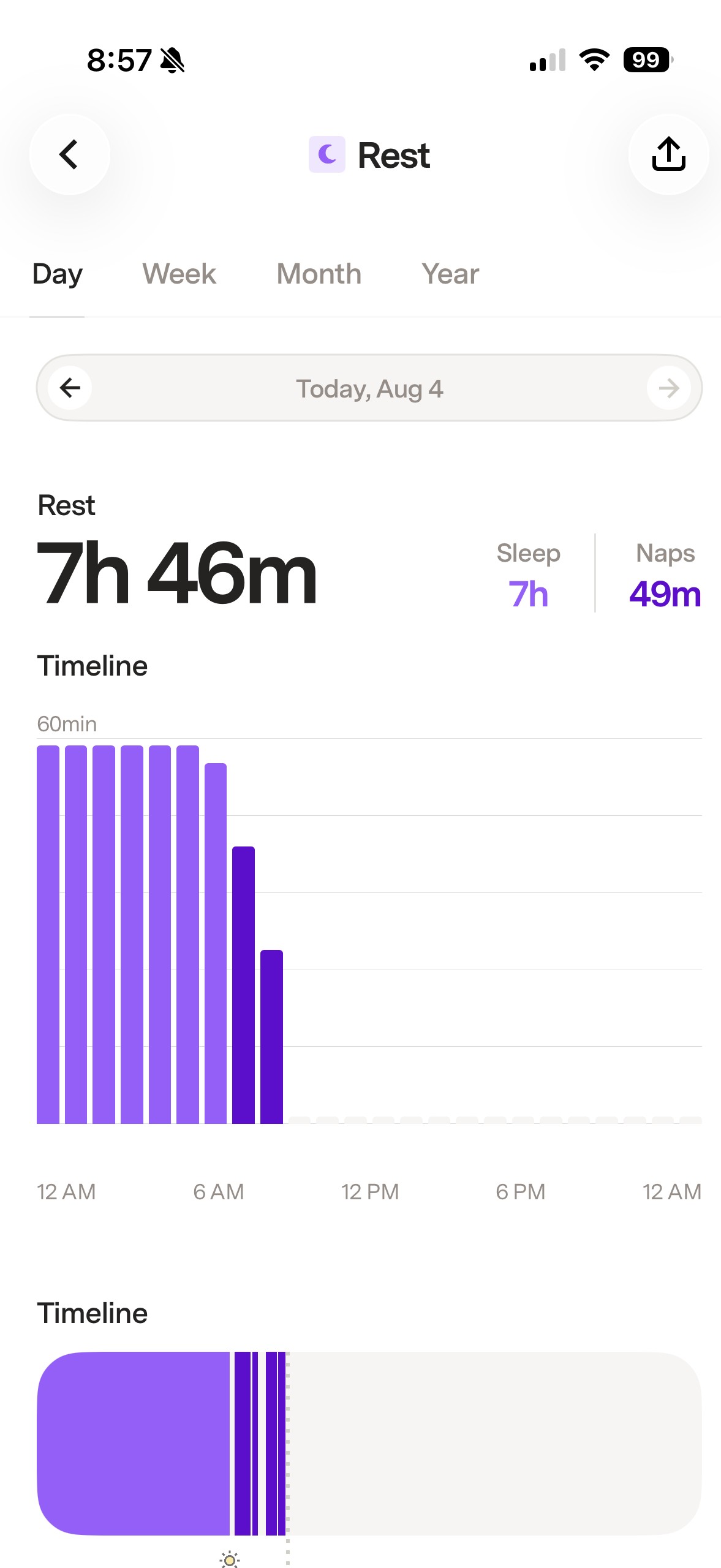
GPS is why I bought Fi. The health and activity history is why it has become more useful over time. Once you’ve owned it for years, the interesting part isn’t whether Lucy did a lot of steps on one Tuesday — it’s knowing what normal looks like for her.
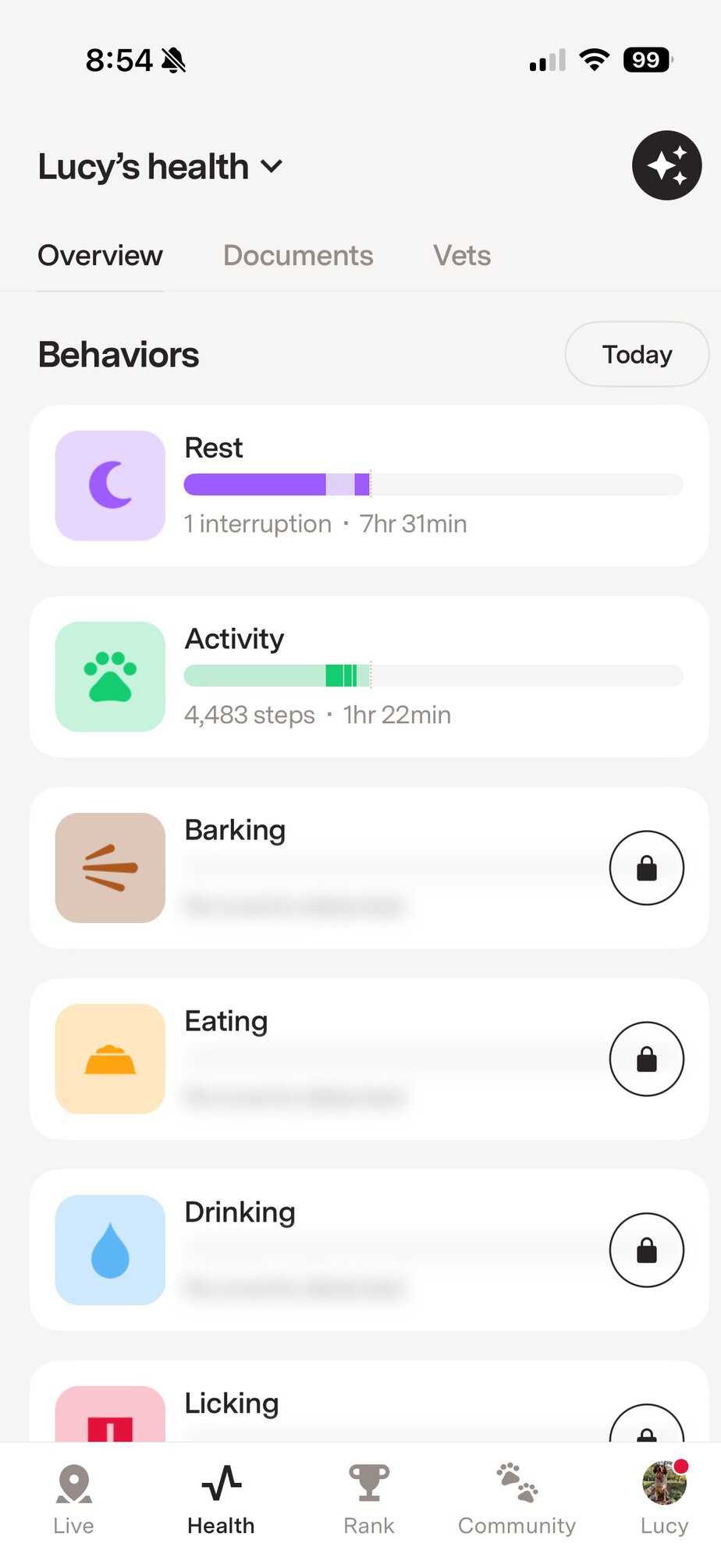

Activity, sleep & health tracking
I used to check the novelty numbers much more often. Now I’m more interested in changes from each dog’s established baseline: activity, sleep, licking and scratching can all become useful context when I’m thinking about stress, pain, recovery or general wellbeing.

AI features: promising, but not there yet
Fi has years of individual-dog data available. I want the AI to make much more meaningful use of that history rather than giving me observations I could get from a generic description of senior dogs.

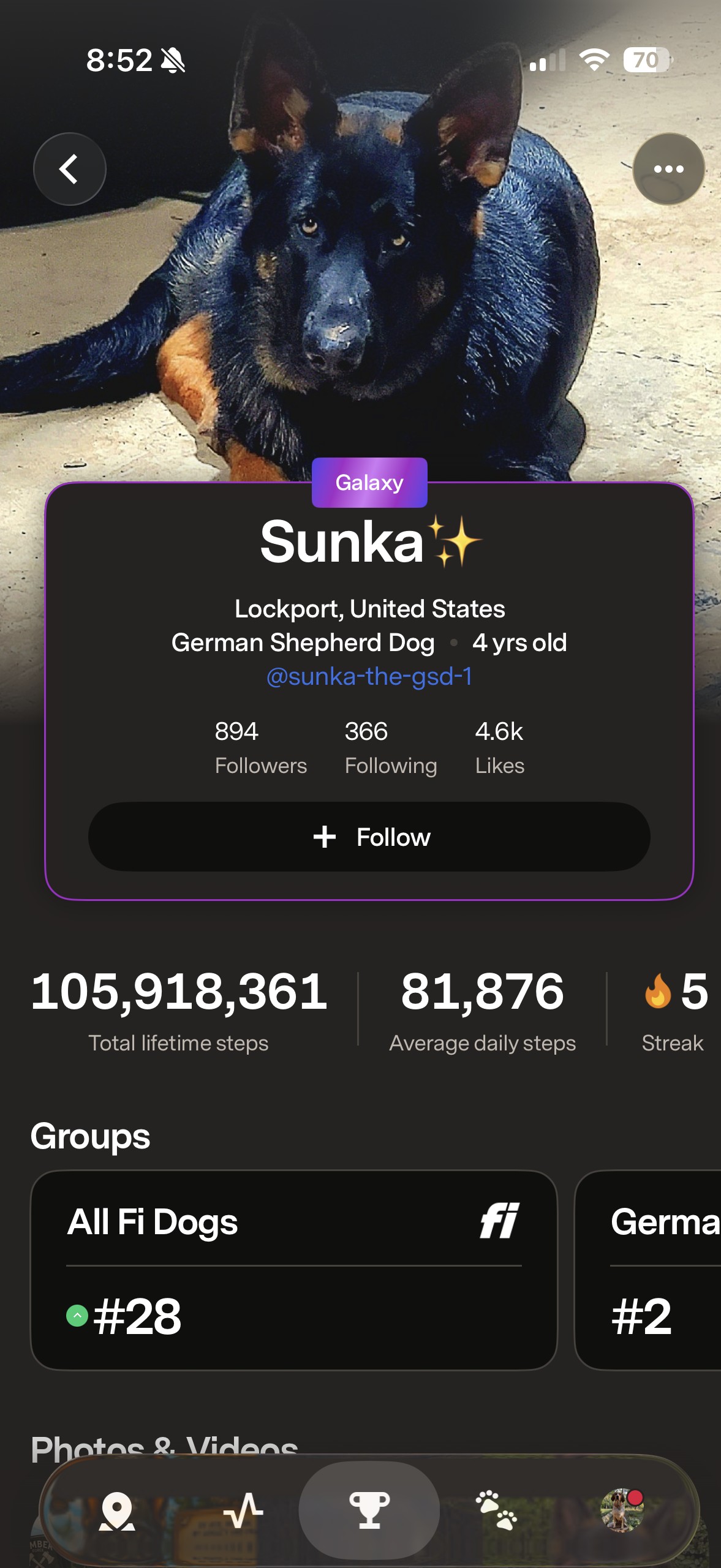
Leaderboards & multi-dog households
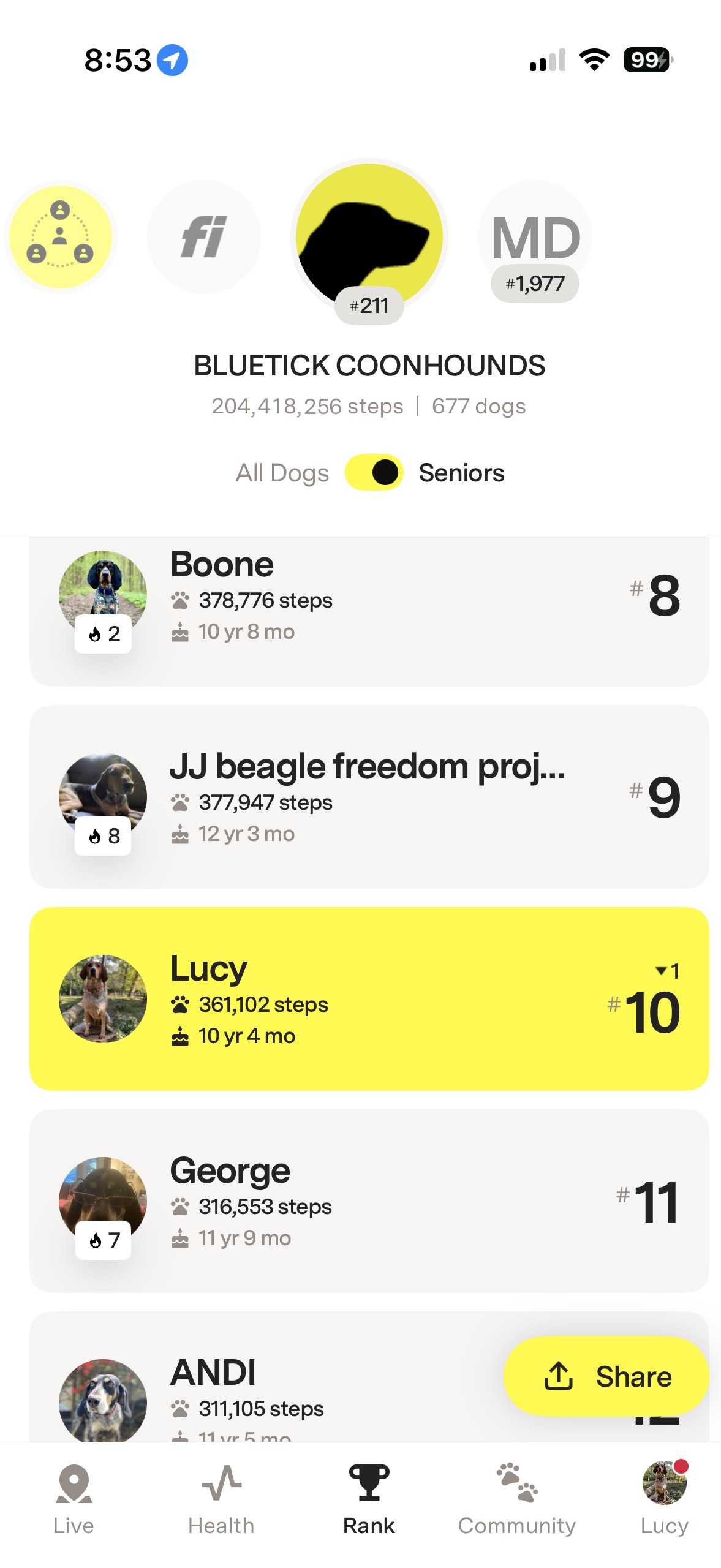
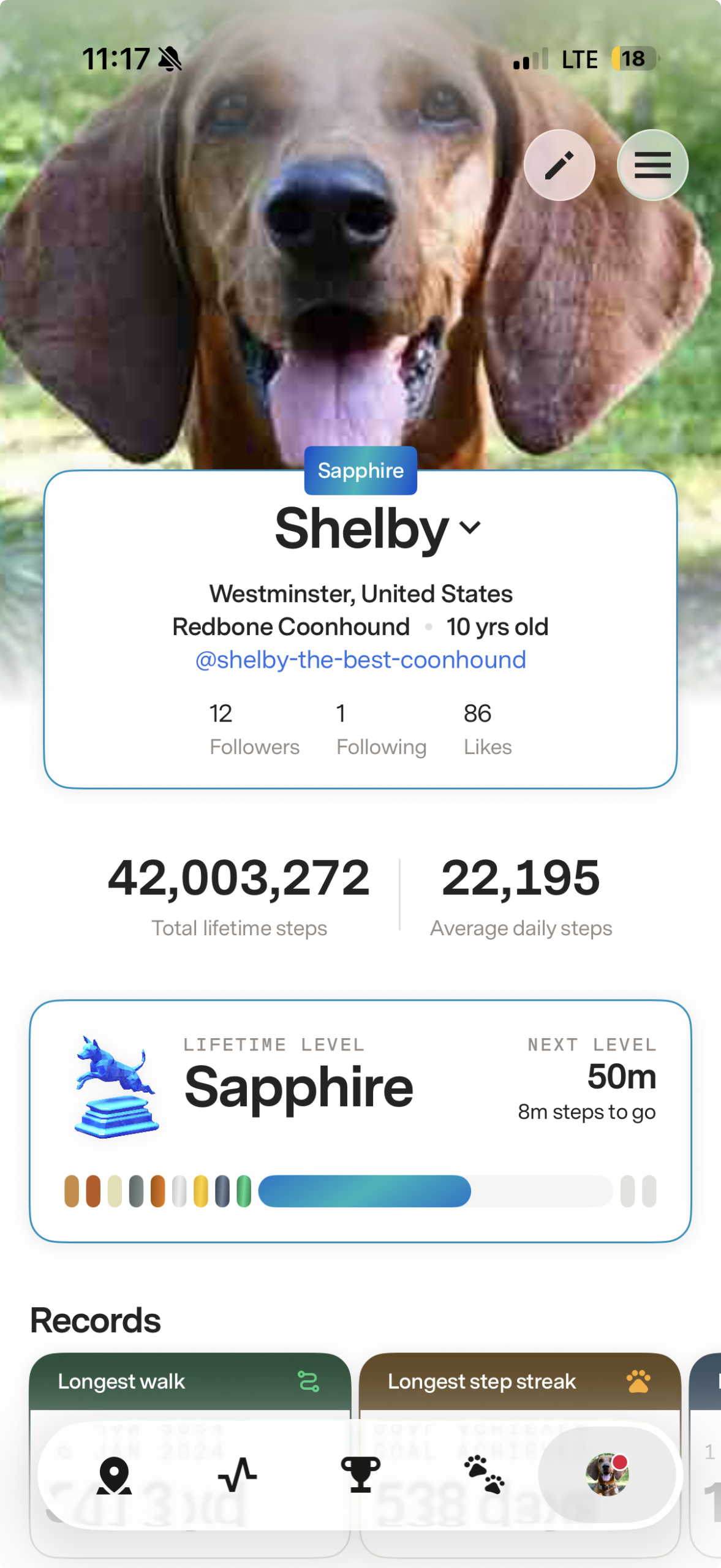
The leaderboards are fun, but I don’t use them to decide how much exercise my dogs need. Their own baseline matters more. Multi-dog management in the app has also improved enormously since we started using Fi.
How Fi Safe Zones and escape alerts work
Safe Zones are the bit that turns Fi from a location tracker I can check into something I can actually rely on in the background. You set the places where your dog is supposed to be — home is the obvious one — and Fi can alert you when the collar leaves that area unexpectedly.
That distinction matters. Fi is not an invisible fence and it does not stop a dog crossing a boundary. The Safe Zone is a geofence for the app: when Lucy or Shelby gets outside it, the useful part is that I can find out quickly rather than discovering an open gate or missing hound much later.
If a dog really is missing, Fi’s Lost Dog Mode switches to more frequent GPS updates so you can follow their location more closely. Fi also now offers Search Party+, which can notify nearby Fi members when an owner marks their dog as lost. Fi explains its current Lost Dog and Search Party features here.
Why I still use Fi
When everything is going well, I forget about it. When a hound gets out, it suddenly becomes the most important app on my phone.
 Fi is not a replacement for recall. It gets me close enough for our recall training to matter.
Real escapes, not test scenarios
These are not “I walked away from the house to see whether the app noticed” tests. These are the times I was extremely glad the dogs were actually wearing the things. Coonhounds are exactly why I care about this stuff; I’ve written more about living with coonhounds and their tendency to follow their noses.

The glamorous side of GPS testing: owning dogs who occasionally make extremely questionable decisions.
Lucy pushed open the gate
This one is probably the cleanest example of what I actually want Fi to do. Lucy managed to nose a gate open and head into the woods. Fi alerted us that she had left the safe area, so instead of standing at the house shouting her name and trying to guess which direction a Bluetick Coonhound had chosen, I had somewhere to go.
I followed her location into the woods until I was close enough that our recall training could actually do its job. Fi didn’t magically make Lucy come home — and I think that distinction matters. The tracker got me close enough to my dog for the training we’d already done to become useful. She was back home in roughly ten minutes.
Both hounds escaped while I was ill
This one was entirely human error. I was ill, I left a gate open, and both Lucy and Shelby took advantage of it. My husband was driving home when he could see both dogs moving on Fi.
That meant he wasn’t coming home to discover two missing dogs and then beginning a search from scratch. He could see where they were going while he was still on his way back and intercept them. With two scent hounds moving at once, knowing that both collars were reporting a location was enormously reassuring.
Shelby followed a deer
Shelby following a deer was much less tidy. She took off across the property and fields and we ended up in the sort of chaotic hound chase where knowing a direction is considerably better than knowing nothing at all.
Live tracking let us follow her movement rather than blindly searching acres of woods and fields. She eventually came home, but Fi gave us information while the situation was unfolding — which is the entire reason I put GPS collars on these dogs.
The escape that happened before Fi
This is really the reason the other stories matter so much to me. Before we had Fi, a tree came down across our fence and Lucy and Shelby got out. They were missing for seven days and were eventually found miles away in the snow.
So when I say the subscription is expensive but my dogs kind of require this, that is the context. I know exactly what searching for these two without live location information feels like, and I have absolutely no desire to do it again.
Battery life: Series 3 vs Series 3+ in our real use
Battery life is one of those things where the marketing number matters less to me than how often I actually have to think about charging the dogs’ collars. We now have two consecutive months of Fi’s internal diagnostics, covering August 19 to October 18, 2026.
Lucy’s Series 3+ lasted 21.6 days from 100% to 10%, then another 21.6 days from 100% to 8%. In our use, that is consistently just over three weeks before a low battery.
Fi battery life: our monthly results
Estimated days per full charge · Fi’s 28-day diagnostic snapshots
Estimated runtime (days)
21.922.9
38.323.8*
September 18: values & connection context
Lucy: 21 days 21 hours. Shelby: 38 days 8 hours. Both use the dashboard’s 28-day “Extrapolated Lifetime” metric. Fi’s broader September analysis found Shelby spent approximately 97% of its reporting period connected through the base, consistent with substantial off-dog time.
* October 18: values & our Wi-Fi note
Lucy: 22 days 21 hours. Shelby: 23 days 20 hours. Our home Wi-Fi was patchy for several weeks during this reporting period—thanks, Xfinity! Connection quality can affect Fi’s battery consumption, so keep that in mind when comparing these results with September’s. It does not establish how much of the change was caused by Wi-Fi.
View the graph’s source data
| Report | Lucy · 3+ | Shelby · 3 |
|---|---|---|
| Sep 18, 2026 | 21d 21h | 38d 8h |
| Oct 18, 2026 | 22d 21h | 23d 20h |
The graph uses the same 28-day “Extrapolated Lifetime” metric from each dog’s dashboard, so we are comparing like calculations rather than mixing completed cycles with projections. These are estimates based on consumption during each window, not full-to-empty tests or rolling averages. I’ll add each monthly report as we collect it.
Lucy’s actual recorded cycles ran from August 25 to September 16 and September 23 to October 15. Her latest written analysis separately estimates 23.9 days per full charge, against a Series 3+ fleet median of 28.8 days, placing her at the 40th percentile. That is a different calculation from the 22-day, 21-hour dashboard figure plotted above; I’m keeping the two clearly labelled.
Shelby’s Series 3 still isn’t a fair head-to-head battery test. Fi’s broader September analysis projected around 40 days, but she spent about 97% of that period connected through the base. Fi noted that the pattern was consistent with substantial off-dog time. October’s dashboard estimate was lower, while her most recent partial discharge was slower than the preceding cycle. Those describe different windows, so they aren’t contradictory results.
Our roughly one-acre property normally has good coverage through a mesh network, although the Xfinity disruption above interrupted that. Time away from the base, connection quality and GPS/cellular use all matter. These two collars don’t establish a battery-life advantage worth replacing a working Series 3 for.
Charging reliability deserves its own mention
The charging setup has sometimes been a wrestling match, and now we have figures to put alongside that complaint. Lucy took 7.2 and 10.8 hours to reach 99% on her two latest charges. Fi flagged both as unusually slow. An earlier session stopped at 67% after nine hours on power. The telemetry identifies a charging issue to investigate, but does not establish whether the collar, base, cable or power supply is responsible.
That is separate from battery wear: Lucy’s latest average reported health was 97.2%, almost exactly Fi’s Series 3+ fleet median, and her capacity readings showed no measurable loss. Shelby’s health estimate needs more explanation, as detailed below. Neither report establishes that a replacement is required.
By the end of our time with Series 2, charging was becoming an almost daily job. That was the practical reason we moved on from it. Our current results are much more manageable, but long runtime is only useful if the collar reliably takes a charge.
🤓 Really nerdy battery info
September report: Lucy’s 28-day dashboard recorded 114% battery drain, 139% battery charge and an extrapolated lifetime of 21 days 21 hours. Shelby’s recorded 73% drain, no charging during the window and 38 days 8 hours. The broader analysis covered August 19–September 18; its approximately 40-day projection for Shelby used a different window/calculation.
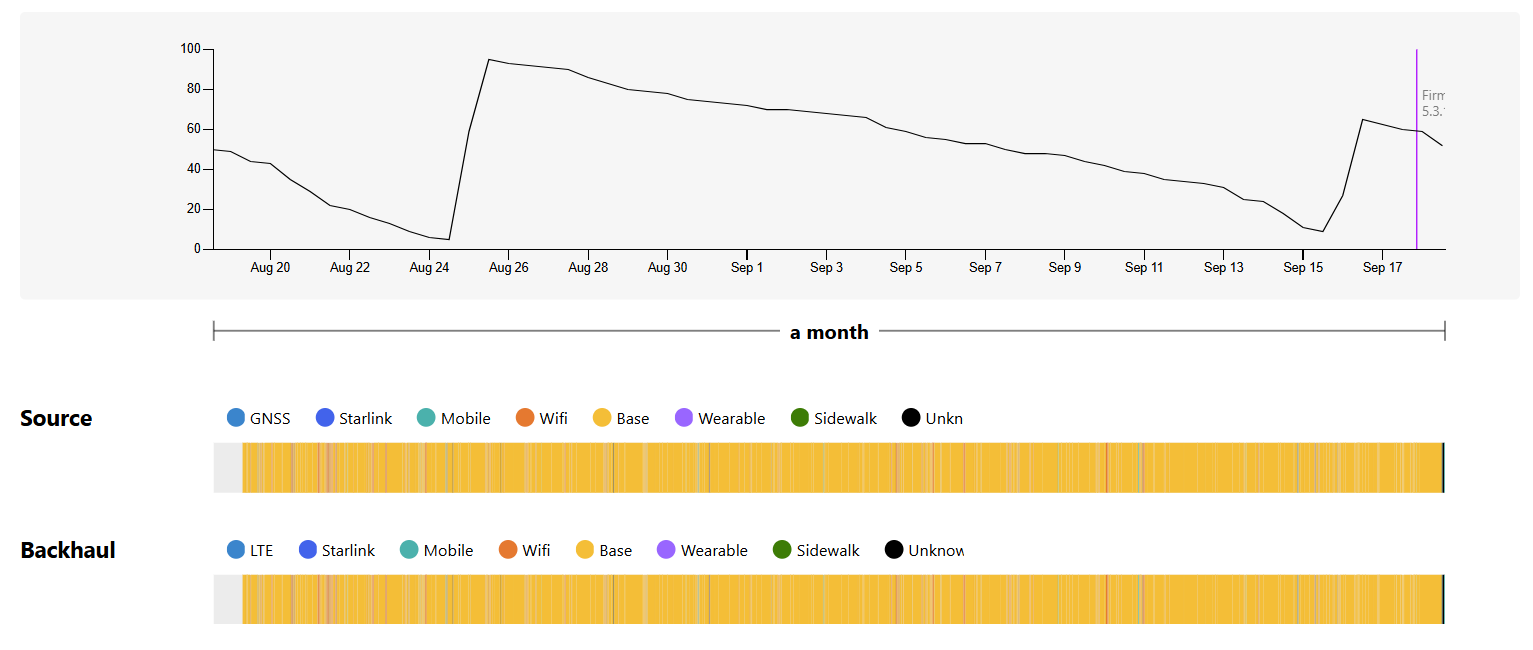

October report: Lucy’s 28-day dashboard recorded 109% drain, 146% charge and 22 days 21 hours extrapolated lifetime. Shelby’s recorded 109% drain, 157% charge and 23 days 20 hours. These are the October values used in the graph.
Lucy’s cell and charging: average reported health was 97.2% (range 96–100%; fleet median 97%). Estimated full capacity was approximately 301 mAh against 299 mAh nominal, giving a capacity ratio of 1.005. These are gauge estimates, not an independent laboratory capacity test. Her two charging rates were 13.7 and 8.4 percentage points/hour, both below Fi’s 15-point/hour charging-hardware investigation threshold and its fleet tenth percentile of 29. Fi reported no temperature-related charging throttling during the window.
Shelby’s health estimate: the valid reading changed from 98% to 85% during the October 11 recharge and persisted for roughly eight days. Fi says charge-time re-estimation is expected, but this 13-point step is unusually large. Her recent discharge rate improved from approximately 4.6 to 2.3 percentage points/day across the compared cycles. That does not confirm sudden capacity loss, but it cannot rule it out without comparable usage and capacity measurements. Gauge recalculation and firmware/reporting issues remain possible explanations. Roughly 22% of reports contained a zero health field, which Fi identified as missing-data artifacts; those zeros are not genuine health measurements and do not explain the valid 85% reading.
How to read this: state of charge is how full the battery is now; state of health estimates its condition or remaining capacity. Runtime also depends on power consumption. The graph tracks estimated runtime, while the completed cycles and charging results are reported separately. Two monthly snapshots are a starting record, not proof of a long-term trend or a model-wide defect.
Durability and reliability after nearly four years
Series 2, Series 3 and Series 3+ after real use — not pristine review samples.
The Series 2 in these photos is probably the quickest possible explanation of how we test gear. The trackers have been worn outside, knocked around and used by actual coonhounds for years. I’ve also used Fi around water and wet weather rather than treating it like delicate electronics.
They’ve been pretty reliable. We have had a couple of replacement units sent over the years — I believe one during our Series 2 years and one during Series 3 — but I don’t want to pretend I remember the exact device history more precisely than I do. Across two dogs, multiple generations and nearly four years of daily use, I’m not particularly upset by two replacements.
And it hasn’t been completely flawless: we’ve had a couple of false escape alarms over the years too. They’ve been infrequent enough that I still take an escape notification seriously, but they are worth mentioning. A system like this is much more useful if you understand that an alert is information to check, not absolute proof that your dog is currently halfway into the next county.
Fi’s customer service has also improved noticeably over the years. That matters with something I’m relying on as a safety tool: hardware can fail, but I care enormously about what happens next when it does.
What annoys me after nearly four years
The subscription is not cheap. I don’t particularly enjoy another recurring bill, and I think it is an important part of the buying decision rather than something to hide in the small print. Fi’s plans and offers change, so I’d check the live terms before buying rather than relying on an old price quoted in a review.
Check current Fi price & availability →
But Lucy and Shelby kind of require it. They are scent hounds, they have escaped before, and before we owned Fi they once disappeared for seven days after a tree came down across our fence. Against that history, live GPS is not a novelty feature in this house.
The charging dock can occasionally turn into a wrestling match. October’s diagnostics put numbers alongside that frustration: Lucy’s two latest charges took 7.2 and 10.8 hours to reach 99%, both flagged by Fi as unusually slow. Her capacity readings were healthy, so I’m keeping charging reliability separate from battery wear; the data does not identify which part of the charging setup is responsible.
You need compatible collar hardware. And the AI still feels like it could do substantially more with the years of individual-dog data Fi already holds.
None of those things disappear because I like the product. They’re simply weighed against the question that matters most to me: when Lucy or Shelby gets out, do I want Fi on their neck? Yes.
Fi vs Tractive vs AirTag
Fi and Tractive are the real GPS comparison. I’ve used both. Fi suits our wooded property and my preference for a collar-integrated tracker particularly well, and its battery life has been stronger in my real use. Tractive has advantages too: it clips onto an existing collar, its LIVE tracking is fast, and it has broader international coverage.
I own and use AirTags as well, but I treat them as inexpensive backup tags rather than a substitute for a cellular GPS dog tracker. Apple describes AirTag as working through the Find My network; on a rural wooded property, that is a very different proposition from following an escaped hound live.
For the deeper comparisons, see my Fi vs Tractive real-world comparison and AirTag vs Fi comparison.
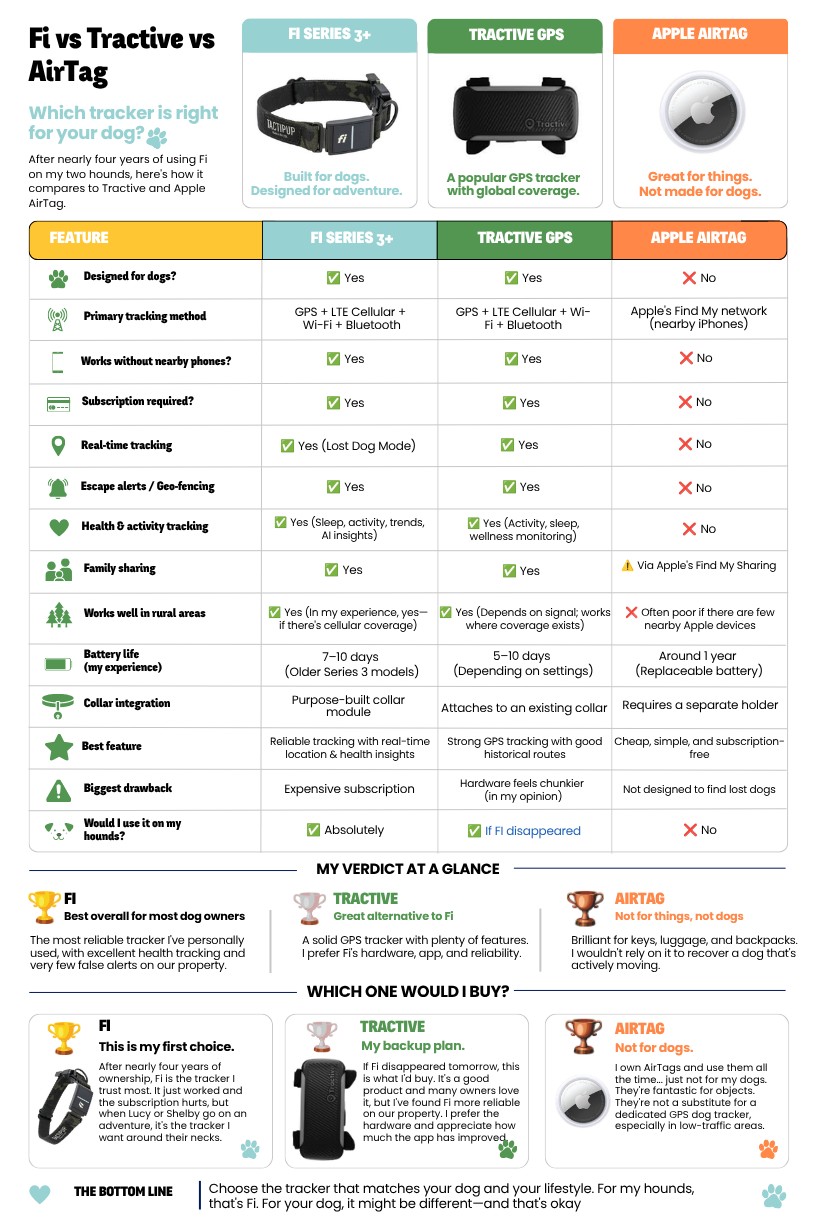
They overlap, but they are not the same kind of tool — especially once a dog is genuinely missing.
Would I buy Fi again?

Lucy wearing Fi long before this became a four-year review. This has been part of our normal dog gear for years.
For Lucy and Shelby: yes. If both trackers disappeared tomorrow, I’d replace them. Not because Fi is perfect, but because after nearly four years and several genuine escapes, it has earned a place in the way I manage these particular dogs. Indie still doesn’t need one.
If you can afford it, do it.

That comes with the caveats above: the subscription isn’t cheap, the hardware isn’t immortal, and I still want more from some of the newer health and AI features. But the thing I originally bought Fi to do — help me find my dogs if they get out — is still the reason I keep it on them.
Frequently asked questions about Fi
Is Fi worth it for an escape-prone dog? For my two coonhounds, yes. The GPS and escape alerts are the reason I continue paying for it.
Is the Fi Series 3+ worth it? If you’re buying new, the Series 3+ gives you Fi’s newer health monitoring alongside the GPS features I use Fi for. As an upgrade from a working Series 3, though, I wouldn’t call it essential.
Should I upgrade from Series 3 to Series 3+? Not automatically. I upgraded Lucy and kept Shelby on Series 3 because Shelby’s existing tracker still works. For me, the upgrade makes most sense when the newer scratching, licking, barking or drinking data answers a genuine question about your dog.
Can an AirTag replace Fi? I don’t use it that way. An AirTag is a useful backup tag, but it is not the same tracking system as a cellular GPS collar.


0 Comments