Are booties necessary?
This entirely depends on your dog and where you’re walking!
Further reading: related guidance from Rebarkable
Why/why not?
We have to remember that dogs can only sweat through their paws, and lose heat via panting. So, in warm weather? You can absolutely make your dog more prone to overheating.
However, in salty environments, on sharp rocks, or in debris filled areas it can be advisable.
Or, alternatively, boots are great if you’re planning on doing a lot of climbing with your dog, they definitely can amp up the grippiness of the dog’s paw.
They can also be great for elderly dogs whose paws have smoothed off.
What types of dogs need them?
Any dog can wear boots!
What other cold weather gear should pet parents think about investing in?
This depends on your dog. For example, my German shepherd has no winter gear, because even in serious freezing conditions he’s absolutely fine.
Yet, my coonhounds? For ice we need boots, for snow we need a good winter coat, and for rain/harsh wind, a wind and water-proof layer is needed to keep them happy.
Tips and general advice for pet parents for keeping their dogs safe and happy in winter
– Make sure to adjust your dog before you making them wear them. Desensitise them to their boots and introduce a coat gently.
– Listen to your dog! If they’re saying it’s too cold, or too wet? Then maybe skip your walk!
Why does my dog need boots?
Sometimes the world isn’t paw friendly. As humans population grows, and dog population follows, we’re taking our dogs into more and more situations across the world – and it’s not always comfortable for a paw. That includes taking less weather-appropriate dogs into weather that they may not be bred for. Sometimes that means that we have to include something like boots in order to help them be comfortable in a habitat they might not be otherwise.
When should I use boots for my dog?
Some great ideas of when to introduce boots are:

From Rebarkable
Want the training steps laid out for you?
My illustrated Core Skills guide turns positive-reinforcement training into clear, practical exercises you can follow at home.
Get the Core Skills GuideDigital download · Instant access via Etsy
- Cold weather
- Hot weather
- Rough terrain
- Slippy surfaces
- Hiking
- Salty surfaces
These are all instances where we may be asking our dogs to do things where they would benefit from a little extra grip, or an extra protective surface between their paws and whatever it is we’re walking on together.
Personally, Indie and I tend to use this when we’re on mountain trails. Indie (my German shepherd) does like to clamber over rocks, and given we’re new to the US, there’s a few rocks here that he’s never really understood, we don’t get a whole lot of volcanic rock in the UK, so the Appalachians are a seriously new environment for us to be exploring.
How to help your dog love their boots
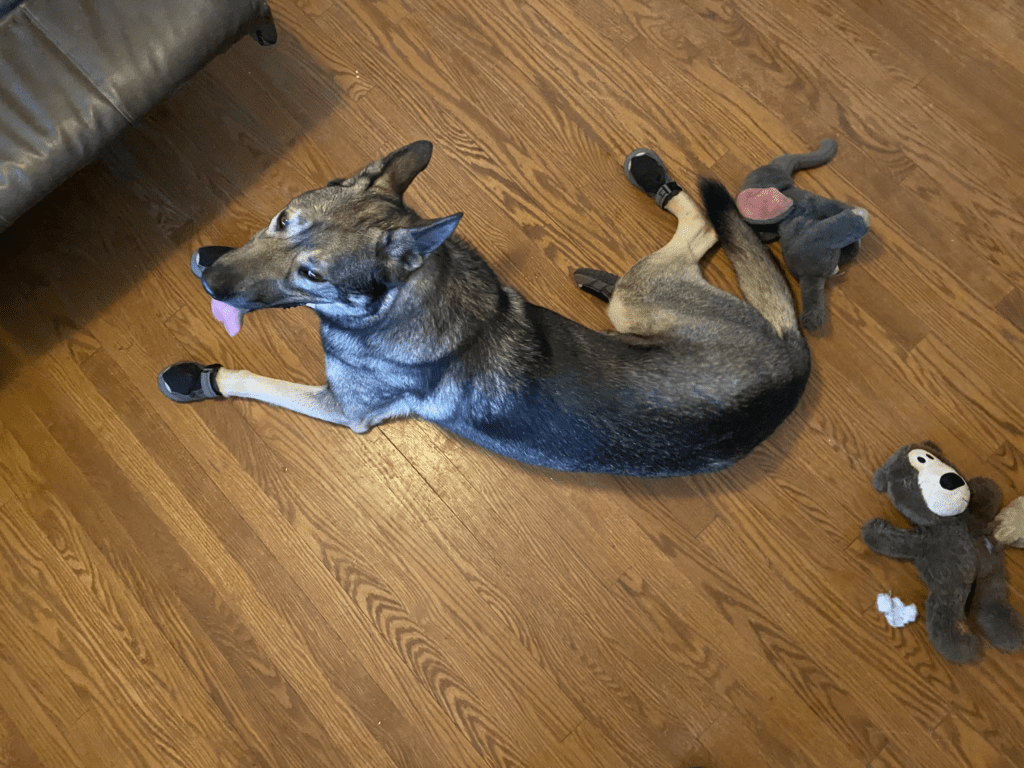
It’s really important with boots in particular that you make a positive introduction, and as much as possible, this should be an experience that is relaxed and not stressful (because let’s face it, if it’s a war, you know who’s going to win and come back without their new shoes when you’re out on a hike.)
I know it’s so tempting to just pop them on and look at your dog in boots and watch them be silly? But that’s not necessarily going to reach your goals for boot wearing.
I’m starting this with the assumption that your dog doesn’t mind their paws being touched, but if they do, then do make sure to desensitise this first.
Step 1 – Visual introduction
First! when you get rid of the packaging, sit on the floor with your dog, show them the boots, and praise reward, hiding the boots swiftly afterwards.
You’ll quickly notice that the appearance of the boots becomes a predictor for a reward – and this is absolutely what you’re looking for.
Step 2 – Interaction
You can pop those suckers on the floor, and put treats around and under them. This should encourage your dog to interact with them. This will create trust, normalise their presence and push away uncertainty.
Call that session to a halt wherever you need to and then.
Step 3 – Start with one.
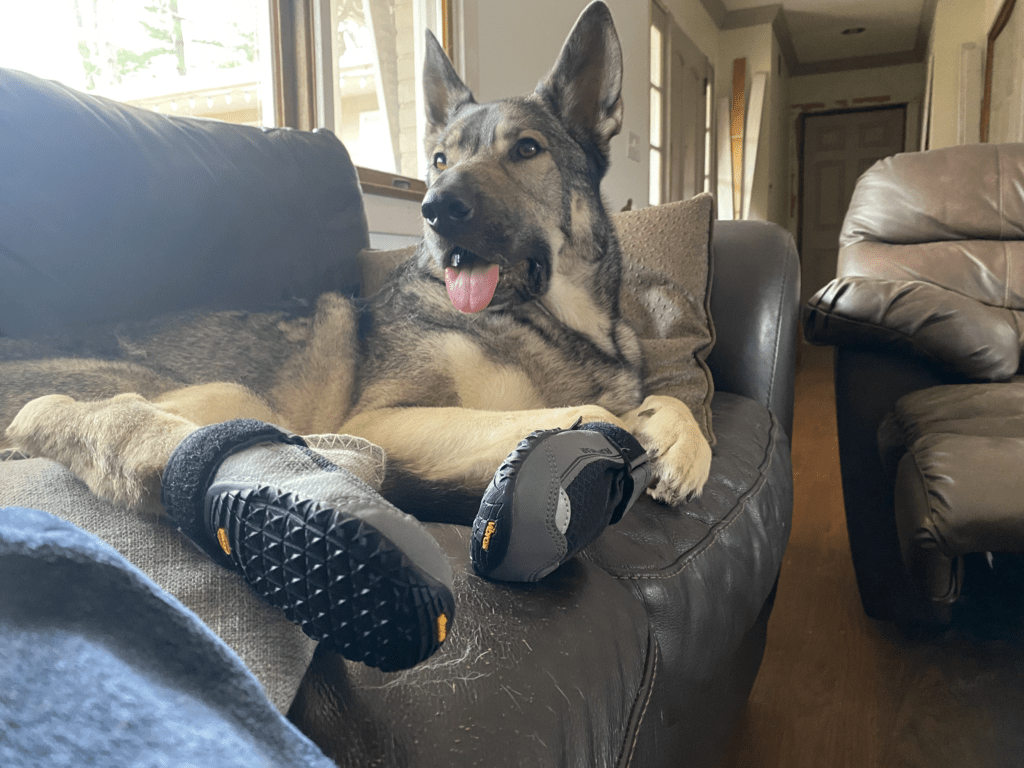
When you’re chilling on the sofa, take one boot, and test it out. You may not want to fasten it at this stage, but if your dog is readily accepting this? Then pop it on! Reward your dog, and remove the boot.
It’s really important that if you see signs of stress or discomfort, then try and back up, take it back a step and do it gently.
Step 4 – Move it forward
Then, when this is a relaxed process, secure the boot, and if your dog isn’t too worried, see if they’ll go for a little wander around your home, yard and driveway! This will allow you to test the fit and size.
Initially you can expect that your dog is gonna do that silly walk, but they should adjust quickly.
Then more boots at one time until you get all of them on together and it looks like adventuring time for you both!
Remember to monitor!
Monitoring the fit on these is really important. When you’re out, compare their gait to how they normally walk. After every hike or excursion, check your dogs paws and make sure there are no sores or rubbing points.




0 Comments