Most well-run daycares accept puppies around 12 to 16 weeks, but that number is really just a starting point. Readiness depends on where your puppy stands with vaccines, how a specific facility screens for temperament, and whether your dog can actually cope with a room full of strangers. Before you book anything, check both the vaccine schedule and your pup’s health and personality with your vet and the daycare itself.
TL;DR:
- Core vaccines start at 6 to 8 weeks and repeat every 2 to 4 weeks beyond 16 weeks; high risk facilities may continue boosters to 20 weeks.
- Well run indoor puppy classes can begin at 7 to 8 weeks after first vaccines, but they are not equivalent to commercial daycare.
- Before enrolling, verify vaccine and parasite records, staff supervision, rest breaks, group separation, cleaning practices, and written policies for excluding sick dogs.
- Start with a temperament assessment and supervised half day, then try one day weekly for a few weeks and increase only if recovery stays normal.
Table of Contents
- Why vaccination timing drives the daycare age debate
- Socialization classes versus full daycare: these are not the same thing
- Is your puppy actually ready? Here’s how to tell
- What to check before you enroll
- A starter plan: trial visit, frequency, and scaling up
- Building the skills that make daycare easier
- Minimum ages vary a lot by facility type
- The long game: benefits and risks at different starting ages
- Easing the move from home to a daycare floor
- When to hit pause on daycare
- Balancing socialization with disease risk
- A weekly option to help your puppy get daycare-ready
- FAQ
- Sources
Why vaccination timing drives the daycare age debate
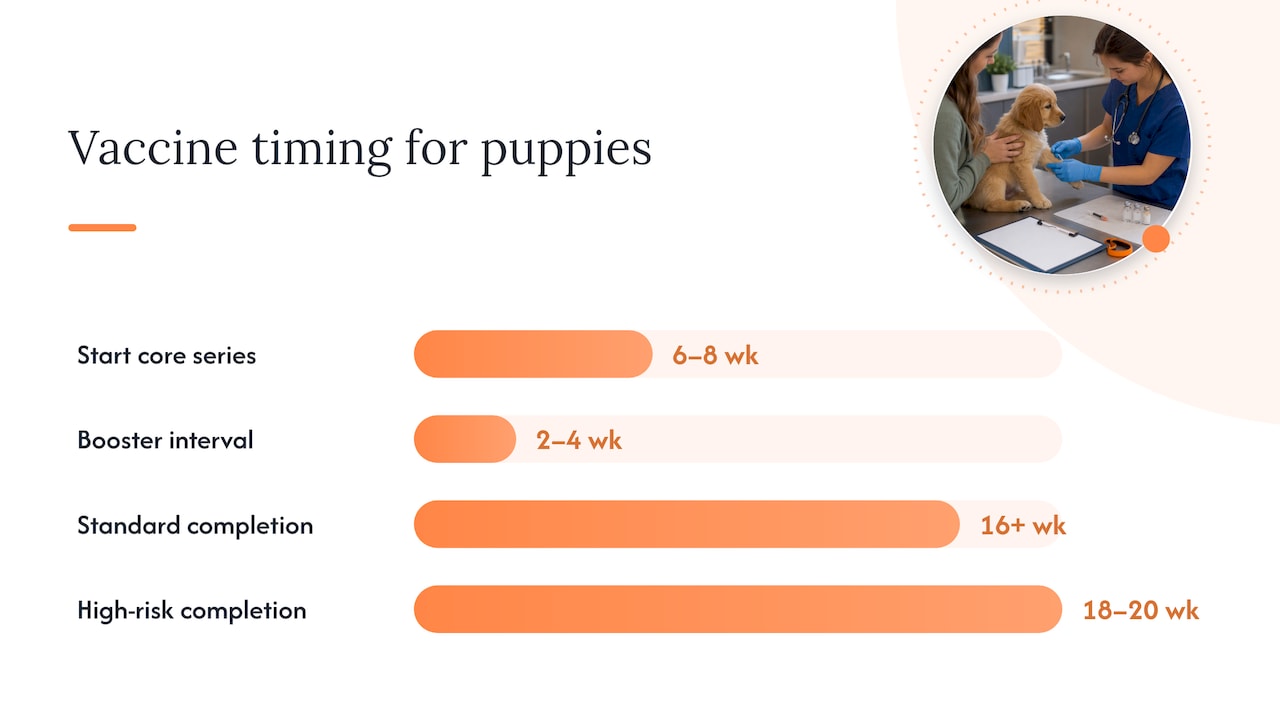
Age is really a proxy for immunity, and that’s where things get technical fast. The AAHA guidelines recommend starting the core vaccine series at 6 to 8 weeks, then revaccinating every 2 to 4 weeks until your puppy is past 16 weeks old. In places with higher disease risk, vets may push that final booster out to 18 to 20 weeks.
Here’s the part new owners often miss: maternal antibodies, the protective proteins passed from mom through nursing, can actually block a vaccine from working properly in young puppies. Nobody knows exactly when those antibodies fade in an individual dog, which is why vets stack booster after booster through those early months instead of giving one shot and calling it done. A facility that asks for proof of a completed series, rather than just “started,” isn’t being difficult. It’s following the same logic your vet uses.
One well-run daycare’s requirements often include:
- DA2PP (or DAPP) series completed or well underway
- Rabies vaccine, timed per your state’s legal requirements
- Bordetella vaccine, since kennel cough spreads fast in group settings
- Canine influenza vaccine, depending on regional risk and facility policy
- Current flea, tick, and deworming records
In higher-risk environments like shelters or high-turnover daycares, veterinarians often recommend an accelerated protocol: boosters every 2 to 3 weeks until 18 to 20 weeks, according to AAHA. That’s worth asking about if your chosen facility sees a lot of daily turnover.
Socialization classes versus full daycare: these are not the same thing
This is where a lot of advice online gets muddled, and it drives us a little nuts. The AVSAB position statement is clear that the first three months of a puppy’s life are the most important window for building social skills, confidence, and resilience. Puppies can start well-run, indoor socialization classes as early as 7 to 8 weeks, as long as they’ve had their first vaccines and show no signs of illness.
That is a completely different setting from commercial doggy daycare. A puppy class is usually small, supervised closely, held indoors, and run by someone actively teaching owners how to read their dog. Daycare, by contrast, often means higher dog turnover, less individualized attention, and a wider mix of ages, sizes, and temperaments all playing at once.
Safer early options before full daycare include:
- Owner-led walks in low-traffic areas (your own yard, a quiet sidewalk)
- Small, vetted puppy classes held indoors with vaccine checks at the door
- Staged one-on-one playdates with a known, healthy, vaccinated dog
Pro Tip: Call ahead and ask any puppy class or daycare exactly how they verify vaccine records before admitting a new dog. A real answer beats a vague “we handle that.”
For more on this stage, our piece on socializing a puppy before full vaccination walks through specific low-risk outings you can start this week.
Is your puppy actually ready? Here’s how to tell
Vaccines are only half the equation. The other half is whether your puppy’s personality and nervous system are ready for a room full of unfamiliar dogs, and that takes honest observation, not wishful thinking.
- Watch how they play. A ready puppy initiates and responds to play with appropriate pauses, not just frantic chasing or hiding under furniture.
- Check recovery time. After excitement or a startle, does your pup bounce back in a minute or two, or stay rattled for an hour?
- Track eating and sleeping. Puppies who are coping well eat normally and sleep soundly after a stimulating day.
- Notice the red flags. Persistent fear, resource guarding, panic at the door, or diarrhea after visits are signs the environment is too much, too soon, according to Rover’s practitioner guidance on reading post-daycare behavior.
- Ask for a trial visit. A short, supervised half-day with staff watching closely tells you more than any age chart ever could.
If your pup leans shy or easily overwhelmed rather than outgoing, our guide to socializing a shy puppy covers pacing that actually builds confidence instead of flooding them with too much too fast.
What to check before you enroll
Before you hand over a deposit, get specific answers in writing, not just a friendly nod from the front desk.
Ask for documentation first: exact vaccine dates, current parasite prevention, any required vet clearance form, and whether the facility accepts titer testing as an alternative to a full vaccine series.
Then get into the operational details that actually protect your puppy day to day:
- Staff-to-puppy ratio during active play sessions
- Scheduled rest or nap breaks away from the group
- Separation by size, age, or energy level
- Cleaning and disinfection routine between groups
- A written outbreak or sick-dog exclusion policy
- Emergency veterinary arrangements if something goes wrong on-site
It’s also worth asking how staff handle a puppy who’s clearly overstimulated, whether they offer temperament testing before full enrollment, and whether a recent vet exam is required on file. Our list of questions to ask a doggy daycare before joining gives you a script for that first phone call, and our broader socialization questions checklist is handy for comparing facilities side by side.
A starter plan: trial visit, frequency, and scaling up
Jumping straight to five days a week is how a lot of puppies end up exhausted, snappish, or avoiding the car on daycare mornings. A slower on-ramp works better.
- Start with a temperament assessment. Most reputable facilities offer this before full enrollment, and it’s worth insisting on one if they don’t mention it first.
- Book a short trial half-day. Watch how your puppy acts that evening and the next morning before committing further.
- Settle into one day a week for a few weeks. This gives your puppy’s body and brain time to adjust without constant overstimulation.
- Increase gradually, based on how your puppy recovers, not on a fixed calendar.
Many puppies genuinely do better at 1 to 3 days a week rather than daily attendance until they’re older and have proven they can handle the pace, as Rover notes in its guidance on daily versus occasional daycare use. Watch for excessive panting long after pickup, appetite changes, or new clinginess, and don’t be afraid to pause and call your vet or a trainer if something feels off.
Pro Tip: Keep a quick note on your phone after each visit (mood, appetite, sleep that night). Patterns show up faster than memory does.
Building the skills that make daycare easier
A puppy who already tolerates short separations, settles in a crate, and responds to a few basic cues walks into daycare with a real advantage. Practicing settle, recall, and brief alone time at home, alongside basic handling tolerance, builds the resilience that keeps group play from becoming overwhelming. A training treat pouch makes it easier to reward these moments consistently during short outings and practice sessions, which matters more than any single cue on its own. Staging this kind of prep in the weeks before enrollment, rather than throwing a puppy in cold, tends to produce a calmer first few visits.
Minimum ages vary a lot by facility type
Not all daycares set the same bar, and that’s worth knowing before you call around. Small, boutique setups that limit group size and separate puppies from adult dogs sometimes accept pups as young as 10 to 12 weeks, provided the first vaccine round is documented and a staff member actively supervises play in smaller pods.
Larger commercial daycares with bigger group sizes and more turnover tend to set the bar higher, often requiring the vaccine series to be fully completed, which usually lands closer to 16 weeks or later. Some facilities built around high-density group play, similar to what AAHA describes for shelter-type environments, may ask for an extended vaccine timeline before admitting any puppy at all, simply because the exposure risk is higher with more dogs cycling through.
Veterinary-affiliated daycares, the kind attached to an animal hospital, sometimes offer a middle ground: smaller “puppy only” sessions starting earlier, with the option to graduate into general group play once vaccines and temperament checks are both complete. There’s no universal rulebook here, which is exactly why a phone call beats a generic age chart every time.
The long game: benefits and risks at different starting ages
Starting daycare early, once vaccines and temperament line up, can reinforce the social skills your puppy is already building during that critical first-three-month window, according to AVSAB. Puppies who get structured, positive exposure to other dogs during this stage often carry that comfort forward into adolescence and adulthood.
But starting too early, before vaccines are adequate or before a puppy shows real readiness, raises genuine infectious disease risk in group settings, a concern AVMA flags directly for training classes, daycares, and dog parks alike. There’s also a behavioral risk: a puppy flooded with too much chaotic exposure before they can handle it may learn to fear group settings instead of enjoying them.
Waiting too long carries its own tradeoff. Missing the bulk of that early socialization window can make a dog more prone to wariness around unfamiliar dogs later, simply because they never had the graded practice. The sweet spot isn’t a fixed age so much as a match between your puppy’s documented immunity, their temperament, and the specific facility’s setup.
Easing the move from home to a daycare floor
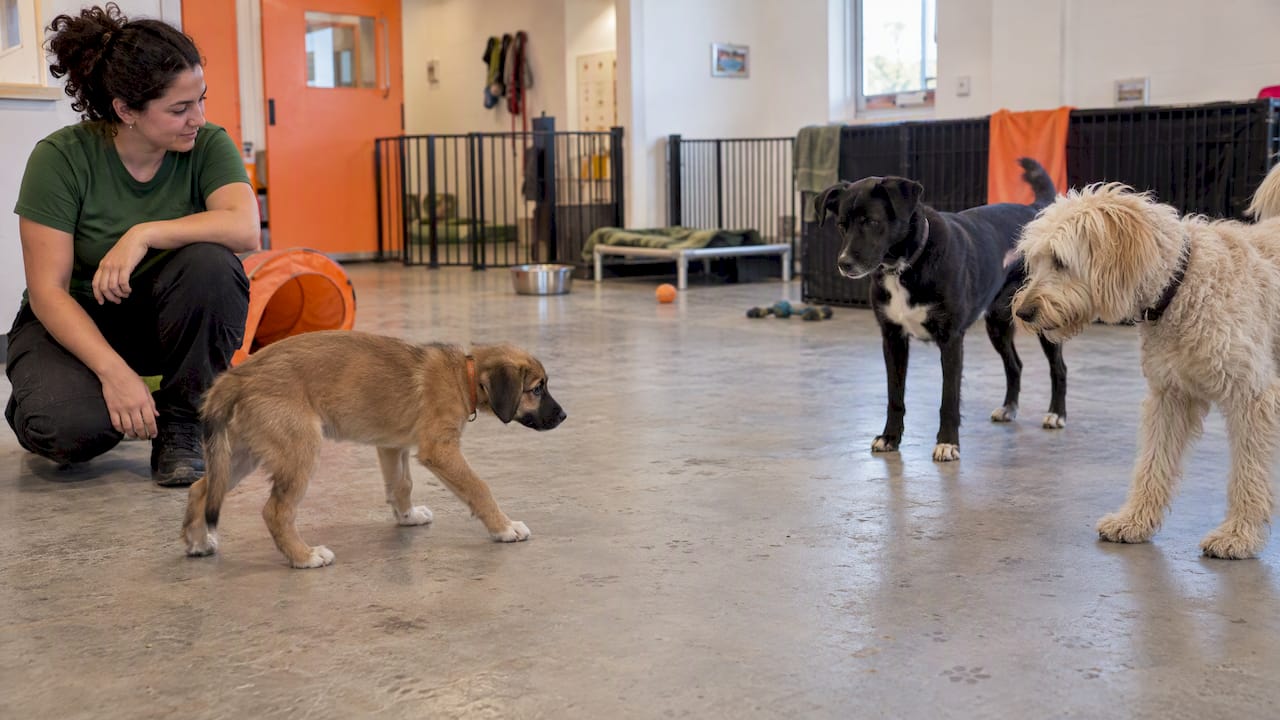
Puppies who’ve only ever known a living room and a backyard can find a daycare floor genuinely overwhelming on day one, no matter how friendly the staff are.
Start the transition at home before the first visit even happens: practice brief separations from you, get your puppy comfortable settling in a crate or pen, and introduce short car rides so the trip itself isn’t a new stressor stacked on top of a new place. Bringing a familiar blanket or toy on the first visit can help bridge the gap between home and the daycare floor.
On the actual day, a shorter session beats a full day every time, and picking up right when your puppy still seems engaged, rather than exhausted, helps build a positive association instead of a dreaded one. Staff who ease a new puppy into a smaller sub-group rather than the full room on day one are doing this part right.
When to hit pause on daycare
Sometimes the right call is simply not yet, and that’s not a failure on your part. Watch for physical signs: vomiting, diarrhea, lethargy, or any illness should delay a visit regardless of how excited your puppy seems to go.
Behaviorally, persistent fear at drop-off, shutting down rather than engaging, resource guarding toward other dogs, or repeated defensive reactions are signals worth taking seriously rather than hoping your puppy will “grow into it” through repeated exposure. Rover’s guidance on reading overstimulation, prolonged panting well after pickup, appetite refusal, or new clinginess, applies here too: these are cues to step back, not push through.
If you see any of these patterns, a short break paired with a conversation with your vet or a trainer usually sorts out whether the issue is medical, developmental, or simply a pacing problem that a slower reintroduction can fix.
Balancing socialization with disease risk
We’d rather see a puppy get graded, careful exposure during those critical early weeks than sit at home “waiting to be ready.” Track behavior closely, stay in touch with your vet, and let the facility’s own policies guide your pace.
— Ali
A weekly option to help your puppy get daycare-ready
We offer a program of weekly email lessons, video walkthroughs, and community support designed to build crate comfort, recall, and settle skills before your puppy ever sets foot on a daycare floor.

- Weekly lessons delivered straight to your inbox, no scheduling a class around your workday
- Video content that shows the mechanics, not just the theory
- Community support from other new puppy owners working through the same stages
| What you get | Format |
|---|---|
| Weekly training lessons | |
| Skill-building videos | Video |
| Owner community | Community support |
This isn’t a daycare substitute, it’s preparation that makes those first daycare visits go smoother. Take a look at Pupdates to see how the weekly format fits into your own puppy’s schedule.
FAQ
Can I leave my 12 week old puppy alone for 2 hours?
Most 12 week old puppies can handle short alone periods of a couple of hours, provided they’ve had a chance to relieve themselves and burn off some energy beforehand. Building up alone time gradually, starting with just a few minutes, helps prevent separation anxiety later.
What is the 3-3-3 rule for puppies?
The 3-3-3 rule is a general guideline some trainers use to describe adjustment periods for a newly adopted dog: roughly 3 days to decompress, 3 weeks to start settling into routine, and 3 months to feel fully at home. It’s a rough framework, not a strict timeline, since every puppy adjusts at a different pace.
Can I take my 9 week old puppy for a walk outside?
Yes, with some care. Short, low-traffic outings in your own yard or quiet areas are generally fine once your puppy has started their first vaccines, and the AVSAB position statement supports graded early exposure rather than waiting until vaccines are fully complete.
Can a 2 month old puppy go to daycare?
Most commercial daycares won’t accept a puppy this young because the full vaccine series typically isn’t complete until well past 16 weeks, per AAHA guidelines. A small, vetted indoor puppy class is usually a better fit at this age than full group daycare.
Sources
- 2022 AAHA canine vaccinations guidelines
- AVSAB puppy socialization position statement
- Disease risks for dogs in canine social settings | AVMA
- Is doggy daycare a good fit for my dog? | Rover
Recommended
- What Age Is Best To Bring Home A Puppy Or Dog?
- Doggy Daycare: Everything That You And Your Puppy Need To Know!
- How to Safely Socialize a Puppy Before Vaccinations
- 12 Socialization Questions To Set Your Puppy Up For Success





0 Comments