Your puppy needs a substantial amount of sleep each day in the first six months of life. Tonight, expect at least one or two nighttime wake-ups if your pup is under 12 weeks old. That’s completely normal, and it won’t last forever.
Here’s the quick version:
- 8–12 weeks: 18–20 hours/day, 1–3 nighttime potty trips
- 3–6 months: 18–20 hours/day, stretches of 4–5 hours at night becoming more common
- 6–12 months: 16–18 hours/day, night wakings dropping off significantly
- 13 months+: 14–16 hours/day, closer to adult sleep patterns
Tonight’s action: take your puppy out for a final potty trip right before bed, keep the crate close to your bed, and skip the big goodnight fuss. A calm, boring send-off is your best tool.
Table of Contents
- How does a puppy’s sleep schedule change as they grow?
- Sample daily schedules you can actually copy
- How do you build a bedtime routine that actually sticks?
- Why enforced naps are the secret weapon against evening chaos
- Where should your puppy sleep?
- Nighttime potty schedule and when to expect full nights
- Common sleep problems and how to fix them fast
- Your daily puppy sleep checklist
- Key Takeaways
- What actually works in real homes
- Rebarkable makes the routine easier to stick with
- Useful sources and further reading
How does a puppy’s sleep schedule change as they grow?
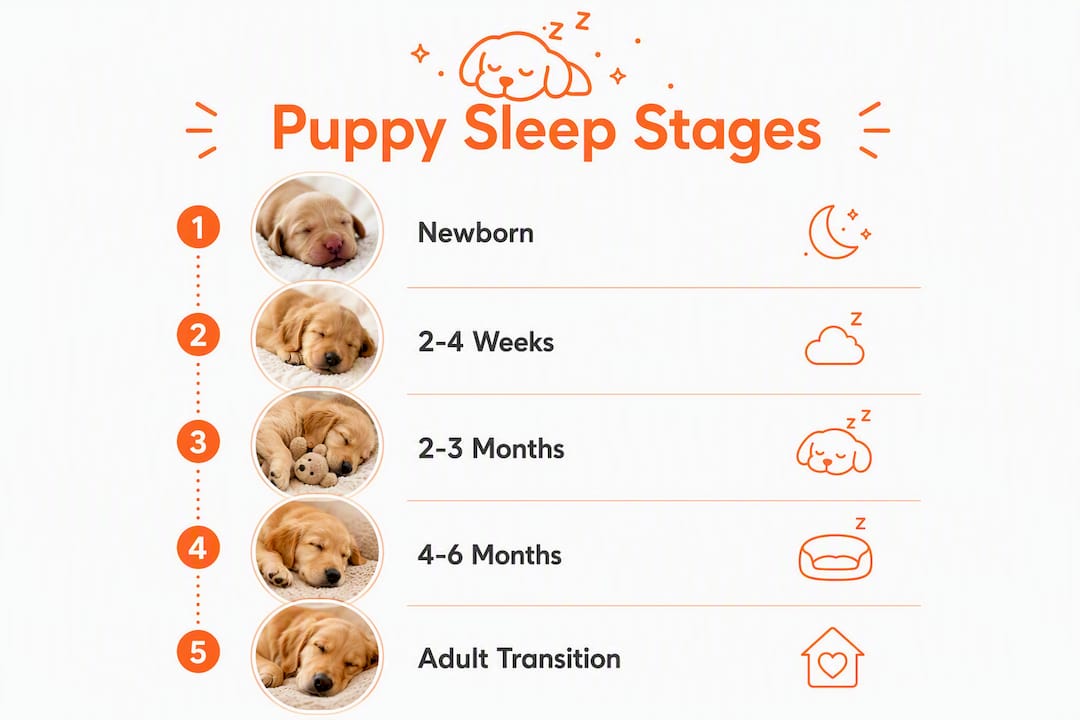
Puppies sleep so much because their brains and bodies are doing an enormous amount of work. According to the American Kennel Club, puppies in the earliest weeks need 18–20 hours of sleep per day, gradually declining toward adult levels as they mature. That decline isn’t linear, and it isn’t always obvious until you’re looking back at it.
The biological reason is straightforward: puppy sleep cycles are shorter than adult cycles, with more frequent REM-like active sleep. Their brains are processing everything they encountered during their brief awake windows, which is why you’ll see twitching, paddling legs, and little yips during naps. All of that is healthy.

| Age | Daily Sleep Needed | Night Stretch (typical) |
|---|---|---|
| 8–12 weeks | 18–20 hours/day | shorter night intervals between trips |
| 3–6 months | 15–18 hours/day | night intervals lengthen gradually |
| 6–12 months | 14–16 hours/day | night intervals lengthen further |
| 13 months+ | 12–14 hours/day | long uninterrupted night sleep |
Most puppies begin sleeping through longer nighttime stretches by around 12–14 weeks, with further increases by 4–6 months. The transition from multiple wake-ups to extended sleep periods usually happens faster than owners expect once a consistent routine is in place.
Most puppies reach a consistent 5–6 hour nighttime stretch by 12–14 weeks with a reliable bedtime routine and enforced daytime naps.
Pro Tip: Don’t drop enforced naps the moment your puppy looks more grown-up around 3–4 months. That’s exactly when owners stop scheduling naps and then wonder why evenings get chaotic again. Keep nap windows on the calendar through 6 months.
Sample daily schedules you can actually copy
These are starting templates. Adjust the clock times to fit your household, but keep the sequence consistent. Puppies don’t read clocks, but they absolutely learn patterns.
8–12 weeks
At this age, awake windows are short, about an hour or less before a nap is needed. A young puppy should nap frequently, with naps lasting from half an hour up to a couple of hours.
- 6:00 AM — Wake, immediate potty outside
- 6:15 AM — Breakfast, short gentle play
- 7:00 AM — Nap (crate or pen, 1–2 hours)
- 9:00 AM — Potty, play/training (15–20 minutes)
- 9:45 AM — Nap (1–2 hours)
- 11:30 AM — Potty, lunch, short play
- 12:30 PM — Nap
- 2:30 PM — Potty, play/socialization
- 3:15 PM — Nap
- 5:00 PM — Potty, dinner, calm play
- 6:00 PM — Nap (30–60 minutes)
- 7:00 PM — Potty, quiet wind-down
- 8:00 PM — Final potty, crate for bed
- 11:00 PM — Potty trip (set an alarm)
- 2:00–3:00 AM — Potty trip if needed
3–4 months
Awake windows lengthen moderately. Plan for a longer nighttime sleep stretch.
- Wake early morning, potty, and breakfast
- Morning play or training
- Morning nap
- Potty and lunch
- Afternoon nap
- Potty and afternoon play/training
- Short late afternoon nap
- Dinner and calm evening
- Final potty before bed
- Possibly one nighttime potty trip
4–6 months and beyond
By this age, most puppies can stay awake for a few hours and have two main naps per day. The goal is a longer nighttime sleep stretch. The middle-of-the-night alarm can be discontinued once your pup consistently sleeps through the night. For a complete daily routine framework, the key is keeping feeding, potty, and nap times at consistent intervals even as the schedule loosens.
Pro Tip: If you’re a night owl or an early riser, shift every clock time by the same amount. A 10 PM bedtime works just as well as an 8 PM one, as long as the sequence stays the same every night.
How do you build a bedtime routine that actually sticks?
Consistency is the whole game here. Puppies learn sleep cues the same way they learn any other behavior: through repetition. A short, predictable sequence every night tells their nervous system “this is the part where we sleep.”
Here’s a template that works for most households:
- Wind down activity — Stop active play 30–45 minutes before bed. Swap fetch for a chew toy or a calm sniff session.
- Last meal check — Make sure the last meal was at least 2 hours before bed to reduce overnight bathroom urgency.
- Pre-bed potty trip — Take your puppy outside (or to their potty pad) for a calm, boring, no-fuss bathroom break.
- Crate setup — Place a worn T-shirt or a piece of your clothing in the crate. Familiar scent is genuinely calming for young puppies.
- Dim the lights — Lower household lighting 20–30 minutes before crating. This isn’t just for ambiance; light suppresses melatonin in dogs too.
- White noise or quiet — A fan, white noise machine, or simply a quiet room helps buffer household sounds that trigger alert barking.
- Cue phrase — Use the same phrase every single night (“bedtime,” “go to sleep,” whatever you like) as you place the puppy in the crate.
- Final potty — One last quick trip right before you close the crate door.
The 7–7–7 rule, which some trainers reference, suggests keeping the same bedtime, wake time, and feeding time for 7 consecutive days before adjusting anything. The principle is sound: seven days of the same routine is usually enough for a puppy to start anticipating the sequence rather than resisting it.
For more on crate training setup and timing, getting the crate right is half the battle.
Pro Tip: Pick one specific phrase and use it every single night. “Bedtime” said in the same calm tone becomes a sleep cue within a week or two. Puppies are pattern machines.
Why enforced naps are the secret weapon against evening chaos
Here’s something that surprises a lot of new owners: that wild, bitey, zoomy behavior at 6 PM is usually not a sign your puppy needs more exercise. It’s almost always a sign they’re overtired.
Overtiredness is a more frequent cause of evening zoomies than under-exercise. When puppies push past their natural sleep window, their stress hormones spike, and they get wired rather than tired. The fix isn’t a longer walk. It’s an earlier nap.
The 1-hour-up / 2-hours-down rule is the most practical framework for this: after roughly 1 hour of being awake, schedule a nap of about 2 hours for young puppies. The critical detail is to enforce naps on the clock, not when the puppy looks tired. By the time a puppy looks tired, they’re often already past the point where settling is easy.
How to actually enforce a nap:
- Place the puppy in their crate or pen with a chew or stuffed Kong
- Keep the space calm and low-stimulation
- Don’t respond to initial protest; most puppies settle within 5–10 minutes
- Resist the urge to let them “just play a little longer”
For more on managing evening hyperactivity and zoomies, the pattern is almost always the same: missed nap, overtired puppy, chaotic evening.
When to call a vet: If your puppy is sleeping far more than the age-typical range, is difficult to rouse, shows labored breathing during sleep, or seems disoriented after waking, those are red flags. Excessive sleepiness, labored breathing, and prolonged disorientation can indicate hypoglycemia, infection, or neurological issues. Don’t wait on those signs.
Where should your puppy sleep?
The short answer: in a crate, in your bedroom, at least for the first few weeks. Here’s why that specific setup works better than the alternatives.
Crate placement near family during early weeks speeds settling and lets you hear real toilet wake-ups without encouraging social play at night. When the crate is in a separate room, you either miss genuine potty signals or you’re doing a full walk through the house at 2 AM, which wakes everyone up more than necessary.
| Setup | Pros | Cons |
|---|---|---|
| Crate beside your bed | Easy to monitor, faster settling, hear real potty cues | Takes up bedroom space |
| Pen in bedroom | More room to move, can include a potty pad | Harder to enforce sleep, puppy may stay awake playing |
| Crate in separate room | Quieter for owners | Miss potty signals, puppy may cry longer |
| Co-sleeping | Bonding, puppy settles faster | Safety risks, harder to transition later, disrupts your sleep |
A few safety non-negotiables:
- Crate should be just large enough for the puppy to stand, turn around, and lie down. Too much space and they’ll use one corner as a bathroom.
- Skip fluffy, loose bedding for young puppies who chew. A flat mat or a crate liner is safer.
- Keep the room between 65–75°F. Puppies can’t regulate their temperature well.
- Never leave a collar on a puppy in a crate unsupervised.
Nighttime potty schedule and when to expect full nights
The bladder-hold rule of thumb: a puppy’s age in months roughly equals the number of hours they can hold their bladder. A 2-month-old can hold for about 2 hours; a 4-month-old for about 4. It’s a guideline, not a guarantee, and stress, excitement, and drinking water right before bed all shorten it.
Realistic nighttime potty expectations:
- In early weeks, puppies may need several nighttime potty trips spaced every few hours.
- As they mature, the number of trips decreases and sleep stretches lengthen.
- By several months old, many puppies can sleep through longer nighttime periods with a late final potty.
The single most effective way to lengthen nighttime sleep is a final potty trip as late as possible before you go to bed, ideally 10–11 PM even if your puppy went to bed at 8 or 9. That extra trip can buy you an additional 1–2 hours of uninterrupted sleep.
For more detail on when puppies sleep through the night and what to expect at each stage, the timeline is more predictable than most owners realize once the routine is consistent.
Vet red flag: Nighttime waking that suddenly increases after a period of improvement, or a puppy who wakes up and seems confused or distressed rather than just needing to go outside, warrants a vet call. Urinary tract infections are common in young puppies and often show up as sudden regression in bladder control.
Common sleep problems and how to fix them fast
Most puppy sleep issues have a straightforward cause. Here’s the quick diagnostic:
- Whining at night: Usually separation anxiety or a genuine potty need. Check the clock. If it’s been 2–3 hours, take them out. If it’s been 20 minutes, wait. Responding immediately to every whine teaches the puppy that whining works. For a full breakdown of why puppies whine at night and 16 specific fixes, that resource covers every scenario.
- Refusing naps: Often means the awake window was too long and the puppy is already overtired. Try shortening the awake window by 15 minutes and enforcing the nap before the puppy shows tired signs.
- Sudden sleep regression: Common during teething (around 3–4 months) and growth spurts. Stick to the routine. Add a frozen chew in the crate to help with teething discomfort.
- Excessive daytime sleep: Normal in very young puppies. If a puppy over 6 months is sleeping more than 16 hours and is hard to wake, that’s worth a vet visit.
- Night wakings after sleeping through: Check for illness first (UTI, digestive upset). Then look at what changed: new environment, schedule shift, a stressful event. Re-anchor the routine for 5–7 days.
Pro Tip: Travel and schedule disruptions are the most common triggers for sleep regression. When you’re away from home, bring the puppy’s crate, their usual bedding, and stick to the same bedtime sequence as closely as possible. Familiar smells and a consistent routine do more than any new calming product.
For tips on getting a puppy to sleep more and stay calmer, the most effective strategies are almost always about the routine, not the puppy.
Your daily puppy sleep checklist
Run through this each day to keep sleep on track.
Morning:
- [ ] First potty immediately after waking
- [ ] Breakfast within 30 minutes of waking
- [ ] Note wake time to calculate first nap window (45–60 min for under 12 weeks, 90 min for 3–4 months)
Daytime:
- [ ] Enforce naps on the clock, not on visible tired signs
- [ ] Keep nap space calm and low-stimulation
- [ ] Exercise before naps, not right before bed
- [ ] Last meal at least 2 hours before bedtime
Evening:
- [ ] Wind down active play 30–45 minutes before bed
- [ ] Dim lights and reduce household noise
- [ ] Pre-bed potty trip
- [ ] Crate setup check (bedding, temperature, no loose collar)
- [ ] Use your consistent sleep cue phrase
- [ ] Final potty as late as possible before you sleep
If-this-then-that:
- Traveling or new environment: Bring the crate and familiar bedding. Keep the same bedtime sequence. Expect 2–3 nights of adjustment.
- Growth spurt or teething week: Add a frozen chew to the crate. Expect slightly more sleep and possibly one extra nighttime waking. Stay consistent.
Key Takeaways
A consistent puppy sleep schedule, built around enforced naps and a predictable bedtime routine, is the fastest path to full nights for both of you.
| Point | Details |
|---|---|
| Sleep needs by age | Puppies sleep a very high amount of hours daily in the first 6 months; this gradually declines toward adult sleep patterns by over a year old. |
| Enforce naps on the clock | Schedule naps after 45–60 min awake for young puppies; don’t wait for tired signs. |
| Final potty = longer nights | A late-night potty trip (10–11 PM) is the single most effective way to extend nighttime sleep. |
| Vet red flags | Excessive sleepiness, labored breathing, or disorientation after waking need prompt veterinary attention. |
| Rebarkable’s 52-week program | Stepwise weekly guidance covers sleep routines, crate training, and potty training in one structured plan. |
What actually works in real homes
The hardest part of a puppy sleep schedule isn’t knowing the rules. It’s holding the line at 11 PM when you’re exhausted and your puppy is staring at you with those eyes.
Here’s what I’d tell any new owner: the routine doesn’t have to be perfect. It has to be consistent. A slightly imperfect schedule that happens at the same time every day beats a textbook-perfect schedule that shifts by two hours depending on who’s home. Puppies are pattern learners. Give them a pattern.
The other thing that trips people up is expecting linear progress. Some nights will be worse than the week before, especially during teething or after a change in environment. That’s not failure. That’s a puppy being a puppy. The answer is always the same: go back to basics, tighten the routine, and give it a few days.
If you’re juggling a busy household, stagger responsibilities. One person handles the 11 PM potty, another takes the early morning. Split the load so no one person is running on fumes by week three. Small, consistent steps from an imperfect schedule will always outperform a perfect plan that falls apart by Thursday.
Rebarkable makes the routine easier to stick with
Sleep training doesn’t happen in isolation. It connects directly to crate training, potty training, and the broader behavioral patterns your puppy is building right now. That’s exactly what Rebarkable’s 52-week program is designed for: weekly, science-backed guidance delivered to your inbox so you’re never guessing what to work on next.

Each week covers a specific stage of puppy development, including the sleep and routine milestones that matter most in the first six months. Whether you’re working through potty training basics or getting your crate setup dialed in, the program walks you through it step by step without the overwhelm of trying to figure it all out at once. New owners who want structured, week-by-week support can start the program at Rebarkable and get the guidance they need right when they need it.
Useful sources and further reading
The following sources informed this guide and are worth bookmarking for deeper reading:
- How Much Do Puppies Sleep? — American Kennel Club — AKC’s overview of age-based sleep needs and what’s normal for young dogs.
- Understanding Your Dog’s Sleeping Patterns — Zoetis Pet Care — Covers sleep architecture differences between puppies and adult dogs and why routine matters.
- How Much Sleep Does a Puppy Actually Need at Each Age? — Pet Wise Tips — Evidence-backed look at overtiredness as a cause of evening hyperactivity.
- Puppy Survival Guide: The Importance of Sleep — Utah Humane Society — Accessible overview of why sleep is critical to puppy development and health.
- Finding the Right Veterinarian — Rebarkable — Helpful resource if you need to find a vet for sleep-related medical concerns.
For any sleep concern that looks medical (excessive sleepiness, labored breathing, disorientation), consult your veterinarian directly. This article is general guidance, not veterinary advice.
Recommended
- What Time Should A Puppy Go To Bed? – Rebarkable
- How Much Sleep Do Puppies Need? An In-depth Guide – Rebarkable
- When Do Puppies Sleep Through The Night? – Rebarkable
- 11 Ways To Get Your Puppy To Sleep More And Stop Being Cranky – Rebarkable






0 Comments