Yes, you should cover your dog’s crate — if your dog likes it darker and warmer, or you want to block off some sound, or you’ve got a nosey puppy who can’t stop watching the world go by. A covered crate can genuinely help many dogs settle faster, sleep longer, and feel more secure. The catch? It only works when you do it safely and as part of real crate training, not instead of it.
The non-negotiables up front:
- Never fully seal a wire crate. Keep the door side open and at least one full panel unobstructed for airflow.
- Use breathable fabric only. Lightweight cotton, bamboo, or mesh-panel covers — not heavy wool or non-breathable plastic.
- Skip the cover in hot rooms. If the ambient temperature is warm without air conditioning, the cover can trap heat and create a real risk.
- A cover is an enhancement, not a fix. If your dog hasn’t built a positive association with the crate yet, draping a blanket over it won’t solve the anxiety.
Table of Contents
- Does covering a dog crate actually help?
- Which dogs benefit from a covered crate?
- What are the safety rules you must follow?
- How do you cover a crate safely, step by step?
- How do you introduce a cover as part of crate training?
- How can you tell if the cover is making things worse?
- How do you choose the right cover for your dog’s crate?
- Keeping your crate cover clean and safe over time
- What do trainers and vets actually say about covering crates?
- Key Takeaways
- The cover is the easy part — the training is what actually matters
- Rebarkable makes crate training less guesswork
- Sources and further reading
Does covering a dog crate actually help?
It does, for the right dogs. A covered crate creates a den-like environment that reduces visual stimuli and ambient light, which can promote deeper, longer sleep. Think about it from your dog’s perspective: a wire crate in the middle of a living room is basically a glass house. Every shadow, every person walking past, every flicker of the TV is a potential distraction. A cover changes that.
The specific benefits owners notice most:
- Reduced visual stimulation. Dogs that react to movement, other pets, or household activity settle more quickly when they can’t see the trigger.
- Better sleep, especially in the morning. Early light through windows is a common culprit for dogs waking too early. A cover blocks that cue.
- Slight sound dampening. It won’t soundproof the crate, but it takes the edge off ambient noise, which helps in busy households or during travel.
- A consistent bedtime cue. When you cover the crate at the same time each night, dogs learn that “cover on” means rest time. That predictability is genuinely useful for puppies building a routine.
Which dogs benefit from a covered crate?
Not every dog needs one, and that’s fine. Here’s a quick way to think about it.
Dogs that usually do well with a cover:
- Anxious or easily stressed dogs who struggle to settle in open spaces
- Highly reactive or excitable dogs that get wound up by visual stimulation
- Puppies adjusting to a new home who need a quieter, cozier space
- Dogs that naturally gravitate toward sleeping under furniture or in corners (they’re already telling you they like it darker)
Dogs that usually don’t need one, or shouldn’t use one:
- Dogs that panic in enclosed or confined spaces — covering can intensify that feeling
- Dogs showing stress responses when the cover goes on (more on those signs below)
- Active chewers who will pull fabric through the bars and potentially ingest it
A note on physiology: brachycephalic breeds — Bulldogs, Pugs, French Bulldogs, Boston Terriers — and senior dogs with respiratory issues are more vulnerable to heat stress. If your dog is flat-faced or older, be extra cautious about temperature and airflow before covering.
Pro Tip: If your dog naturally seeks out the space under your bed or behind the couch to nap, that’s a strong signal they’ll appreciate a covered crate. Dogs that prefer open, airy spots to sleep may not.
What are the safety rules you must follow?
This is the section to read carefully. A cover done wrong can genuinely harm your dog.
Airflow is non-negotiable. Always leave the door side fully open and keep at least one large panel unobstructed. Avoid heavy wool blankets or non-breathable plastic — in warm environments, those materials trap heat and reduce air exchange fast.
Temperature threshold: Experts warn that even breathable covers can raise the interior temperature of a crate. Avoid covering in non-air-conditioned rooms where the ambient temperature exceeds roughly 75–78°F (24–26°C). Brachycephalic breeds hit heat stress at lower thresholds than other dogs.
Material and toxin risks:
- Choose lightweight cotton, bamboo fabric, or mesh-panel covers
- Avoid fabrics with loose fringe, strings, or decorative ties that can be chewed off and swallowed
- Check that dyes are non-toxic — this matters especially for puppies who mouth everything
Chewer and entanglement risks: If your dog is still in an active chewing phase, a loose blanket draped over the crate is an invitation. Thin breathable fabrics like cotton or bamboo are safer for DIY covers than heavy blankets, and they should be clipped or tucked so the dog can’t pull them through the bars.
Fire and heater safety: Keep covers away from space heaters, fireplaces, and any open flame. This sounds obvious, but a blanket draped loosely over a crate near a baseboard heater is a real hazard.
Pro Tip: Before you leave a covered crate unattended, put your hand inside and hold it there for 30 seconds. If it feels noticeably warmer than the room, remove the cover or switch to a lighter material.
How do you cover a crate safely, step by step?
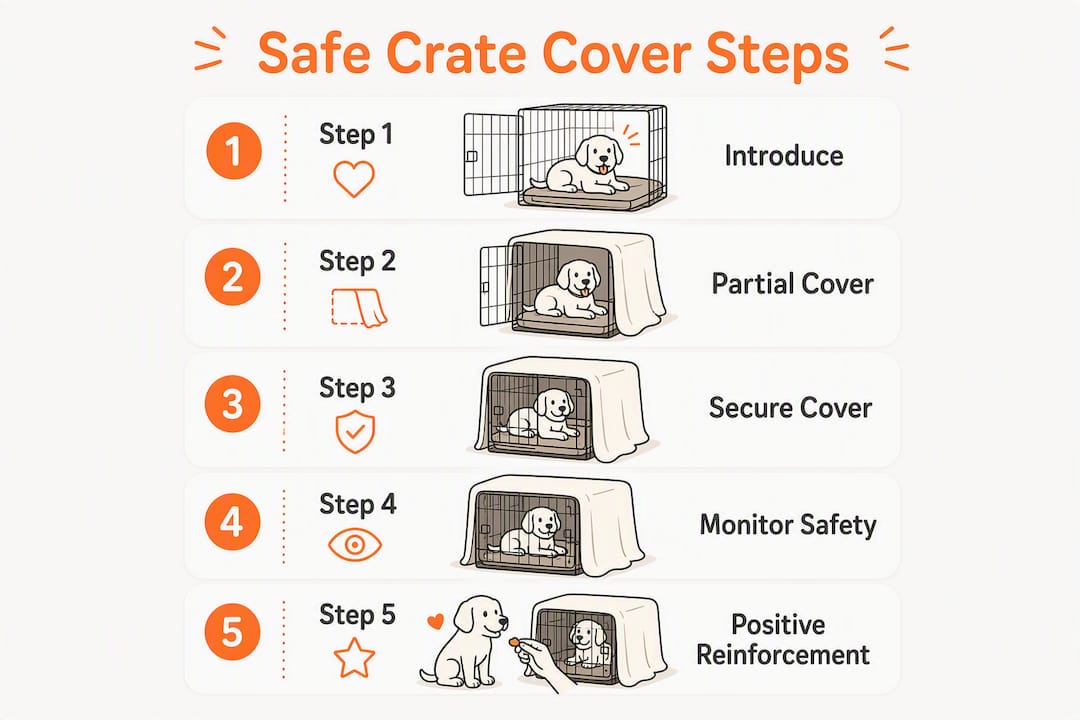
The goal is to end up with the top, back, and both side panels covered, with the door and front fully open. Getting there gradually is what makes the difference between a dog that loves their covered crate and one that panics.
- Day 1–2: Top only. Drape or fit the cover over just the top panel. Let your dog go in and out freely. Watch for any hesitation or stress.
- Day 3–4: Add the back panel. If your dog is relaxed with the top covered, add the back. Keep observing.
- Day 5–6: Add one side panel. Choose the side that faces away from the main room activity first.
- Day 7+: Add the second side panel. By now, most dogs are comfortable with three sides covered and the front open.
This stepwise introduction over several days with rewards is the approach trainers consistently recommend — rushing it is where things go sideways.
Securing the cover: A fitted commercial cover with built-in fasteners is the cleanest option. If you’re using a blanket, use binder clips or pet-gear clips to attach it to the crate bars so it can’t be pulled inside. Avoid knotting fabric around bars — knots loosen and can snag a dog.
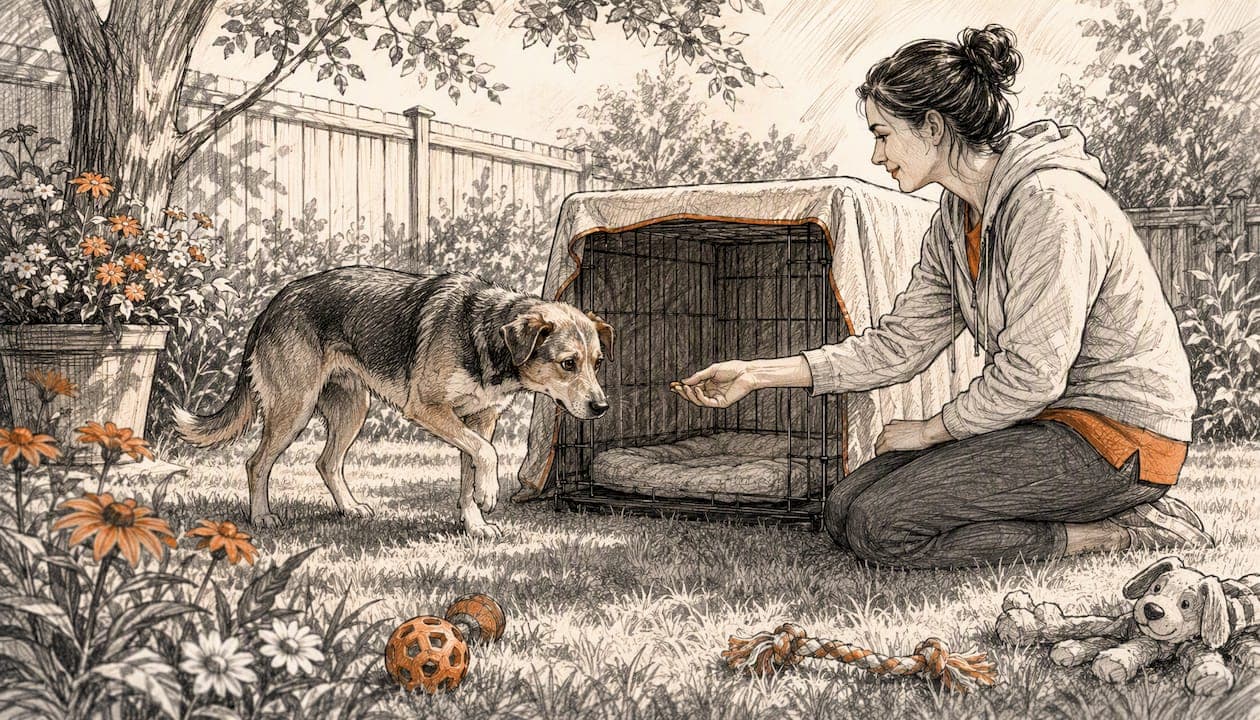
Crate placement matters too. Position the crate away from direct sunlight, drafts, and heat sources. Orient it so the open front faces the room or faces toward where you sleep — your dog should feel connected to you, not isolated.
Pro Tip: The partial coverage approach — top plus three sides, door open — is the trainer-recommended sweet spot. It gives the den feeling without cutting off airflow or making the dog feel trapped.
How do you introduce a cover as part of crate training?
The cover comes after the crate, not before. Your dog needs to already feel comfortable going into the crate voluntarily before you add a cover. If they’re still reluctant to enter, work on that first using your crate training resources before adding any covering.
Once the crate is a happy place, here’s how to layer in the cover:
- Don’t rely on a cover to fix separation anxiety — If your dog is showing genuine distress when left alone, a cover won’t solve it. That’s a training issue that needs proper support, and possibly a vet conversation.
How can you tell if the cover is making things worse?
Watch your dog’s body language closely, especially in the first few covered sessions. Veterinary and training resources advise removing the cover immediately if you see stress responses.
Red flags to watch for:
- Pacing or circling inside the crate
- Excessive panting or drooling (beyond normal post-exercise levels)
- Frantic pawing at the door or sides
- Repeated escape attempts
- Vocalizing more than usual — whining, barking, or crying
- Sudden aggression when you approach the covered crate
If you see any of these, remove the cover immediately. Revert to top-only coverage or no cover at all, and reintroduce more slowly — or stop entirely if the dog consistently shows stress.
Alternatives when covering doesn’t work:
- A larger exercise pen gives more space and less of a “confined” feeling
- Enclosed den-style beds (like a covered bolster bed) can provide the same cozy effect without the crate walls
- Pheromone diffusers like Adaptil can help reduce general anxiety
- More physical exercise and mental enrichment before crate time often reduces the need for a cover altogether
- If distress is significant, consult a professional trainer or your vet — and check out Rebarkable’s guidance on how long to let a puppy cry in their crate for context on what’s normal versus what needs attention
A quick note on “crate syndrome”: you’ll sometimes see this phrase used to describe dogs that are stressed by crates. In most cases, it’s a training and overuse issue, not a problem with the crate or cover itself. Dogs that are crated too long, too often, or without proper positive association will show stress — and a cover won’t fix that. The solution is better training and appropriate exercise, not removing the crate.
How do you choose the right cover for your dog’s crate?
There are two real options: purpose-built commercial covers or DIY with a blanket. Both can work; they just have different trade-offs.
Purpose-built covers (like those from Pet Dreams or Top Paw) are designed to fit specific crate sizes, often include mesh ventilation panels and secure fastenings, and are generally machine-washable. Commercial crate covers are designed to fit and attach securely, which lowers the entanglement and chewing risk compared with a loose blanket. They cost more, but for active chewers or dogs that like to rearrange their bedding, the fit and security are worth it.
DIY blanket covers are low-cost and flexible. The risks are loose fabric being pulled through bars and heavier materials trapping heat. If you go this route:
- Choose lightweight cotton or bamboo fabric
- Clip it securely to the bars on all covered sides
- Avoid anything with fringe, strings, or loose decorative elements
- Check the fit regularly — clips loosen over time
What to look for in any cover:
- Breathable fabric (mesh panels are a bonus)
- Machine-washable or easy to spot-clean
- Non-toxic dyes and minimal loose parts
- Reinforced corners if your dog is a chewer
- Secure fasteners that won’t loosen with normal movement
Sizing: Measure your crate’s length, width, and height before buying. Account for door orientation — double-door crates need a cover designed for that configuration, or you’ll end up blocking a door you need open.
Keeping your crate cover clean and safe over time
A cover that’s dirty, fraying, or loosening is a safety hazard, not just an eyesore. A few habits keep things in good shape:
- Replace when damaged — A cover with chew damage, exposed stitching, or frayed edges should come out of rotation. The cost of a replacement is nothing compared to a vet visit.
What do trainers and vets actually say about covering crates?
The consensus is pretty clear: a partial cover can help many dogs, but it’s not a substitute for proper crate training or adequate exercise. Both trainers and veterinary sources agree on the core safety rules — airflow, temperature limits, and watching for distress signals.
“If a dog shows signs of distress (pacing, excessive drooling, panting, aggression) when covered, the cover should be removed and alternative management strategies pursued.” — Cornell University College of Veterinary Medicine
The temperature guidance from Orvis is worth repeating: even breathable covers can raise the interior temperature of a crate in a non-climate-controlled room. A threshold exists above which covering becomes risky for most dogs, and lower for brachycephalic breeds.
Covering should never be used as punishment and must be paired with positive reinforcement — that’s not just good training advice, it’s the difference between a dog that loves their crate and one that dreads it.
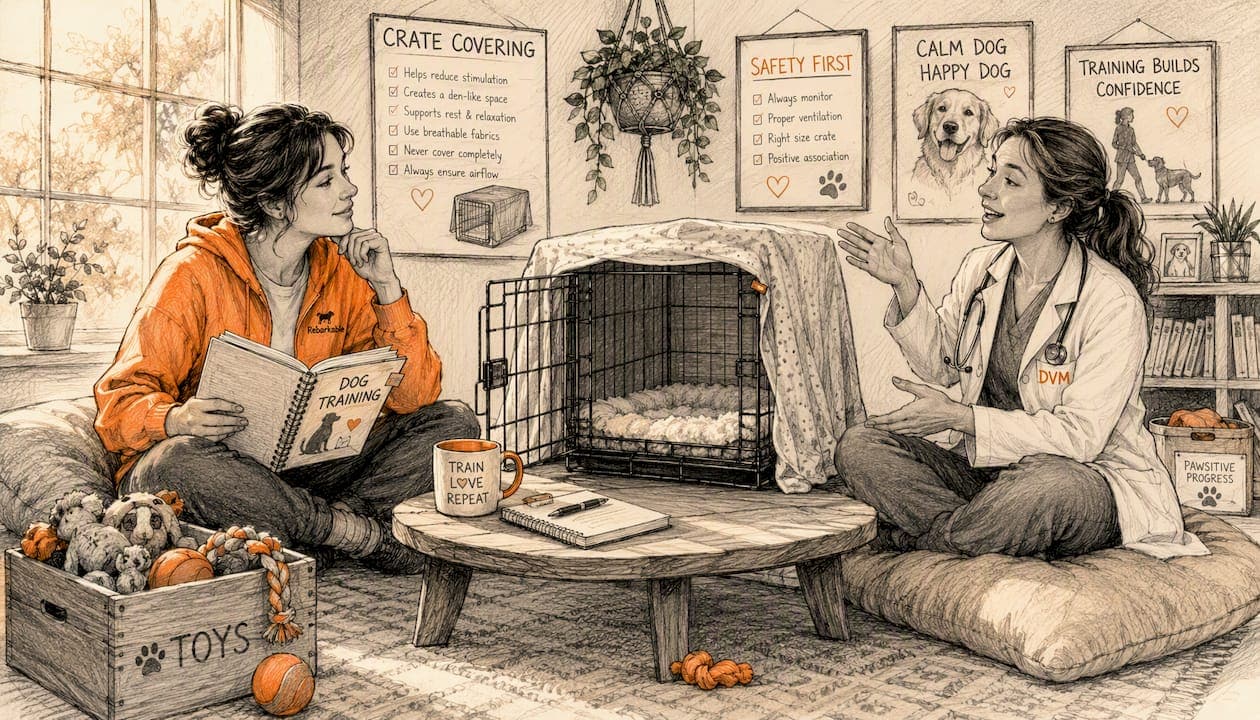
Rebarkable’s crate training information center covers the full picture: how to build a positive crate association from day one, how to use management tools like covers safely, and how to troubleshoot when things aren’t going smoothly. A cover is one small piece of a much bigger training puzzle.
Key Takeaways
Covering a dog’s crate works best as part of a positive crate-training routine, using breathable materials, partial coverage, and careful attention to temperature and your dog’s body language.
| Point | Details |
|---|---|
| Partial coverage is safest | Cover the top and three sides; always leave the door and front panel open for airflow and social contact. |
| Temperature threshold matters | Avoid covering in rooms above roughly 75–78°F (24–26°C) without AC, especially for brachycephalic breeds. |
| Introduce gradually | Start with the top only, then add one panel at a time over 7+ days, pairing each step with treats and calm praise. |
| Watch for stress signals | Pacing, panting, drooling, or escape attempts mean the cover should come off immediately. |
| Rebarkable’s crate training center | Rebarkable’s structured resources guide you through building a safe, positive crate association before and after adding a cover. |
The cover is the easy part — the training is what actually matters
Here’s my honest take: a crate cover is one of those tools that gets a lot of credit for doing the work that good training actually does. When a cover helps a dog settle, it’s usually because the dog already had a solid, positive relationship with their crate, and the cover just added a little extra comfort. The cover didn’t fix anything — the training did.
That said, I genuinely think partial covers are underused. A lot of owners either go all-in (fully draping a blanket over everything and wondering why their dog is stressed) or skip covers entirely because they seem fussy. The middle ground — top plus three sides, breathable fabric, door open, introduced gradually — is where the real benefit lives. It’s a small change that can make a meaningful difference for the right dog.
My advice? Follow your dog’s lead. If they walk into a covered crate and immediately lie down, you’ve got your answer. If they hesitate, pace, or try to back out, slow down and work on the crate association first. No cover in the world is a shortcut around that.
Rebarkable makes crate training less guesswork
Covering a crate is one piece of a much bigger picture, and that picture is a lot clearer when you have a structured plan to follow. Rebarkable’s 52-week puppy training program walks you through crate training step by step, including how to build a positive association, when to introduce management tools like covers, and how to troubleshoot the moments that feel impossible at 2 AM.

The program lands in your inbox every week, which means you get the right guidance at the right stage of your puppy’s development — not a wall of information you have to sort through yourself. From potty training basics to behavioral changes and beyond, it’s built for real dog owners who want practical, science-backed help without the cost of weekly in-person sessions. Ready to make crate training click? Start with Rebarkable’s crate training center and see what a structured approach actually looks like.
Sources and further reading
- Cornell University College of Veterinary Medicine — Dog Crates: When to Use Them and How to Pick One — Primary veterinary source for behavioral red flags, distress signals, and when to remove a cover.
- Orvis News — Should You Cover Your Dog’s Crate? — Covers den-like benefits, temperature thresholds, breathable material guidance, and the stepwise introduction method.
- Rebarkable Crate Training Information Center — Rebarkable’s full hub for crate training best practices, including how to use management tools like covers as part of a structured training plan.
Recommended
- Decompression Activities From A Dog Trainer – Rebarkable
- The Rebarkable Crate Training Information Center! – Rebarkable
- Reactivity: How To Give Your Anxious Dog Confidence with 7 Clear Steps Of Training – Rebarkable
- Fireworks: How To Prepare Your Puppy For A Fearless July 4th! – With A Real-Life Example – Rebarkable





0 Comments