
For most new puppy owners, the best dog crate is a MidWest Homes for Pets wire crate with a divider panel. It grows with your puppy, ventilates well, cleans up fast, and pairs directly with house-training. That said, your household, travel plans, and pup’s temperament all shape the right call. Here’s the shortlist:
- Best overall: MidWest LifeStages wire crate (one or two doors) with divider
- Best for airline travel: Petmate Ultra Vari hard-sided kennel (IATA-compatible)
- Best for car/soft travel: PetSafe Happy Ride soft-sided travel crate
- Best heavy-duty: GUNNER Kennels impact-resistant crate
- Best small-breed/budget: EliteField or AmazonBasics soft-sided pop-up crate
| Crate type | Best for | Material | Divider included | Airline compliant | Ease of cleaning | Portability | Price range |
|---|---|---|---|---|---|---|---|
| Wire (MidWest) | Home, house-training | Coated wire | Yes | No | Easy (slide-out tray) | Foldable | $40–$100 |
| Hard plastic (Petmate Ultra Vari) | Airline/car travel | Recycled plastic | No | Yes (verify airline) | Moderate | Moderate | $50–$130 |
| Soft-sided (PetSafe Happy Ride) | Short car trips, calm small breeds | Fabric/mesh | No | In-cabin only | Easy | Very portable | $30–$80 |
| Heavy-duty (GUNNER) | Escape artists, impact protection | Aluminum/reinforced | No | No | Moderate | Heavy | $400–$600 |
| Soft pop-up (EliteField/AmazonBasics) | Small breeds, budget travel | Fabric/mesh | No | In-cabin only | Easy | Very portable | $25–$60 |
Table of Contents
- How do you choose the right puppy crate size?
- The best puppy crates in 2026: detailed picks
- How to introduce a crate so your puppy actually likes it
- What you need to know before traveling with your puppy’s crate
- Keeping your crate clean, safe, and working long-term
- Key Takeaways
- The crate is just the beginning
- Rebarkable’s weekly training pairs perfectly with crate work
How do you choose the right puppy crate size?
Start with measurements, not guesswork. Measure your puppy from nose to tail base (length) and from the floor to the top of their head when standing (height). The crate interior should be 3–4 inches longer and taller than those numbers. That gives them room to stand, turn, and lie down without so much extra space that they treat one corner as a bathroom.
Because puppies grow fast, buy the adult-sized crate from day one using your breed’s expected adult dimensions (or the parent dogs as a reference). Then use a divider panel to section off the right amount of space now, adjusting it every few weeks as your pup fills out. This approach is far more cost-effective than buying a small crate and replacing it in three months.
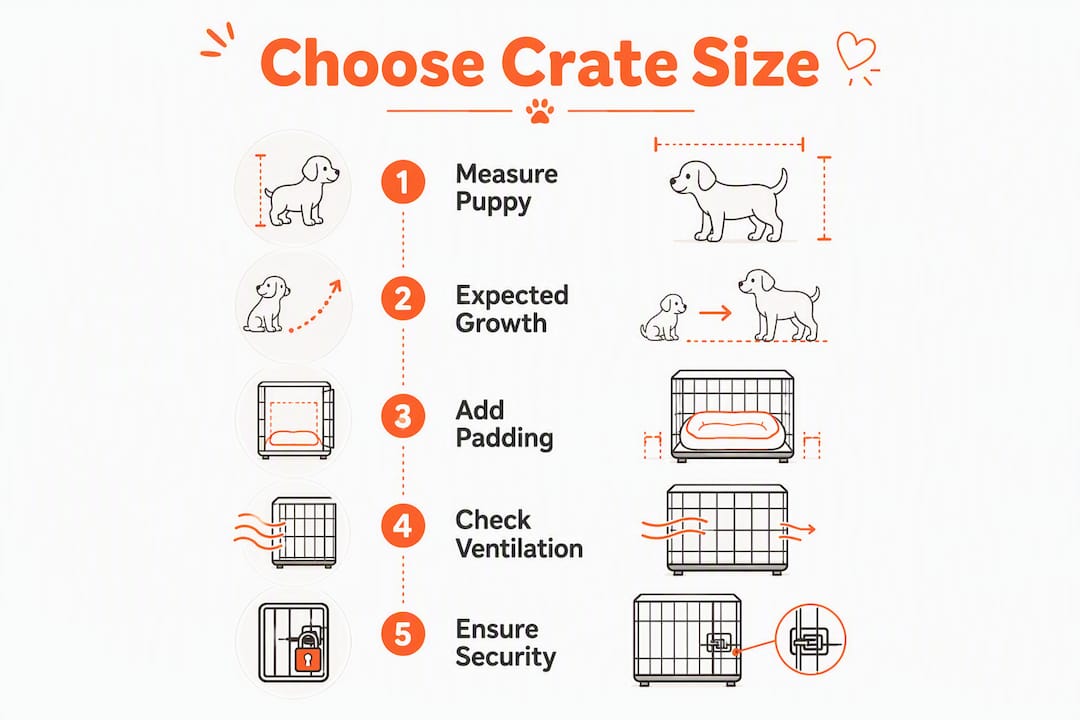
Pro Tip: Factor in your crate pad’s thickness before you buy. A 2–3 inch orthopedic pad reduces effective headroom, so if your pup needs 24 inches of clearance, you may need a 27-inch-tall crate to account for the bedding.
Matching material to your situation
According to sizing guidance from PetMD, crate size should always be based on your dog’s actual measurements, not their weight. Breed charts are a useful starting point, but individual variation is real.
- Wire crates suit most home setups: good airflow, easy to fold and store, and the slide-out tray makes accident cleanup straightforward.
- Hard plastic/travel crates work well for households that fly or drive frequently; they feel more den-like and travel securely.
- Soft-sided crates are fine for calm, small-breed puppies in low-stress environments, but they’re not built for escape artists or unsupervised use.
- Heavy-duty/impact crates are for dogs that have already demonstrated they can break out of standard wire. They’re a containment upgrade, not a behavioral fix.
Safety checklist before you buy: ventilation on at least three sides, secure latches your pup can’t nose open, no sharp edges or exposed wire tips, a tray that fits flush, and enough headroom after accounting for bedding.
The best puppy crates in 2026: detailed picks
MidWest LifeStages wire crate (our default pick)
This is the one Rebarkable recommends for the majority of new puppy owners. Wire crates with dividers consistently top trainer roundups because they balance cost, ventilation, and adjustability better than any other type. The MidWest comes in single- and double-door configurations; the two-door version gives you more placement flexibility in your home. The slide-out plastic tray handles accidents without drama, and the folding panel means you can move it between rooms.
- Divider included: Yes
- Airline compliant: No
- Portability: Folds flat
- Price range: $40–$100
- Pros: Affordable, adjustable, easy to clean, widely available at Chewy, Amazon, and Petco
- Cons: Not suitable for travel, bulkier than soft options
Petmate Ultra Vari hard-sided kennel
Petmate’s Ultra Vari is built from 90% pre-consumer recycled plastic and is designed specifically for travel. It features tie-down holes, an interior moat that collects liquids, and hardware that assembles without tools. Most major US airlines accept IATA-style hard plastic kennels for checked or cargo travel, but always verify your specific carrier’s rules before booking.
- Divider included: No
- Airline compliant: Yes (verify airline policy)
- Portability: Moderate (two-piece assembly)
- Price range: $50–$130
- Pros: Airline-ready, durable, den-like feel
- Cons: Heavier than soft carriers, no divider for growing puppies
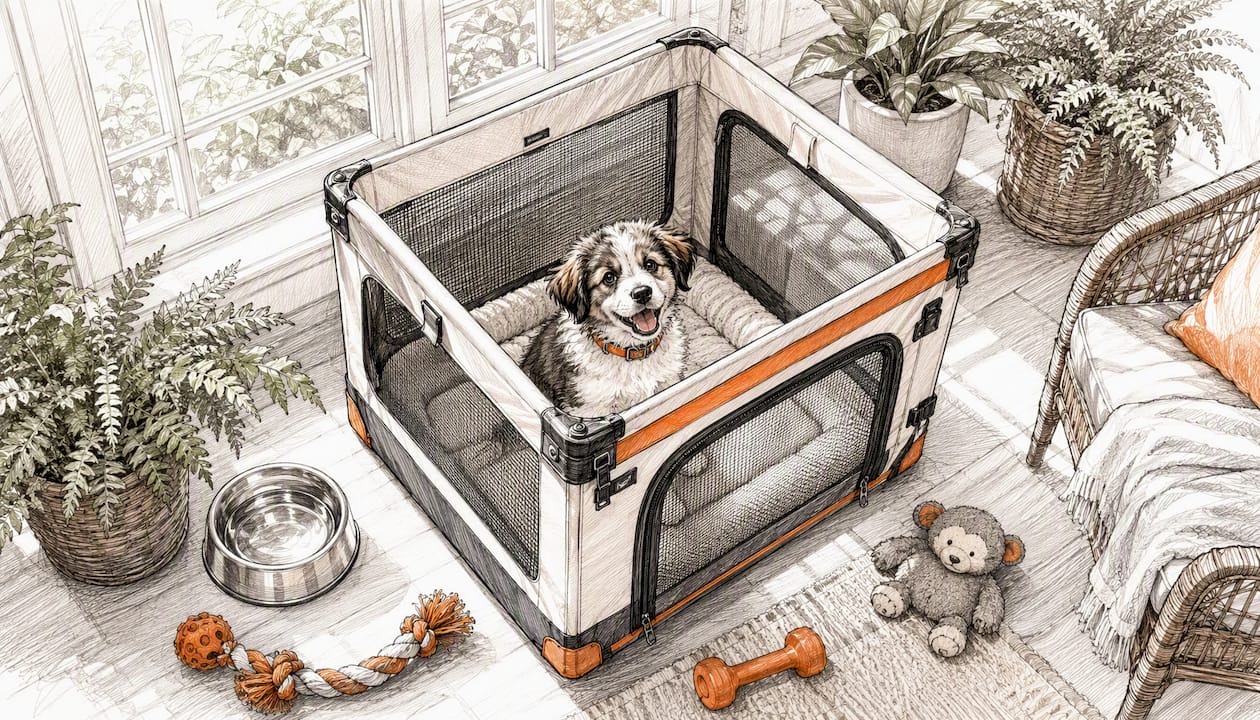
PetSafe Happy Ride soft-sided travel crate
A good fit for calm, small-breed puppies on short car trips or in-cabin flights. Soft-sided carriers provide comfort and visibility but lack the structural protection of hard plastic. Not appropriate for cargo travel or any puppy that pushes against walls.
- Divider included: No
- Airline compliant: In-cabin only (verify dimensions with airline)
- Portability: Very portable, lightweight
- Price range: $30–$80
- Pros: Lightweight, easy to carry, comfortable for calm pups
- Cons: Not escape-proof, not cargo-safe
GUNNER Kennels impact-resistant crate
GUNNER builds heavy-duty crates for dogs that have already escaped standard wire. The reinforced construction and secure latches make breakouts far less likely. Worth noting: impact crates address physical containment, not behavioral distress. If your puppy is panicking, a heavier crate is not the answer. Slow down your training first.
- Divider included: No
- Airline compliant: No
- Portability: Heavy
- Price range: $400–$600
- Pros: Extremely durable, secure latches, long lifespan
- Cons: Expensive, heavy, overkill for most puppies
EliteField / AmazonBasics soft-sided pop-up crates
These budget-friendly options work well for small breeds in low-demand situations: a calm puppy at a friend’s house, a short vet visit, or a travel backup. They’re not built for unsupervised use with a chewer or an escape-prone pup. If your puppy is still figuring out the crate, stick with the wire option at home and use these only when you’re present.
- Divider included: No
- Price range: $25–$60
- Pros: Inexpensive, very portable, easy to store
- Cons: Not durable for chewers, limited structural protection
Where to buy: All five options are available on Amazon, Chewy, and Petco. Chewy and Petco both offer return windows (check current policies at checkout); Amazon’s return policy varies by seller. Buying from a retailer with a clear return policy matters if your pup’s measurements change before the crate arrives.
Pro Tip: Reviewer-tested roundups consistently highlight safety, durability, and ease of cleaning as the three factors that matter most after the first month. Prioritize those over aesthetics when you’re buying for a puppy.
How to introduce a crate so your puppy actually likes it
The crate works when it’s a den, not a detention cell. A puppy that associates the crate with good things will choose to hang out in it. One that’s been locked in as punishment will fight it every time.
Here’s a first-two-weeks sequence that works:
- Place the crate in a busy room with the door open. Let your puppy sniff and wander in on their own.
- Toss high-value treats inside without closing the door. Repeat several times a day.
- Feed meals inside the crate, still with the door open.
- Once your puppy eats comfortably inside, close the door for the duration of the meal, then open it immediately after.
- Gradually extend closed-door time in small increments, always ending before your puppy gets anxious.
- Add a crate cover on three sides to create a den-like feel. Many puppies settle faster in a darker, quieter space.
“Introduce the crate through positive association. Size it to your dog’s adult dimensions and use a divider during puppy months so the space feels snug and den-like without being too large for house-training to work.” — Marcus Bell, CPDT-KA
For crying at night, graduated approaches work better than cold turkey. Rebarkable’s guide on how long to let a puppy cry in their crate walks through the timeline and when to step in.
If your puppy panics: stop, reduce session length, and go back to basics. Panting, drooling, frantic scratching, or self-injury are signs the training has moved too fast. Slow down. Some puppies need weeks of counterconditioning before they’re comfortable with the door closed. A few dogs genuinely don’t adapt to crates, and that’s okay. Crates are a tool, not a requirement. If your puppy is showing signs of separation anxiety, consult a trainer or vet before continuing.
Daily crate time by age (rough guide):
- Very young puppies should be crated for short periods during the day
- As puppies grow, crate time can gradually increase
- Overnight stretches lengthen once puppies sleep through the night
What you need to know before traveling with your puppy’s crate
IATA-style hard plastic kennels are the standard for air travel. Most US airlines require a kennel that meets IATA Container Requirement 1 (CR1) specifications for checked or cargo travel. Always call your airline directly before flying, because policies vary and change.
Airline checklist:
- Hard-sided construction (no soft carriers for cargo)
- Ventilation on at least three sides
- Tie-down holes for securing in cargo
- Removable tray for cleaning
- Enough interior height for your dog to stand without touching the top
- Absorbent bedding and a water dish attached to the door
- Health certificate from your vet (most airlines require one issued within 10 days of travel)
Car travel checklist:
- Crate secured against movement (use a seatbelt adapter or cargo anchor)
- Adequate ventilation
- No loose items inside the crate during transit
- Puppy acclimated to the crate before a long trip
Soft-sided carriers are generally acceptable for in-cabin travel on US airlines for small dogs, provided the carrier fits under the seat. The Petmate Ultra Vari is a solid choice for checked travel. The PetSafe Happy Ride works for calm small breeds on short in-cabin trips. Neither is interchangeable with the other for cargo use.
Keeping your crate clean, safe, and working long-term
Pull the tray out and wipe it down after any accident. For a deeper clean, a diluted white vinegar solution or a pet-safe enzymatic cleaner handles odors without leaving residue that might put your puppy off the space. Wash crate pads weekly, or immediately after accidents.
Monthly safety checks:
- Test all latches; replace any that stick or feel loose
- Check wire for rust spots or bent sections
- Inspect plastic for cracks, especially around the door hinges
- Look for chew damage on corners and tray edges
- Confirm the tray still fits flush (warped trays create gaps)
If your puppy is chewing through the crate or escaping repeatedly, the first question is whether the training needs adjustment, not whether you need a heavier crate. Escape behavior is often a sign of under-stimulation, anxiety, or a crate introduction that moved too fast. Upgrade to heavy-duty construction only after ruling out those causes.
Crates are not for punishment or timeouts. If your puppy is panicking, distressed, or showing signs of genuine fear, pause crate use and get guidance from a trainer or vet. Not every dog is a good candidate for crate training, and forcing it can make things worse.
Key Takeaways
The wire crate with a divider is the right starting point for most new puppy owners because it adjusts as your puppy grows, supports house-training, and costs a fraction of premium alternatives.
| Point | Details |
|---|---|
| Default crate pick | MidWest LifeStages wire crate with divider fits most puppies and homes. |
| Sizing rule | Measure nose-to-tail and floor-to-head; add 3–4 inches to each for correct interior size. |
| Divider use | Buy adult-sized and use the divider now; adjust it frequently as your puppy grows. |
| Travel crates | Use an IATA-compatible hard plastic kennel for air travel; verify your airline’s policy first. |
| Rebarkable training | Rebarkable’s 52-week program pairs weekly crate and house-training guidance with your puppy’s growth milestones. |
The crate is just the beginning
Here’s my honest take: the crate you buy matters far less than how you introduce it. Owners who spend $400 on an impact crate and skip the positive introduction often end up with a panicking puppy. Owners who spend $50 on a wire crate and follow a gradual, treat-based introduction usually have a puppy that walks in voluntarily within two weeks.
The wire crate with a divider is Rebarkable’s default recommendation not because it’s the flashiest option, but because it pairs best with the progressive house-training work that happens in the first 52 weeks. The divider keeps the space appropriately sized for potty training. The open wire sides let you monitor your puppy’s comfort level. And the price point means you’re not stressed about the investment while you’re still figuring out what your puppy actually needs.
If your puppy isn’t adapting, slow down. Check Rebarkable’s Crate Training Information Center for a full breakdown of introduction stages, cry duration guidance, and what to do when things stall. The crate is a tool for building confidence and routine, and it works best when it’s introduced at your puppy’s pace.
Rebarkable’s weekly training pairs perfectly with crate work
Picking the right crate is step one. Knowing what to do with it every week for the next year is where most new owners get stuck. Rebarkable’s 52-week email program delivers bite-sized, positive reinforcement-based lessons directly to your inbox, timed to your puppy’s actual developmental stages.

Each week covers the milestones that matter right now: crate introduction, potty training, separation confidence, and behavioral changes as your puppy grows. You get video demos, trainer tips for common crate problems, and a community of owners going through the same thing. No guesswork about what to work on next.
If you’re starting crate training this week, Rebarkable’s puppy toilet training guide is the perfect companion read. It covers exactly how the crate and divider work together to build house-training habits fast. Ready to get started? Head to Rebarkable and sign up for weekly guidance that grows with your pup.
Recommended
- 2024’s Best Puppy Toys – And They’re All On Amazon! – Rebarkable
- The Rebarkable Crate Training Information Center! – Rebarkable
- How Long Should I Leave Puppy Crying In Their Crate? – Rebarkable
- How to Set Up a Puppy Play Pen: From a Professional Dog Trainer – Rebarkable






0 Comments