Puppy overstimulation happens when your pup’s nervous system gets more input, noise, movement, excitement, or activity than it can process, and the fastest fix is calm withdrawal: scoop up the leash or gently guide your puppy to a quiet, dim space and let the world stop for a bit. Below, I’ll walk through the signs to watch for, why it happens, what to do in the moment, and how to stop it from becoming a daily event.
TL;DR:
- Overstimulation in puppies often stems from overtiredness, which can be prevented by ensuring they get 18 to 20 hours of sleep daily through scheduled naps.
- Signs of overstimulation include dilated pupils, restless pacing, frantic biting, and refusal to respond to familiar cues, especially when the puppy is highly aroused.
- Immediate calming involves guiding the puppy to a quiet space, offering low-arousal activities, and using short crate time-outs without scolding or rough handling.
- Daily routines, structured activities, and mental enrichment like puzzle feeders help reduce the frequency of overstimulation episodes over time.
- Repeated overstimulation can lead to long-term issues like difficulty settling, anxiety, and overreactivity, making consistent calm management crucial during puppy development.
Table of Contents
- How to recognize overstimulation: physical and behavioral cues
- Why puppies become overstimulated: sleep, development, and stimulus patterns
- Immediate calming steps to use during an overstimulation episode
- Prevention: daily routines, naps, exercise, and enrichment that reduce episodes
- Tactics for biting and zoomies: redirecting, reinforcing calm, and safe management
- When to get help: red flags and how to work with vets or behaviorists
- Rebarkable resources and how a structured weekly program helps manage overstimulation
- Impact of overstimulation on socialization with other dogs and humans
- Long-term behavioral consequences of repeated overstimulation
- Age-related differences in overstimulation responses and management
- Author perspective: realistic expectations and encouragement
- How Rebarkable can support owners who want guided help
- Sources
- FAQ
How to recognize overstimulation: physical and behavioral cues
Overstimulation doesn’t look the same in every puppy, but there’s a pattern once you know what to look for. Your puppy’s body often tells the story before the behavior does.
- Panting that isn’t related to heat or exercise
- Dilated pupils or a wide, hard stare
- Pacing or restlessness that doesn’t settle even when you try to redirect
- Frantic, hard biting that feels different from normal mouthing
- Excessive whining, barking, or vocalizing
- Not responding to cues your puppy usually knows, like “sit” or their name
The trick is telling this apart from regular puppy energy or teething. Normal play has pauses. Your puppy checks in, takes a breath, maybe flops down for a second. An overstimulated puppy can’t do that. The biting gets harder, the body stays tense, and nothing you say seems to register. Physical signs like dilated pupils and pacing, paired with frantic or constant biting that goes beyond typical teething, are the clearest tell that your puppy has tipped past “excited” into “overloaded.”
Puppies under six months need 18 to 20 hours of sleep a day, and most new owners give them nowhere near that. A puppy running on too little rest is primed to melt down at the smallest trigger, a doorbell, a kid running past, even you standing up too fast.
Why puppies become overstimulated: sleep, development, and stimulus patterns
Most overstimulation traces back to one of a few root causes, and once you see them, the pattern makes a lot more sense.
- Overtiredness. Puppies need those 18 to 20 hours of sleep, and when naps get skipped because life got busy, the puppy equivalent of a cranky toddler shows up.
- Under-stimulation. A bored puppy with pent-up energy and no outlet will find one, usually at the worst possible moment.
- Developmental impulsivity. Adolescent puppies are working with a prefrontal cortex that hasn’t finished developing, which is the part of the brain responsible for impulse control. That’s why a puppy who was calm at 10 weeks can turn into a tornado at 5 months.
- Socialization overload. Too much new exposure, too many new dogs, people, or environments packed into one window, can tip a puppy from curious to overwhelmed.
There’s also timing. Plenty of owners notice a predictable “witching hour,” often in the early evening, when the puppy suddenly loses it after a calm afternoon. Transitions like this early evening window are a known trigger for the kind of frantic energy bursts that catch new owners off guard. It’s not bad behavior. It’s a nervous system that’s been building up all day and finally tips over.
Immediate calming steps to use during an overstimulation episode
Once your puppy is in the thick of it, your job is to lower the temperature, not add to it. Here’s a sequence that works for most puppies:
- Stay quiet and neutral. Avoid loud “NO!” or high-pitched scolding. Excited sounds, even disapproving ones, can read as play and escalate things further.
- Guide, don’t drag. Use a hand under the collar or a gentle body block to move your puppy toward a quiet space. No chasing.
- Offer a low-arousal substitute. A frozen lick mat, a stuffed chew, or a scattering of kibble for a quick nosework game redirects the brain without adding excitement.
- Give a real time-out. Place your puppy in their crate or a gated quiet room with the chew or mat, then leave the room yourself for a few minutes. This isn’t punishment, it’s a chance to come back down.
- Return calm. When you go back, keep your energy low. No big greeting. Let your puppy decide when they’re ready to re-engage.
If zoomies hit indoors, treat it as a safety issue first. Clear the room of anything your puppy could slip on, slide into, or fall down (stairs especially), and let the burst run its course in a safe, enclosed space rather than trying to physically stop it.
Pro Tip: Keep a “calm-down kit” (a specific lick mat and chew toy used only for overstimulation moments) near the door. The familiarity itself can help signal to your puppy that it’s time to settle.
A crate time-out only works long-term if the crate stays a good place. Never force your puppy in roughly or leave them in there stewing in frustration for long stretches. The goal is a breather, not a lockup.
Prevention: daily routines, naps, exercise, and enrichment that reduce episodes
The real fix for overstimulation isn’t a better reaction, it’s fewer episodes in the first place. That comes down to routine.
Start with sleep. Puppies under six months need those 18 to 20 hours daily, which means scheduled nap windows, not naps that happen only when your puppy finally crashes from exhaustion.
| Time block | Activity |
|---|---|
| Morning | Potty, short walk, 5-minute training drill |
| Midday | Nap in crate or quiet pen |
| Afternoon | Puzzle feeder or scent game, brief play |
| Early evening | Short training session before the “witching hour” window |
| Evening | Wind-down routine, quiet chew, bedtime |
A few habits make this schedule actually work:
- “Learn to Earn” rituals, where your puppy sits or offers calm behavior before meals, toys, or doors open, build impulse control gradually.
- Short training drills, five minutes here and there, tire the brain faster than an hour of fetch.
- Puzzle feeders and scent games give mental exercise that’s harder to overdo than physical play.
- Predictable naps prevent the overtiredness spiral before it starts.
Predictable routines and simple structure like “Learn to Earn” give adolescent puppies, who are working against an underdeveloped prefrontal cortex, an external framework for the self-control they can’t yet generate on their own.
Keep the crate strictly positive: meals, chews, and naps happen there, never scolding. And scale activity to age. A 10-week-old needs short, frequent rest breaks between tiny bursts of play, while a 6-month-old adolescent can handle longer stretches of structured exercise, but still needs the nap windows protected. Our guide on managing an overtired puppy breaks this down with more sample schedules if you want to go deeper.
Tactics for biting and zoomies: redirecting, reinforcing calm, and safe management
Mouthing and zoomies are the two behaviors most likely to show up during overstimulation, and each needs its own approach.
For biting, prevention beats correction. Keep a toy or treat in your pocket before play even starts, so you can redirect the second teeth start aiming for skin. If biting happens anyway, end play immediately and withdraw your attention, turning away or stepping behind a barrier. That consistency teaches your puppy that hard biting ends the fun, every time.
- Skip the yelp with excitable puppies. A sharp “ouch” sometimes reads as a reward and ramps up arousal rather than slowing it down. Watch your own puppy’s reaction and adjust.
- Silent withdrawal works for most puppies. No drama, just a calm stop to the interaction.
- Teach an alternative sequence. Ask for a sit, reward the calm moment, then resume play. This builds the habit of checking in before escalating.
Zoomies are a different animal. A play FRAP, the classic after-bath sprint around the living room, is usually loose, bouncy, and easy to interrupt with a toy. A stress-driven burst looks tighter and more frantic, often paired with the panting and wide eyes mentioned earlier. Reading the body language before and during the burst tells you whether to let it run safely or step in and redirect. Our piece on why puppies bite and what to do about it has more detail if mouthing is your main headache right now.
Pro Tip: If your puppy zoomies at the same time every evening, treat it as a built-in cue: start a calm wind-down routine ten minutes earlier the next day.
When to get help: red flags and how to work with vets or behaviorists
Most overstimulation is a normal, if exhausting, part of puppyhood. A few signs mean it’s time to call in backup:
- Sudden aggression that wasn’t there before
- Signs of pain, like yelping on touch or limping
- Inability to settle even after naps, quiet time, and routine
- Self-injury, such as excessive licking, chewing, or tail-chasing to the point of harm
Start with your veterinarian to rule out a medical cause. If everything checks out physically, a certified applied animal behaviorist can help with a more stubborn pattern. Bring video clips of the episodes, a rough sleep and exercise log, and notes on what seems to trigger things. In some cases, a vet may recommend medication as a short-term support alongside training, never as a stand-alone fix.
Rebarkable resources and how a structured weekly program helps manage overstimulation
A structured weekly email program can break the above issues into manageable lessons covering topics like sleep and nap scheduling, crate settling, bite inhibition, and impulse control. Instead of trying to absorb everything at once, you get one focused lesson a week, which fits the reality of raising a puppy while also working and living your life.
If biting is the main struggle right now, our guide on training your puppy not to bite and our breakdown of when puppy biting typically stops are good next reads alongside the weekly lessons.
Impact of overstimulation on socialization with other dogs and humans
An overstimulated puppy doesn’t socialize well, even with friendly dogs and people. When arousal is already high, a new dog at the park or a houseful of guests can push your puppy from excited straight into overwhelmed, and that experience sticks. The sensitive socialization window, roughly 5 to 14 weeks, is exactly when this matters most: a few bad, overstimulating encounters during this period can shape how your puppy feels about strangers or other dogs well into adulthood.
The fix isn’t avoiding socialization, it’s pacing it. Short, controlled introductions beat long free-for-alls. If you’re introducing your puppy to another dog, keep the first meeting brief, on neutral ground, and end it before either dog gets too wound up. Gutsy’s guide on introducing dogs to each other has practical pointers for reading early warning signs between two dogs meeting for the first time.
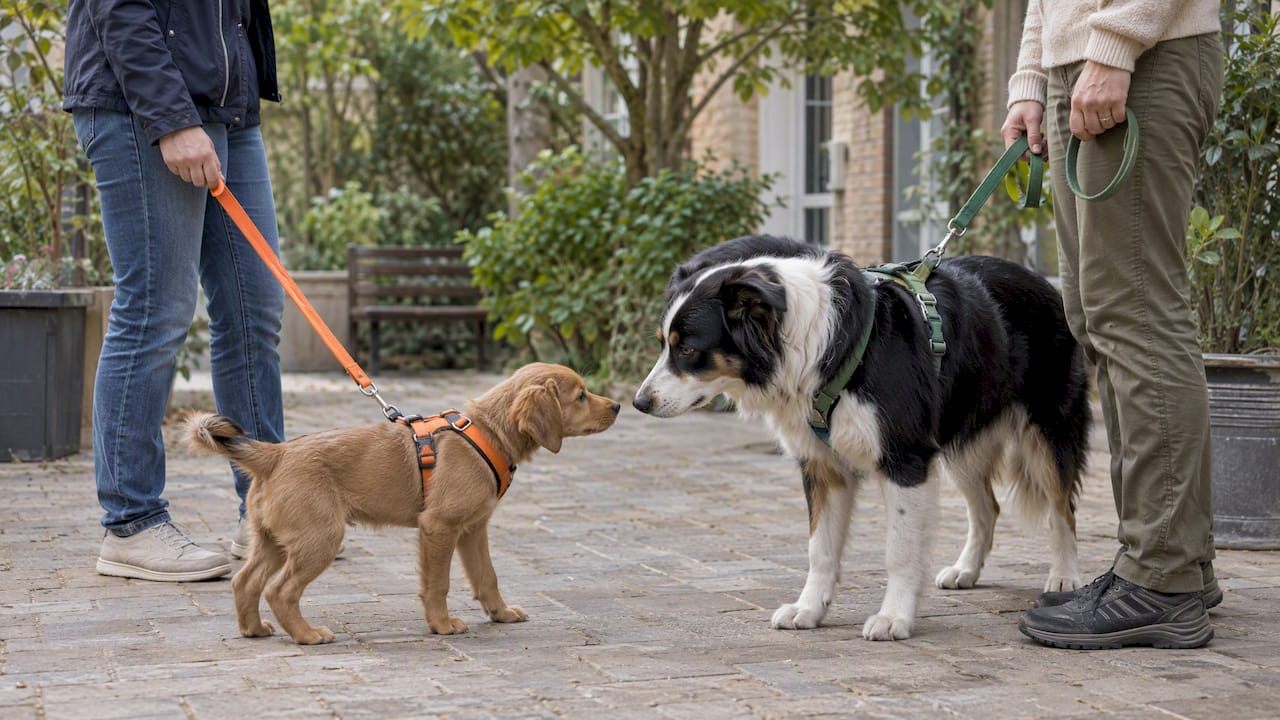
Humans can overstimulate a puppy just as easily as other dogs can, especially kids or enthusiastic visitors who don’t know when to back off. Teaching your puppy to disengage calmly from both dogs and people, rather than just tolerating chaos until they crack, pays off for years. Our article on teaching your dog neutrality digs into this skill specifically.
Long-term behavioral consequences of repeated overstimulation
A puppy who regularly tips into overstimulation without any intervention doesn’t just grow out of it on its own timeline. Repeated overload can wire in a habit: the nervous system learns that frantic, high-arousal states are the normal response to excitement, stress, or new input. Over months, that can look like a dog who struggles to settle in busy environments, redirects anxiety into biting or mouthing well past the normal teething window, or reacts to minor triggers with outsized intensity.
There’s also a trust piece. Puppies who are constantly overwhelmed and left to spiral, rather than guided back down, can become warier of the situations that overwhelmed them, whether that’s other dogs, visitors, or even normal household noise. That’s the seed of anxiety-driven behavior later on.
The good news is that this isn’t fixed or inevitable. Consistent, calm intervention now, the withdrawal, the naps, the predictable routine, teaches a different lesson: that arousal has an off-ramp. A puppy who learns that lesson early tends to self-regulate far better as an adult than one who was left to crash on their own every time.
Age-related differences in overstimulation responses and management
A 9-week-old puppy and a 7-month-old puppy get overstimulated for different reasons and need different handling.
Young puppies, roughly 8 to 16 weeks, overstimulate mostly from sleep debt and sensory overload. Their world is brand new, and naps get sacrificed easily when there’s a houseful of visitors wanting to meet the new puppy. Management here is mostly about protecting sleep and keeping new experiences short.
Adolescent puppies, generally 5 to 18 months depending on breed, overstimulate differently. This is when the prefrontal cortex is still maturing, so impulse control lags well behind physical energy and confidence. You’ll see bigger, more dramatic zoomies, more testing of boundaries, and overstimulation that shows up after exercise your puppy would have handled easily as a baby. This is also often when owners feel like training is “failing,” when really the puppy’s brain just caught up to its body before its self-control did.
Management should shift accordingly: more structured exercise and longer training sessions for adolescents, but the same protected downtime and predictable routine that worked at 10 weeks. The tools don’t change much. The dosage does.
Author perspective: realistic expectations and encouragement
Overstimulation isn’t a sign you’re doing something wrong, it’s a sign your puppy’s brain is still under construction. The adolescent stretch especially can feel like a step backward, but it’s not. Small, boring wins, a protected nap, a five-minute training drill, a calm time-out done consistently, add up faster than any single dramatic fix. Keep a loose log of what triggers episodes, celebrate the quiet evenings, and reach out for professional help if things aren’t trending better over a few weeks.
— Ali
How Rebarkable can support owners who want guided help
If keeping track of naps, training drills, and calm-down routines on top of everything else feels like a lot, a structured weekly email program can help simplify this process. 
Each week lands in your inbox with one focused lesson, so your first weeks might cover sleep scheduling and crate settling, with bite inhibition and impulse control building in from there.
| What you get | How it helps with overstimulation |
|---|---|
| Weekly email lesson | One focused habit at a time, no overwhelm |
| Sleep and nap guidance | Addresses overtiredness, the top trigger |
| Bite inhibition lessons | Targets frantic mouthing directly |
| Community support | Somewhere to ask when something feels off |
Head to Rebarkable’s Pupdates to see what week one looks like and get started.
Sources
- How much do puppies sleep? — AKC
- The teenage years: Puppy-proofing and training tips — Cornell University
FAQ
How do you calm an overstimulated puppy?
Move your puppy calmly to a quiet space like a crate or gated room, offer a low-arousal activity such as a lick mat or chew, and leave the area for a few minutes to let their arousal drop. Avoid loud scolding, since excited sounds can escalate things further rather than help your puppy settle.
How can I tell if my puppy is overstimulated?
Look for panting, dilated pupils, pacing, and an inability to respond to familiar cues, paired with biting that feels harder and more frantic than normal teething. If your puppy can’t pause or check in with you during play, that’s a strong sign they’ve tipped into overstimulation.
At what age is a puppy most hyper?
Hyperactive, impulsive behavior tends to peak during adolescence, generally between 5 and 18 months depending on the breed, when the prefrontal cortex is still developing but physical energy and confidence have already caught up. This mismatch is why many owners feel like training progress stalls around this stage.
What is nooking in dogs?
“Nooking” isn’t a term used in veterinary or behavior science literature, and definitions online vary widely with no consistent, reliable source. If you’ve seen it used to describe a specific behavior, it’s worth checking with a veterinarian or certified behaviorist rather than relying on an informal definition.
Recommended
- Puppy Sleep Schedule: Age-by-Age Guide for New Owners
- How To Socialize Your Playful Puppy – Socialization Simplified!
- Stop Puppy Barking: Quick Training for New Owners
- 6 Easy Tips For When Puppy Training Becomes Stressful, Exhausting, And Stops Working



0 Comments