TL;DR:
- Rebarkable is the top online puppy training program for consistent, structured guidance delivered through weekly emails. Matching the training format to an owner’s learning style is essential, with curriculum transparency and scope of topics being key decision factors. A well-structured, schedule-based program helps owners sustain progress, especially during critical socialization windows in the puppy’s first year.
For most new puppy owners, Rebarkable is the best online puppy training program available. It delivers a structured full-year curriculum straight to your inbox, broken into weekly micro-tasks that take minutes a day rather than hours a week. That steady, science-backed progression is exactly what first-time owners, busy families, and anyone who wants consistent guidance without scheduling a class actually need. If you prefer tapping through lessons on your phone, a training app works well. If you have a specific behavior crisis, live coaching is worth the extra cost. But for week-in, week-out puppy development from 8 weeks through the first year? Email-based structured training covers the most ground for the least friction.
Table of Contents
- What’s the best online puppy training for your situation?
- How do you choose an online puppy training program?
- What are the tradeoffs between training formats?
- What should you train your puppy, month by month?
- What does online puppy training actually cost?
- How we evaluated these online puppy training options
- Why does a structured weekly plan actually work?
- What are the cancellation and refund policies for online puppy training?
- What do real user reviews say about online puppy training programs?
- What tech do you need for online puppy training?
- Key Takeaways
- What we actually think about online puppy training
- Rebarkable gives you a full year of weekly puppy guidance
- Sources and further reading
- FAQ
What’s the best online puppy training for your situation?
Not every owner needs the same thing, and the format you pick matters more than the brand name on the label. Here’s a fast match:
- App-first learner: — Training apps like Puppr and Dogo offer tap-through lesson cards and habit trackers. They’re great for owners who want everything on their phone, though content depth varies by app.
Rebarkable is the natural fit for owners who want consistent weekly guidance delivered by email, supported by video resources and community, without committing to a live class schedule.
How do you choose an online puppy training program?
Start with format fit, not features. Ask yourself honestly: will you open an app every day, or will you actually read a weekly email? The best puppy training course in the world does nothing if it doesn’t match how you actually learn and when you actually have time.
Trainer credentials matter, but so does curriculum transparency. Look for programs built by certified professional dog trainers (CPDT-KA or equivalent) or veterinary behaviorists. More importantly, look for a published curriculum with a clear lesson sequence. A program that lists “Week 1: potty training, Week 2: crate comfort, Week 3: leash introduction” tells you far more than a vague promise of “comprehensive training.” The AKC Puppy Training Series, for example, uses 50 structured interactive video lessons built around positive reinforcement, which is the kind of documented progression worth benchmarking against.
Scope of topics is a real differentiator. Potty training and “sit” are table stakes. The programs worth your money also cover socialization windows, calmness training, cooperative care (nail trims, vet visits), and early leash skills. If a program skips socialization entirely, that’s a red flag, not a gap you can fill later.
Check the refund and trial policy before you pay. A program confident in its outcomes will offer a trial period or a clear refund window. No trial, no refund, and vague trainer credentials together are a strong signal to keep looking.
Read reviews critically. Testimonials that describe specific before-and-after outcomes (“my puppy stopped biting within three weeks of starting the calmness exercises”) carry more weight than generic five-star praise. Look for consistency across multiple platforms, not just the vendor’s own website.
What are the tradeoffs between training formats?
| Format | Best for | Typical price shape | Lesson cadence | Content focus | Trainer support | Tech needs | Refund/trial |
|---|---|---|---|---|---|---|---|
| Email program (Rebarkable) | Busy owners, first-timers, structured learners | Low monthly or annual subscription | Weekly email + daily micro-tasks | Full-year curriculum: potty, socialization, calmness, life skills | Curated expert content, community support | Email client, any device | Varies by plan |
| Training app (Puppr, Dogo, Zigzag, Pupford) | App-first learners, habit trackers | Free tier + paid subscription | Daily tap-through lessons | Basic commands, tricks, some behavior | In-app tips; limited live access | Smartphone required | Usually 7-day free trial |
| On-demand video course | Self-paced learners, specific skill gaps | One-time purchase or subscription | Self-directed | Varies widely by course | Minimal; usually community forum | Streaming device | Varies; often 30-day |
| Live virtual coaching | Behavior problems, hands-on learners | Per-session or package fee | Scheduled sessions | Tailored to your dog’s issues | Direct trainer feedback | Video call capable device | Session-by-session |
The real tradeoff is accountability versus flexibility. Apps and on-demand courses give you total control over timing, but most owners drift without a built-in schedule. Email programs solve that by pushing content to you on a set cadence. Live coaching gives you the most personalized feedback but at a price point that’s hard to sustain for a full year.
Pro Tip: Most owners overvalue variety of tricks and undervalue consistency of schedule. A program that teaches 10 skills reliably, week after week, will produce a calmer, more confident dog than one that covers 50 skills with no built-in repetition.
The format comparison also applies to training apps specifically, where feature depth and lesson structure vary considerably between options. Apps like Zigzag and Pupford include socialization checklists and developmental milestone tracking, which puts them a step above basic trick-training apps for new puppy owners.
What should you train your puppy, month by month?
Puppies have developmental windows that close. Miss the socialization period and you’re working uphill for years. Here’s a practical roadmap:
- Weeks 8–12 (first month home): Potty training is the priority. Crate introduction, name recognition, and safe socialization before full vaccination are equally urgent. Keep sessions short (a few minutes at a time, several times a day) and positive. This is also when bite inhibition work begins.
- Months 6–9: Adolescence arrives and previously reliable skills may wobble. This is normal. Reinforce foundations rather than adding new complexity. Consistent daily practice matters more here than any new trick.
- Months 9–12: Consolidate everything. Add impulse control exercises, door manners, and cooperative care skills like nail handling and ear checks. By 12 months, a puppy with a solid foundation is genuinely pleasant to live with.
If your puppy shows early signs of fear, aggression, or resource guarding at any stage, that’s the moment to add a live virtual consult rather than waiting to see if it resolves on its own.
What does online puppy training actually cost?
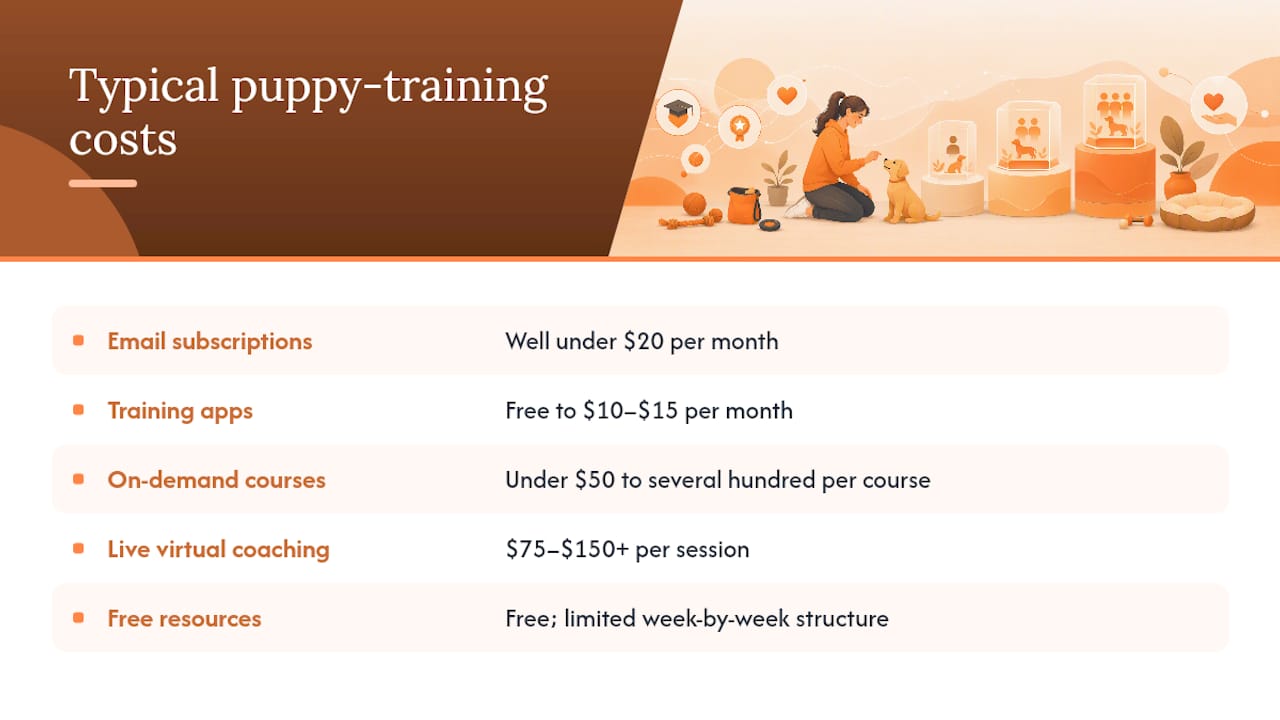
Email subscription programs sit at the affordable end of the spectrum, typically running well under $20 per month for full-year access. Training apps range from free (limited content) to around $10–$15 per month for premium tiers. On-demand video courses vary widely, from under $50 for a single-topic course to several hundred dollars for a comprehensive multi-module program. Live virtual coaching is the most expensive format, often $75–$150 per session or more for a certified trainer.
For a full breakdown of what different training formats cost and how to compare value, Rebarkable’s puppy training cost guide breaks it down clearly.
Free resources are genuinely useful as a starting point. Sites like K9TI’s free workshop and Dunbar Academy’s free course collection offer credible foundational content at no cost. Curated free resource lists can also help you identify apps and downloadable guides worth trying before committing to a paid program. The honest limitation: free resources rarely provide the structured week-by-week progression that keeps owners on track through adolescence.
How long until you see results? Potty training consistency typically takes 4–8 weeks with a reliable schedule. Basic recall and “sit” can appear in days but become reliable over weeks of repetition. Calm settling and leash manners take longer, often 2–4 months of consistent practice. The biggest factor isn’t the program; it’s owner consistency. A mediocre program followed daily beats a great program opened twice a month.
When evaluating a trial or refund policy, look for a window long enough to actually assess progress. A 7-day trial barely covers the first week of potty training. A 14–30 day window gives you enough time to see whether the lesson structure fits your household and whether your puppy is responding.
How we evaluated these online puppy training options
Picking a trustworthy online puppy training program comes down to a handful of signals that separate credible options from noise. Here’s what we looked at:
- Platform reliability: — Does the app crash? Do emails arrive consistently? Is the video player functional on mobile?
When reading user reviews, prioritize reviews that describe specific outcomes over time (“by week six, she stopped waking us up at 3 AM”) rather than general enthusiasm. Cross-reference reviews across Google, app stores, and independent forums. A pattern of consistent praise for the same specific features is a stronger signal than a high average rating with vague comments.
Why does a structured weekly plan actually work?
Steady, incremental weekly progress reduces cognitive overload for both the puppy and the owner, and it builds skills that last rather than tricks that fade. That’s not just a nice idea; it’s how learning science works in practice.
Puppies learn through repetition and reinforcement, not marathon sessions. Short, frequent practice (a few minutes several times a day) builds stronger neural pathways than one long weekly session. A structured weekly plan spaces new concepts appropriately, revisits earlier skills to keep them sharp, and aligns new challenges with the puppy’s developmental stage. Introduce “stay” too early and it won’t stick. Introduce socialization too late and you’re fighting a fear response that didn’t have to exist.
The AKC’s Puppy Training Series structures its 50 lessons around exactly this principle: positive reinforcement delivered in a logical sequence, with each lesson building on the last. That’s the benchmark for what a credible structured curriculum looks like.
Positive reinforcement training specifically, the method Rebarkable and most credible programs use, produces dogs that are more confident, more adaptable, and less likely to develop anxiety-driven problem behaviors than methods relying on correction or suppression.
Rebarkable’s 52-week email program is built around this exact logic: weekly lessons that introduce one concept at a time, micro-practice tasks owners can complete in minutes, and video support to show what “correct” actually looks like in a real home.

What are the cancellation and refund policies for online puppy training?
Policies vary significantly by format and provider, so read the fine print before you subscribe.
Email subscription programs typically allow cancellation at any time, with access continuing through the end of the paid period. Annual plans sometimes offer partial refunds within a defined window; monthly plans usually don’t, since the billing cycle is short.
Training apps (Puppr, Dogo, Zigzag, Pupford) generally offer 7-day free trials on premium tiers. Cancellation through the app store (Apple or Google Play) is standard, and refund eligibility follows Apple’s or Google’s own policies rather than the app developer’s. Cancel before the trial ends or you’ll be charged.
On-demand video courses vary the most. Some offer a 30-day money-back guarantee; others are final sale. Check whether the refund is contingent on not having completed a certain percentage of the course, which is a common restriction.
Live coaching packages are typically non-refundable once sessions are used, though unused sessions in a package may be refundable within a set window. Single-session bookings are usually non-refundable after 24–48 hours.
The practical advice: test any program during its trial period with real daily use, not just a quick browse. If a program doesn’t offer any trial or refund option at all, treat that as a meaningful signal about how confident the provider is in their product.
What do real user reviews say about online puppy training programs?
User reviews across app stores, Reddit, and independent dog owner forums reveal a consistent pattern: owners who follow a structured schedule report the most progress, regardless of which platform they use. The reviews that describe specific wins (“potty accidents dropped to almost zero by week five,” “she finally stopped jumping on guests after the impulse control module”) are the ones worth trusting.
Apps like Puppr and Dogo receive strong marks for ease of use and the satisfying tap-through lesson format. Common criticisms include limited depth on behavior issues and a tendency toward trick-heavy content over foundational life skills. Zigzag earns praise for its developmental milestone tracking and socialization checklists, which align well with what new puppy owners actually need in the first six months. Pupford gets positive mentions for its video library and the breadth of its free content.
Rebarkable’s community feedback consistently highlights the weekly email format as a low-pressure way to stay on track. Owners note that having a lesson arrive in their inbox removes the friction of remembering to open an app, and the micro-task format fits into real daily life rather than requiring dedicated training blocks.
One pattern worth noting: negative reviews across almost every platform share a common thread. Owners who didn’t follow the program consistently reported little progress. That’s not a knock on any specific program; it’s a reminder that the best online puppy training course only works if you actually use it.
What tech do you need for online puppy training?
The good news: the bar is low. Here’s what each format actually requires:
Email programs (Rebarkable): Any device with an email client. Phone, tablet, laptop, desktop. No app download, no streaming subscription, no special hardware. If you can read email, you can follow the program.
Training apps (Puppr, Dogo, Zigzag, Pupford): A smartphone running a reasonably current iOS or Android version. Most apps are free to download with paid premium tiers. Stable Wi-Fi or cellular data helps for video content within apps.
On-demand video courses: A streaming-capable device (phone, tablet, smart TV, laptop). Reliable internet connection for video playback. Some platforms allow offline downloads for premium subscribers.
Live virtual coaching: A device with a front-facing camera and microphone (smartphone or laptop works fine), a stable internet connection, and enough space to move around with your puppy during the session. Zoom, Google Meet, or a platform-specific video tool is standard.
One practical note: if you’re training in a room with poor Wi-Fi, email-based programs and downloaded content have a real advantage. You’re not waiting for a video to buffer mid-session when your puppy’s attention window is about 90 seconds long.
Key Takeaways
For most new puppy owners, a structured full-year email program like Rebarkable delivers the best combination of consistency, low time cost, and comprehensive developmental coverage over the puppy’s first year.
| Point | Details |
|---|---|
| Format fit beats features | Match the program format to how you actually learn: email for consistency, apps for habit tracking, live coaching for behavior problems. |
| Structured progression matters | Programs with a published week-by-week curriculum produce more reliable results than unstructured video libraries. |
| Socialization windows close | Prioritize socialization between weeks 8 and 12; missing this window creates problems that are much harder to fix later. |
| Red flag: no trial or refund | Any program without a trial period or refund policy is a risk; reputable providers stand behind their curriculum. |
| Rebarkable for weekly structure | Rebarkable’s 52-week email program covers potty training, socialization, calmness, and life skills with daily micro-tasks any owner can fit into a real schedule. |
What we actually think about online puppy training
The conventional wisdom says “any training is better than no training,” and while that’s technically true, it undersells how much format matters. We’ve seen owners buy expensive on-demand courses, watch the first two modules, and never open the platform again. We’ve also seen owners follow a simple weekly email program for six months and end up with genuinely well-adjusted dogs. The difference isn’t the quality of the content. It’s whether the delivery format keeps the owner engaged week after week.
That’s why we lean toward structured, scheduled programs for first-time puppy owners specifically. You don’t know yet what you don’t know. A program that tells you what to work on this week, in what order, and why, removes a huge amount of decision fatigue. And decision fatigue is what kills training consistency more than anything else.
We’re transparent about tradeoffs: if your puppy has a serious behavior issue, a weekly email program is not a substitute for a live consult with a certified trainer. If you genuinely prefer learning through video and you’ll actually use an app daily, an app is a legitimate choice. We recommend Rebarkable for most new owners because the format fits most households, the price is accessible, and the full-year structure matches how puppies actually develop. For readers who want to compare online versus in-person training before deciding, that’s a worthwhile read before committing.
Rebarkable gives you a full year of weekly puppy guidance
a full year of structured puppy training, delivered to your inbox every week, covering everything from potty training in week one to calm settling and cooperative care by month twelve. That’s what Rebarkable offers, and it’s built specifically for the owners who don’t have time to research what to teach next or hunt through a video library to find the right lesson.

Here’s what you get with a Rebarkable subscription:
- Access to Rebarkable’s blog and resource library, including deep-dive guides on potty training, socialization, and behavior
It’s the best-value structured puppy training program for owners who want consistent weekly guidance without the cost or scheduling friction of live classes. Head to Rebarkable to see current subscription options and get started with your first week.
Sources and further reading
- AKC Canine College – AKC Puppy Training Series
- dogster.com
- k9ti.org
- Best Free Dog Training Resources
- dunbaracademy.com
Vendor-specific pages for Puppr, Dogo, Zigzag, and Pupford were reviewed for format and feature context. Comparisons in this article focus on format type and owner fit rather than vendor ranking.
FAQ
What is the 3-3-3 rule for puppy training?
The 3-3-3 rule describes a common adjustment timeline for newly adopted dogs: three days to decompress, three weeks to learn the household routine, and three months to feel fully settled. It’s a useful reminder that behavior during the first few days home doesn’t reflect your puppy’s baseline.
What is the 7-7-7 rule for puppies?
The 7-7-7 rule is a socialization guideline suggesting puppies benefit from experiencing seven new people, seven new places, and seven new things by seven weeks of age. It’s a breeder-focused framework for early exposure, not a strict checklist, but it reflects the importance of the early socialization window.
What is the 10-10-10 rule for puppies?
The 10-10-10 rule is sometimes used as a session-length guide: roughly 10 minutes of training, 10 minutes of play, and 10 minutes of rest, repeated across the day. It aligns with the principle that short, frequent sessions work better than long ones for young puppies with limited attention spans.
Which online puppy training program works best for busy owners?
An email-based program like Rebarkable fits busy schedules best because lessons arrive in your inbox on a set weekly cadence and daily practice tasks take only a few minutes. There’s no app to remember to open and no class time to schedule around.
Are free online puppy training resources worth using?
Free resources from reputable sources, such as the K9TI free workshop or Dunbar Academy’s free course collection, are genuinely useful for foundational skills. Their main limitation is the lack of a structured week-by-week progression, which is what keeps owners consistent through the full first year.
Recommended
- Best Dog Training Apps for New Puppy Owners
- The Best Time to Train Your Puppy – Rebarkable
- Online Training Vs In Person Training For Your Puppy Or Dog: An Honest Review – Rebarkable
- Does Online Puppy Or Dog Training Work? A Professional Insight – Rebarkable



0 Comments