Stop puppy chewing by managing the environment, redirecting to appropriate chews, and confining your pup safely when you can’t watch them. Right now, in the next hour: clear hazards off the floor, offer a chew like a frozen KONG, a rubber Kong Puppy toy, or a soft rope toy (skip anything rock-hard, like antlers or real bones, which can crack teeth), and set up a playpen or crate if you need to step away. The goal isn’t zero chewing. It’s teaching your puppy what’s okay to chew and what isn’t.
TL;DR:
- Puppies chew to explore, relieve teething discomfort, and satisfy boredom, making redirection and environment management essential from the start.
- Ensuring the home is puppy-proofed by removing hazards, securing cords, and providing distinct, safe toys prevents accidental ingestion or damage.
- Teaching a reliable “drop it” trade and building it into consistent training helps curb destructive behaviors and reinforces appropriate chewing habits.
- Using soothing, food-stuffed, frozen chews and rotating toys effectively eases teething pain while maintaining interest and safety.
- Confinement with enrichment, started gradually and never as punishment, minimizes damage when supervision isn’t possible.
Table of Contents
- Why Puppies Chew in the First Place
- Puppy-Proofing: Your Home Setup Checklist
- Teaching Your Puppy to Trade and Drop It
- Teething Tactics That Actually Soothe Sore Gums
- Managing Chewing When You Can’t Supervise
- When Chewing Signals a Bigger Problem
- Our Take on Building Lasting Chewing Habits
- Get Ongoing Support With Rebarkable
- Sources
- FAQ
Why Puppies Chew in the First Place
Chewing isn’t naughty behavior. It’s how puppies figure out the world, and it’s also how they get through teething, which can feel miserable for them. Mouthing objects, carrying things around, gnawing on furniture legs: it’s mostly instinct, and VCA Animal Hospitals notes that chewing continues to some degree throughout a dog’s life. The real objective is never to eliminate it. It’s to redirect it toward things you actually want gnawed on.
That said, not all chewing comes from the same place, and knowing which one you’re dealing with changes your approach:
- Exploration and mouthing peak early and tend to fade as puppies mature and learn bite inhibition, something we cover in more depth in our guide on when puppies stop biting.
- Teething overlaps heavily with exploratory chewing and causes real gum discomfort, especially as adult teeth push through.
- Boredom and pent-up energy drive a lot of destructive chewing. A puppy who’s had zero mental or physical outlet by 3 PM is going to find their own entertainment, and your couch cushion is right there.
- Separation anxiety looks different from the rest. It’s obsessive, often focused on exit points like doors and window frames, and shows up specifically when you leave.
That last one matters because it’s not a training problem you fix with more toys. It needs its own approach, which we’ll get to later.
Puppy-Proofing: Your Home Setup Checklist
Before any training sticks, your house needs to stop being a buffet of temptation. This is the boring part, but skipping it is the single biggest reason redirection training fails.
- Walk each room at puppy height. Get down on your knees and look for cords, shoes, trash cans, and small objects within reach. What looks fine standing up looks like a chew toy from a puppy’s eye level.
- Secure the obvious hazards. Tuck cords behind furniture or use cord covers, put trash cans behind closed doors, and keep small objects like remote controls and phone chargers up high.
- Set up a dedicated puppy zone. A gated room, playpen, or crate area with absolutely nothing off-limits in it gives your puppy a space where they can’t make a mistake even if you look away for a minute.
- Rotate toys weekly. Puppies lose interest fast. Swapping toys in and out keeps novelty high and cuts down on the “I’m bored, guess I’ll eat the rug” problem.
- Keep chew toys visually distinct from personal items. According to the ASPCA, giving a puppy an old shoe or sock to chew teaches them that shoes and socks in general are fair game. Choose toys that don’t resemble anything in your closet.
Pro Tip: Keep a small basket of approved chews in every room your puppy spends time in, so a legal chew is always closer than the illegal one.
On deterrent sprays: bitter-tasting products can help keep puppies off furniture legs or baseboards, but check with your vet before relying on them, since Royal Canin notes that safety can vary by product and by individual dog. It’s a small step, but worth doing right.
Teaching Your Puppy to Trade and Drop It
This is where the actual training happens, and it’s simpler than it sounds. The core idea: interrupt calmly, retrieve without drama, and make giving something up feel like a win for your puppy, not a loss.
When you catch your puppy chewing something wrong:
- Interrupt with a neutral sound, not a yell. A quick “ah-ah” or a clap works fine.
- Walk over calmly. Chasing turns this into a game your puppy will want to repeat.
- Offer a trade: hold out a treat or a more exciting toy right at their nose.
- The moment they drop the item, mark it (“yes!”) and let them have the treat or toy.
- Immediately hand them an approved chew so the lesson ends on the right object.
PetMD points out that a lot of owners unintentionally reward chewing by reacting with big, excited energy when they find something destroyed, chasing, scolding, dramatic sighing. Calm retrieval plus a rewarded trade teaches the lesson far more reliably than scolding does.
Once your puppy has the trade concept down, build it into a formal “drop it” cue:
- Start with a low-value item your puppy is only mildly interested in.
- Say “drop it,” then immediately present a treat. Don’t wait for compliance first; you’re building the association.
- Once they reliably drop the low-value item for the treat, add the verbal cue before you show the treat, so the word starts to mean something on its own.
- Gradually raise the stakes to more valuable items: a favorite toy, then something particularly tempting like a chewed-up cardboard box.
- Practice five-minute sessions, two or three times a day, is plenty. Short and frequent beats long and rare.
Once your puppy has this down cold at home, take it on the road. Practice “drop it” in the yard, at the park, and even through the bars of the crate. A skill that only works in the living room isn’t really a skill yet, it’s a fluke.
Teething Tactics That Actually Soothe Sore Gums
Teething puppies aren’t being difficult on purpose, their mouths genuinely hurt, and the right chew can make a real difference. Our full teething timeline and tips covers when to expect the worst of it, but here’s what to reach for in the moment.
Safe textures include soft rubber, flexible rope, and rubbery puzzle toys that give a little under pressure. Skip anything that doesn’t flex at all: hard antlers, real bones, and rigid nylon chews carry a real risk of cracking teeth, and a JAVMA study on chewing and dental calculus found that while some chews reduce buildup on teeth, veterinary dentists generally warn against anything too hard for the same reason.
A few go-to tactics worth keeping in rotation:
- Frozen wet washcloths, twisted into a knot, work as a cheap, cold, soothing chew.
- Frozen food-stuffed toys (think a KONG with wet food or peanut butter, frozen solid) take longer to finish and numb sore gums at the same time.
- Chilled rubber chew toys straight from the fridge offer the same cooling relief without the mess.
Frozen, food-filled puzzle toys are considered one of the highest-value, low-risk tools for soothing teething puppies while keeping them occupied, according to research on confinement and enrichment published in JAVMA. That combination of comfort and distraction is hard to beat.
Keep rotating chews to maintain novelty, and always supervise while a new chew is in play until you know it holds up to your puppy’s jaw strength. If you’re ever unsure whether a specific chew is too hard, ask your vet before handing it over.
Managing Chewing When You Can’t Supervise
You can’t watch your puppy every second, and that’s exactly when destructive chewing happens most. The fix isn’t more vigilance, it’s smarter setup.
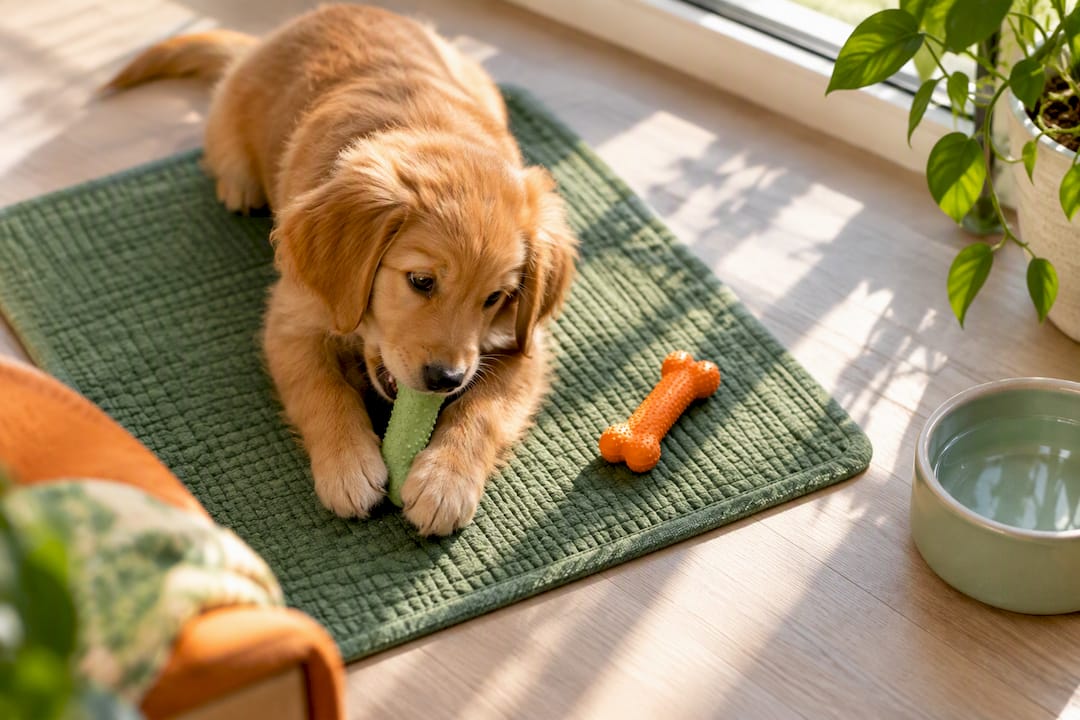
- Choose crate or safe room based on your puppy’s comfort. Some puppies settle faster in a crate’s den-like space; others do better in a gated room with more room to move. Either works, as long as it’s puppy-proofed completely.
- Stock it before you leave, not as an afterthought. Water, a safe chew, and ideally a frozen puzzle feeder to keep them busy for the first stretch of alone time.
- Introduce it gradually. Short sessions at first, always paired with a high-value frozen chew, and a bit of calm praise or play when they come out. Our guide on where to place your puppy’s crate covers setup details that make this step easier.
- Build an enrichment rhythm, not just confinement. Puzzle feeders, a few minutes of scent work, or a short training session before crate time all take the edge off boredom-driven chewing.
Pro Tip: Never use the crate or safe room as punishment. If it’s the place your puppy gets sent when they’re “in trouble,” they’ll start to dread it, and that association can create the exact anxiety-driven chewing you’re trying to avoid.
Confinement paired with enrichment, rather than confinement alone, is what makes this work. Research on managing unwanted behavior in dogs backs this up directly: management has to come with positive enrichment, or it risks creating anxiety instead of preventing it.
When Chewing Signals a Bigger Problem
Most destructive chewing is a phase you train through. Some of it isn’t, and knowing the difference saves you months of frustration.
Watch for these red flags:
- Self-injury, like bleeding gums or broken teeth from compulsive chewing.
- Destructive chewing that continues well past the teething window instead of tapering off.
- Chewing through barriers, doors, crate bars, drywall, especially when it’s focused around exits.
- Severe distress specifically tied to your departure, which often points to separation anxiety rather than boredom.
If you’re seeing any of these, it’s time to loop in a professional. VCA Animal Hospitals recommends investigating causes like separation anxiety or an underlying medical issue, since persistent destructive chewing sometimes has a cause that training alone won’t fix. A vet can rule out dental pain or other medical triggers; a behaviorist can dig into anxiety patterns. Our piece on separation anxiety in puppies is a good starting point if that’s what you’re noticing.
While you wait for an appointment, keep leaning on supervision, safe confinement, and enrichment to limit damage and risk. Before your visit, record video of the episodes, note the time of day, and track exactly what’s being chewed. That record helps a professional tell boredom apart from anxiety far faster than a verbal description alone.
Our Take on Building Lasting Chewing Habits
A lot of chewing advice online is a single tip in isolation: buy this toy, spray this deterrent, crate them more. None of that sticks without sequence. Toy selection means little if the trade cue isn’t taught first, and crate training backfires if enrichment isn’t built in from day one.
That’s the gap that a structured, step-by-step training program can help close. Each week builds on the last, from toy selection through trade drills, crate introduction, and enrichment scheduling, so owners aren’t guessing what comes next. It pairs behavior training with environment management and flags when a vet or behaviorist visit makes sense, rather than assuming training alone fixes everything.
If you want to go deeper on any piece of this, our articles on puppy teething, crate placement, and separation anxiety are good next stops.
— Ali
Get Ongoing Support With Rebarkable

Piecing together advice from ten different websites is exhausting, and it’s easy to miss a step or apply things out of order. Rebarkable’s Pupdates deliver structured, weekly lessons straight to your inbox, covering chewing, potty training, and the dozens of other things that come up in a puppy’s first year, in the order that actually works. You get step-by-step drills, timely tips for whatever stage your puppy is in, and a community of other owners working through the same thing. It’s built for owners who want a plan instead of a search bar full of open tabs. Check out Pupdates on Rebarkable to see how the program is structured and get started.
Sources
- JAVMA article on confinement and enrichment
- Teeth, teething and chewing in puppies | VCA Animal Hospitals
- How to stop a puppy from chewing | PetMD
FAQ
How do I train my puppy not to chew?
Redirect rather than punish: interrupt calmly, trade for an approved chew, and reward the moment they take it. Pair this with puppy-proofing and enough physical and mental exercise, since PetMD notes that positive reinforcement works more reliably than yelling or scolding.
At what age do puppies stop chewing?
Chewing tends to decline significantly as adult teeth finish coming in and puppies mature, but VCA Animal Hospitals notes that chewing continues to some degree throughout a dog’s life. The goal at every age is redirecting it to appropriate items rather than expecting it to disappear entirely.
What is the 7-7-7 rule for puppies?
The “7-7-7 rule” is a popular informal guideline suggesting puppies be exposed to a range of experiences, surfaces, and people early on, but it’s not a formal veterinary or behavioral standard. Definitions of it vary widely across sources, so treat it as a general socialization reminder rather than a strict rule.
What dog breeds are prone to chewing?
Breed can influence chewing intensity, but individual factors like energy level, teething stage, and boredom tend to matter more than breed alone. Regardless of breed, the same core approach applies: manage the environment, redirect to safe chews, and address boredom with enrichment and exercise.
Recommended
- When Will My Puppy Stop Biting? Professional Trainer Explains
- How to Train Your New Puppy Not to Bite: A Trainer Explains
- Anti-Chew Sprays For Puppies: Why Professionals Don’t Recommend Them.




0 Comments