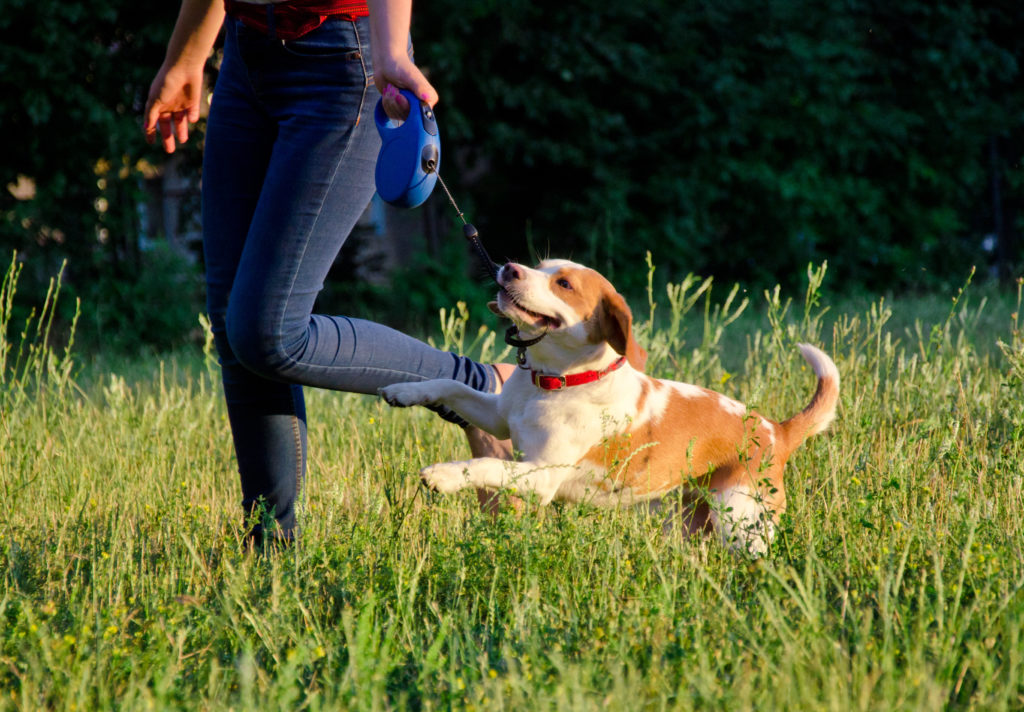
Retractable leashes — Flexi leads, extendable leads, whatever you call them — aren’t something I recommend very often.
Not because they’re inherently evil. They’re a specific tool that needs a specific environment, and they’re very often used as though they’re the default leash for every walk.
For most of the jobs people use a Flexi for, I prefer a long line. It gives a dog freedom while giving me more predictable control. But there are situations where I can understand using a retractable leash, so this isn’t going to be a dramatic “throw yours in the bin” article.
Here’s why trainers like me tend to be cautious about them.
Are Retractable Leashes Bad for Dogs?
Not automatically. The problem is usually the combination of the dog, environment, equipment and how the leash is being used.
A calm dog exploring a quiet open space on a well-maintained tape retractable leash attached to a harness is very different from a dog zig-zagging across a busy sidewalk at the end of a thin cord.
So when I say I rarely recommend them, I’m talking about how easy they are to use in situations where their disadvantages become significant.
1. They Can Reward Pulling
Think about what happens from the dog’s perspective. They move forward, the leash extends, and they gain access to more smells and more space.
That’s not necessarily a problem if your goal is a sniffy walk. But if you’re simultaneously trying to teach your dog that pulling doesn’t move them forward, the equipment is working against that lesson.
If loose-leash walking is the goal, I’d use a normal fixed-length leash while teaching loose-leash skills.
2. Distance Reduces Your Control
A retractable leash extends beautifully. What it doesn’t do is reel your dog back towards you.
If your dog is 15 or 20 feet away when another dog appears, a cyclist comes around the corner or a squirrel makes a deeply inconsiderate decision, you still need to manage that distance.
You can lock the leash and move away — and reversing away from a situation is often the easiest option — but that’s very different from having the dog close to you in the first place.
This is why I don’t like retractable leashes in crowds, near roads or anywhere the environment can change quickly.
3. The Mechanism Adds Another Point of Failure
A normal leash is wonderfully boring: line, hardware, handle. You can inspect most of it with your eyes.
A retractable leash contains a mechanism inside the handle, plus a brake and moving line. Good-quality equipment can last well, but there are simply more components involved.
Inspect the tape or cord, test the brake, check the attachment hardware and replace damaged equipment rather than waiting for it to fail.
4. Cord, Tape and Tangling Can Cause Injuries
This is probably the risk people underestimate most.
A fast-moving thin line against bare skin can cause nasty friction injuries. Long lines can do this too — which is why I don’t grab a moving long line with my hands — but retractable cords can be particularly thin and difficult to see.
They can also wrap around legs, dogs and people very quickly. That’s one reason I prefer a visible tape version if someone is going to use a retractable leash at all.
5. They’re Often Used With the Wrong Equipment
If a dog can accelerate over several metres and suddenly hit the end of the leash, I don’t want that force concentrated through their neck or head.
I would use a retractable leash with a well-fitted harness. I would not attach one to a prong collar, head collar or other equipment where hitting the end at speed could create a significant correction or sudden force through the neck/head.
If your dog is particularly talented at backing out of ordinary harnesses, start with an escape-proof harness. Otherwise, my dog harness guide has the everyday options I’d consider.
6. People Use Them in Places They Don’t Belong
This is the big one for me.
A retractable leash fully extended on a narrow sidewalk, beside traffic, in a pet store or weaving between people gives the dog a huge radius in an environment that requires close management.
The same leash in an empty field is a completely different proposition.
Equipment can’t compensate for choosing the wrong environment.
When Can a Retractable Leash Be Useful?
I can see a sensible use case when:
- you’re in a large, quiet, open area;
- your dog isn’t likely to charge dogs, people or wildlife;
- you’re paying attention rather than relying on the brake at the last second;
- the leash is attached to a secure harness;
- you’ve chosen suitable, well-maintained equipment; and
- your goal is giving the dog sniffing/exploration freedom rather than teaching loose-leash walking.
For some owners, the retracting mechanism is genuinely easier to manage than manually feeding and gathering a long line. That’s a valid practical consideration.
Flexi Lead or Long Line?
For most training purposes, I choose a long line.
It gives me more control over how much line is available, works beautifully for recall training, and is one of my favourite ways to give a dog safe freedom on a decompression walk.
A retractable leash wins on convenience. A long line wins for me on versatility and training.
I’ve broken the choice down properly in Long Line vs Flexi Lead: Which Is Better?.
What I Recommend Instead
If what you really want is for your dog to have more freedom without going off leash, learn to use a long line.
There’s a handling technique to it — you don’t just chuck 30 feet of line on the ground and hope everyone survives — but once you’ve got the hang of feeding, gathering and managing the line, it’s enormously useful.
My complete guide to dog long lines covers lengths, materials, harness attachment and safe handling.
So, Are Flexi Leashes Safe?
They can be. I just don’t think they’re as universally useful as their popularity suggests.
Use one in a suitable open environment, attach it to a harness, keep the line visible, understand the brake and pay attention to what’s around you. But if you’re asking me what I’d buy first for giving a dog more freedom while keeping them safely attached? I’d buy a long line.

Author, Ali Smith
Ali Smith is a professional, qualified, and multi-award winning trainer is the founder of rebarkable. She has always believed animals deserve kindness and champions force free methods. Believing that dog guardians will all choose the kindest options if proper information is provided, she aims to help all dog guardians who need it and make dog training as accessible as possible
Ali lives win Maryland, US with her husband and her three dogs.
0 Comments