Shorten the time your puppy spends crated, carry them straight to the potty spot the moment you let them out, and reward any outdoor elimination like it’s the best thing that’s happened all week. Then check the crate setup and watch for health red flags. The age-based holding guide is just a planning estimate, so if accidents keep happening, treat it as a signal to check in with your vet, not a training failure.
TL;DR:
- Shortening confinement windows and immediately rewarding outdoor elimination can significantly reduce crate accidents, especially when paired with careful tracking of daily patterns.
- Medical issues like urinary tract infections can cause sudden, frequent accidents, making vet consultation and clinical testing essential before behavioral adjustments.
- Using a properly sized crate with a divider and removing bedding during repeated accidents prevents partial housetraining failures caused by excessive space.
- Establishing a schedule based on age-in-months-plus-one-hour and anchoring potty breaks to meals and naps improves consistency and reduces accidents over time.
- Consistent supervision and positive reinforcement are more effective than punishment, especially when training bladder control or addressing excitement-related peeing.
Table of Contents
- Your first 5 minutes after a crate accident
- Ruling out medical causes first
- Getting the crate size and setup right
- Building a potty schedule you can actually stick to
- Training that builds real bladder control
- Cleaning up without leaving a scent invitation
- When it’s time to call in backup
- Why vets back this approach, and how Rebarkable fits in
- What new owners get wrong about crate accidents
- Rebarkable: weekly, science-backed help for crate accidents
- FAQ
- Sources
Your first 5 minutes after a crate accident
Found a wet crate? Don’t panic, don’t scold, just move through this in order.
- Carry your puppy (don’t walk them, carry them if you can) straight to their designated potty spot.
- Wait quietly for a minute or two. If they go, reward immediately, a treat and genuine praise within seconds of finishing.
- Bring them back in and clean the crate before putting them anywhere near it again.
- Shorten the next confinement window. If they lasted two hours before, try ninety minutes next time.
A few things to track while you’re at it:
- Last time they ate and drank before the accident.
- How long they were actually confined.
- Whether they’d just woken up, played hard, or been crated right after a meal.
That log sounds tedious, but after three or four accidents a pattern usually jumps out, often it’s a confinement window that’s simply too long for where your puppy’s bladder control actually is right now.
Ruling out medical causes first
Before you assume this is purely a training issue, rule out a medical one. Sudden, frequent, or unusually smelly accidents deserve a vet visit, not just a longer potty schedule.
Watch for:
- Straining or visible discomfort while urinating
- Blood in the urine
- Frequent, small dribbles rather than one normal-sized void
- A strong or unusual odor
- Excessive licking of the genital area
- Lethargy or a drop in appetite
A sudden change in a previously reliable puppy’s crate habits is one of the clearest signs vets point to for a possible urinary tract issue, and VCA Animal Hospitals notes that UTIs and similar problems can make it physically harder for a dog to hold urine, regardless of training. A vet visit usually starts with a urinalysis, and results often guide next steps within a day or two. If everything checks out medically, you can move forward with the behavioral fixes below knowing you’re not just papering over a health problem.
Getting the crate size and setup right
A crate that’s too big is often the hidden culprit. If there’s enough room for your puppy to pee in one corner and sleep in the other, they will, every time.
- Size the crate so your puppy can stand, turn around, and lie down stretched out, nothing more.
- Use a divider to shrink the space as they grow, rather than buying a crate sized for their adult body right away, a point covered in more detail in our guide to picking the right crate.
- If you’re gone longer than your puppy can realistically hold it, Cornell’s veterinary guidance recommends a pen with a toilet substrate instead of a crate, a crate was never meant to substitute for supervision.
- Pull bedding out entirely if accidents keep happening on it, then reintroduce it only after several clean days in a row.
Pro Tip: If you’re using a divider, move it in small increments, not all at once, puppies notice sudden space changes and some will test the new boundary by peeing in it.
Building a potty schedule you can actually stick to
Guesswork is what gets most new owners into trouble. A loose schedule built around your puppy’s real patterns, not a generic chart, prevents far more accidents than reacting after the fact.
- Start with the age-in-months-plus-one-hour rule as a rough ceiling, a common planning estimate that most puppies can hold urine for roughly their age in months plus one hour, though individual puppies vary quite a bit.
- Anchor potty breaks to meals, naps, and play sessions rather than the clock alone, puppies reliably need to go shortly after eating or waking up.
- Take them out on a leash to the same spot every time, and wait quietly for up to a few minutes rather than rushing back inside.
- Write down the actual gap between successful potty trips, and if you get a slip, shorten the next interval instead of pushing toward the theoretical maximum.
The goal isn’t to hit some ideal number of hours, it’s to find your puppy’s real limit and schedule just inside it.
Training that builds real bladder control
Supervision beats correction every time here. An indoor leash or a watchful eye while your puppy’s loose in the house catches the warning signs (sniffing, circling, suddenly heading for a corner) before they turn into a mess.
- Walk them to the same outdoor spot every time and mark the exact moment they finish with a reward, not a vague “good dog” five minutes later.
- Skip any form of punishment, startling or scolding a puppy mid-accident tends to teach them to hide when they need to go, which makes the problem harder to catch.
- Build positive crate associations separately from potty training: feed meals in the crate, offer a treat-stuffed toy, and practice closing the door for short stretches while you’re still in the room.
- If excitement or submissive urination is the trigger, work on calm, low-key greetings and teach an alternate behavior, like sitting for attention, instead of an excited rush to the door.
Pro Tip: Keep greetings boring on purpose, no eye contact, no high voice, for the first few seconds. Excited puppies pee, calm ones usually don’t.
Cleaning up without leaving a scent invitation
Regular cleaners mask smell to human noses but leave behind the compounds that tell your puppy “this is the bathroom now.” That’s why enzymatic cleaners are the standard recommendation in veterinary house-training protocols, they break down the actual odor-causing residue rather than covering it.
- Clean every contaminated surface with an enzymatic product and wash any soiled bedding on a hot cycle.
- Carry your puppy out, clean the crate, then shorten the next confinement window, in that order, every time.
- If accidents keep happening on bedding specifically, pull it for a week, then bring it back once you’ve had a clean stretch.
When it’s time to call in backup
Some situations are past what a schedule tweak can fix.
- Blood in the urine, visible pain, constant dribbling, or lethargy means a same-day vet call, not a wait-and-see approach, and this checklist of medical red flags is a useful gut-check before you decide.
- Accidents tied to whining, panic, or destructive behavior when crated point toward separation distress, worth a conversation with a behaviorist or trainer.
- If your schedule simply can’t match your puppy’s bladder yet, a dog walker, sitter, daycare, or a pen setup with toilet substrate buys you time without forcing accidents.
Why vets back this approach, and how Rebarkable fits in
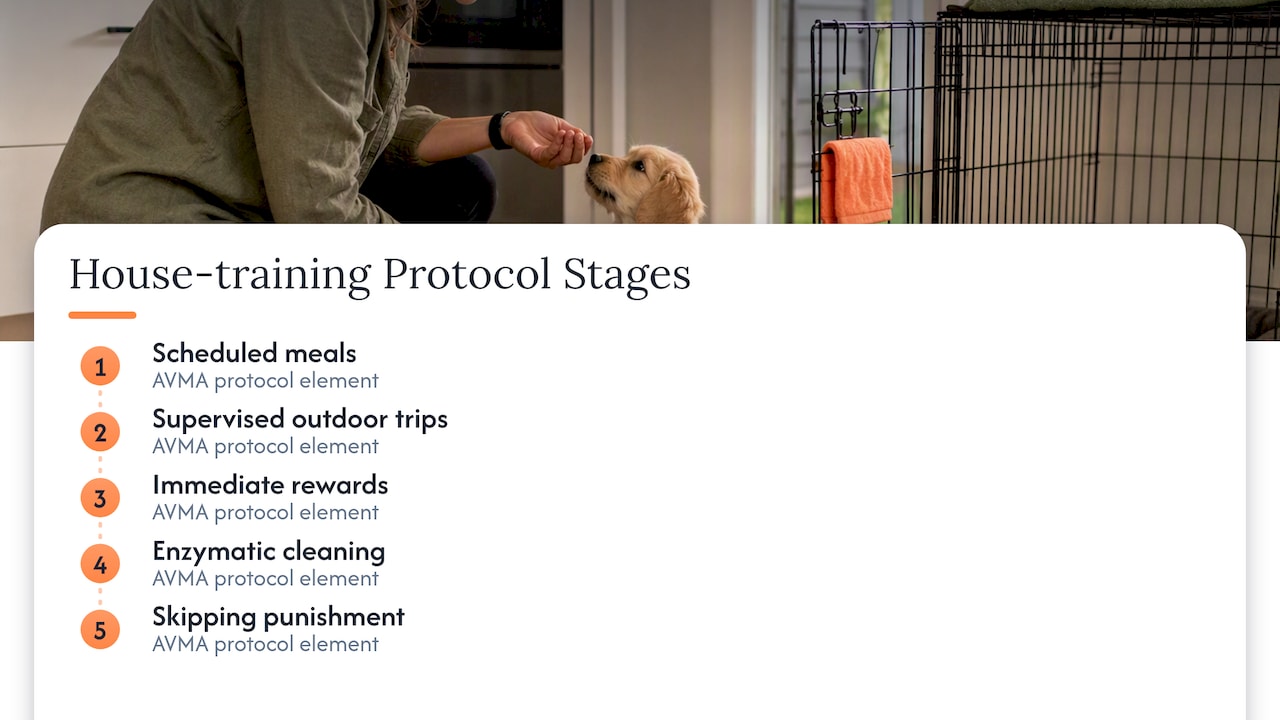
This isn’t guesswork. The AVMA-published house-training protocol found that scheduled meals, supervised outdoor trips, immediate rewards, and enzymatic cleaning, paired with skipping punishment, consistently improved house-training outcomes. The hard part for most new owners isn’t knowing this, it’s doing it consistently every single day. That’s the gap Rebarkable’s week-by-week email guidance is built to close, with crate training and potty training lessons timed to where your puppy actually is.
What new owners get wrong about crate accidents
Most owners treat each accident like a setback. It’s not, it’s data. The fix is almost never punishment, it’s tighter timing and a more predictable routine. Track your intervals, reward the wins, and the pattern changes faster than you’d expect.
— Ali
Rebarkable: weekly, science-backed help for crate accidents
Crate accidents rarely get solved by one article, they get solved by consistent, well-timed repetition over weeks, which is exactly what’s hard to manage alone with a new puppy underfoot. A structured, science-backed training program delivering regular guidance by email across a full year covers potty training, crate habits, and common behavioral challenges for new owners.

Instead of piecing together advice from a dozen tabs, you get it timed to where your puppy actually is, week by week, at a pace that fits a busy schedule. If you want a quick next step before committing to the full program, our potty training quick-tips are a solid starting point. Ready for the full year of support? Check out Pupdates and see what fits your household.
FAQ
How do I get my puppy to stop peeing in his crate?
Shorten confinement time, take your puppy straight to the same potty spot after every crate session, and reward elimination immediately. Clean accidents with an enzymatic cleaner to remove scent cues, and rule out a medical cause if accidents keep happening despite a tighter schedule.
At what age do puppies stop peeing in their crate?
There’s no fixed age, it depends on the individual puppy’s bladder control and how consistent the schedule has been. The age-in-months-plus-one-hour rule is a useful planning estimate, not a guarantee, and some puppies need longer than others to reach reliable control.
Why is my dog peeing in his crate all of a sudden?
A sudden change after previously reliable behavior often points to a medical issue like a urinary tract infection, so a vet check is the first step according to VCA guidance. If your vet rules out health causes, look at recent changes in schedule, crate size, or stress levels instead.
How long can a puppy hold pee in a crate?
VCA Animal Hospitals notes most puppies need a potty break after roughly three hours of confinement, though this varies by individual. Treat any age-based rule as a starting estimate and shorten the interval whenever accidents happen.
Sources
- Effects of preadoption counseling for owners on house‑training success (JAVMA)
- Urinary tract infections (UTIs) in dogs | VCA Animal Hospitals
Recommended
- Puppy Crate Crying: First-Night Triage and a 14-Day Plan
- Crate training: Training Your Puppy To Love Their Crate.
- Crate Training Your Puppy: 35 Essential Questions with Easy Answers
- The 11 Golden Rules Of Crate Training Your Puppy – Learn These Before You Start!

0 Comments