The Ruffwear Grip Trex are still one of my favourite dog boots for hiking and rough terrain. I tested them with Indie, my German Shepherd, on trails and rocky ground, and the things I liked most — the grippy Vibram sole, secure fastening and ability to buy different sizes for front and rear paws — are still part of Ruffwear’s current Grip Trex design.
They’re not a boot I’d put on a dog for every ordinary walk, and getting the sizing right matters enormously. But if I actually need paw protection and traction rather than a decorative dog shoe, these are a pair I’m happy to use.
Ruffwear Grip Trex: Quick Verdict
- Best for: hiking, rough terrain, hot surfaces and situations where paws genuinely need protection.
- Biggest strengths: Vibram outsole, traction, secure closure and separate front/rear sizing.
- Watch for: careful sizing, gradual introduction and checking for rubbing or gait changes.
- My verdict: yes, I recommend them when your dog actually needs boots.
Does Your Dog Actually Need Boots?
Not necessarily. Healthy dog paws are pretty capable, and I don’t use boots simply because we’re going for a walk. I reach for them when the environment creates a genuine reason for extra protection or traction — sharp or abrasive terrain, very hot surfaces, ice and snow, road salt, or situations where a dog needs additional grip.
For winter specifically, remember that Grip Trex are the rugged, breathable option rather than Ruffwear’s insulated winter boot. If snow, ice and cold are your main problem, a winter-specific design may make more sense.
When should I use boots for my dog?
Some great ideas of when to introduce boots are:
- Cold weather
- Hot weather
- Rough terrain
- Slippy surfaces
- Hiking
- Salty surfaces
These are all instances where we may be asking our dogs to do things where they would benefit from a little extra grip, or an extra protective surface between their paws and whatever it is we’re walking on together.
Personally, Indie and I tend to use this when we’re on mountain trails. Indie (my German shepherd) does like to clamber over rocks, and given we’re new to the US, there’s a few rocks here that he’s never really understood, we don’t get a whole lot of volcanic rock in the UK, so the Appalachians are a seriously new environment for us to be exploring.
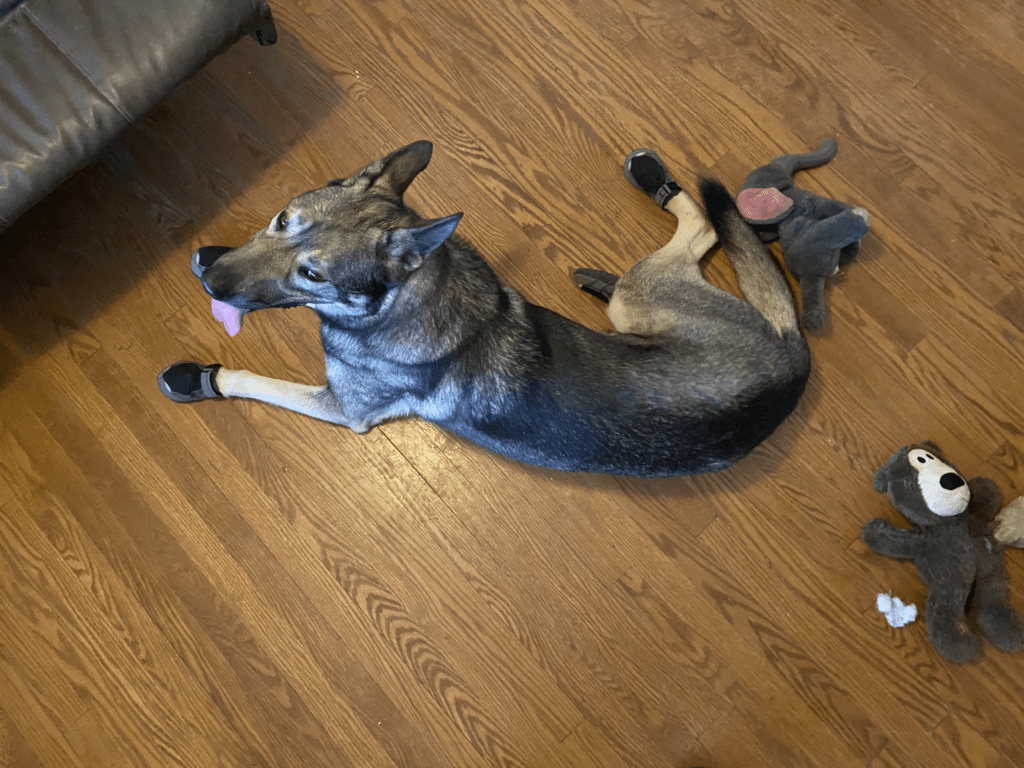
How to help your dog love their boots
It’s really important with boots in particular that you make a positive introduction, and as much as possible, this should be an experience that is relaxed and not stressful (because let’s face it, if it’s a war, you know who’s going to win and come back without their new shoes when you’re out on a hike.)
I know it’s so tempting to just pop them on and look at your dog in boots and watch them be silly? But that’s not necessarily going to reach your goals for boot wearing.
I’m starting this with the assumption that your dog doesn’t mind their paws being touched, but if they do, then do make sure to desensitise this first.
Step 1 – Visual introduction
First! when you get rid of the packaging, sit on the floor with your dog, show them the boots, and praise reward, hiding the boots swiftly afterwards.
You’ll quickly notice that the appearance of the boots becomes a predictor for a reward – and this is absolutely what you’re looking for.
Step 2 – Interaction
You can pop those suckers on the floor, and put treats around and under them. This should encourage your dog to interact with them. This will create trust, normalise their presence and push away uncertainty.
Call that session to a halt wherever you need to and then.
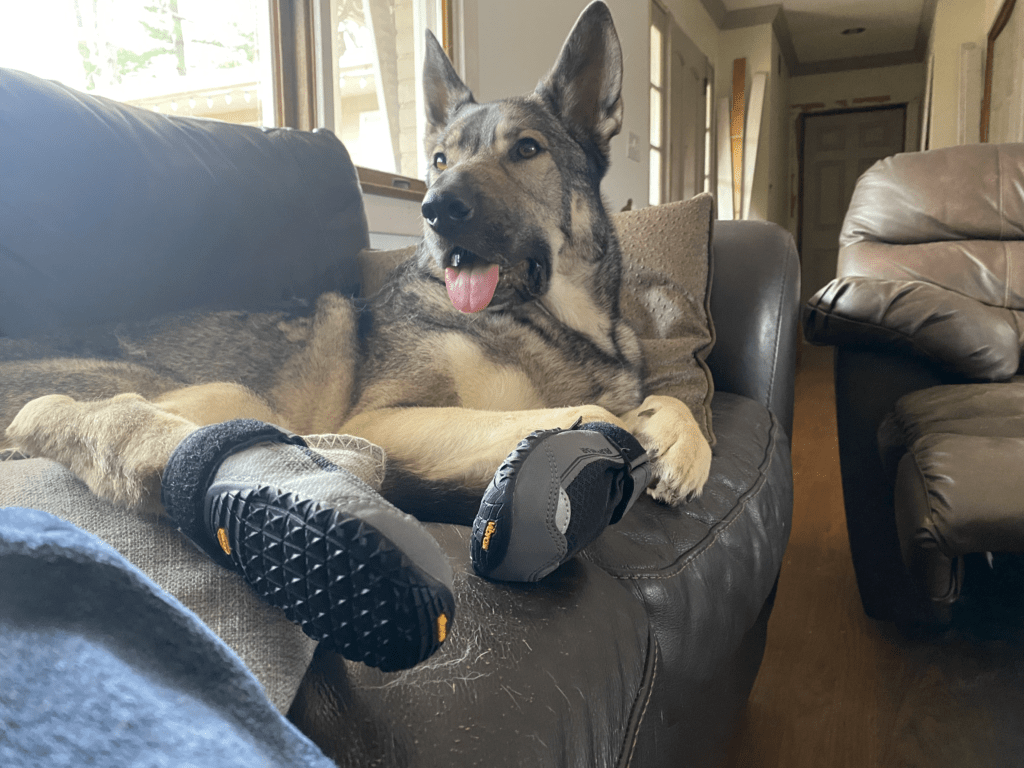
Step 3 – Start with one.
When you’re chilling on the sofa, take one boot, and test it out. You may not want to fasten it at this stage, but if your dog is readily accepting this? Then pop it on! Reward your dog, and remove the boot.
It’s really important that if you see signs of stress or discomfort, then try and back up, take it back a step and do it gently.
Step 4 – Move it forward
Then, when this is a relaxed process, secure the boot, and if your dog isn’t too worried, see if they’ll go for a little wander around your home, yard and driveway! This will allow you to test the fit and size.
Initially you can expect that your dog is gonna do that silly walk, but they should adjust quickly.
Then more boots at one time until you get all of them on together and it looks like adventuring time for you both!
Remember to monitor!
Monitoring the fit on these is really important. When you’re out, compare their gait to how they normally walk. After every hike or excursion, check your dogs paws and make sure there are no sores or rubbing points.
Introducing the Ruffwear Grip Trex Boots

The ruffwear grip trex boots come in neutral colors and in a lot of sizes. Fitting them is really easy, and I'm delighted with how well they stay on Indie's paws.
- Durable
- Really Grippy
- Easy to fit
- Quick dry
- Easy to adjust
- Lots of sizes
Why I love the Ruffwear Grip trex
Comfort
They appear to be pretty comfortable! Indie took to them pretty easily, minimal kicking to try and get them off (almost like I know what I’m doing). And they seem to work as they are meant to, we’ve taken a number of walks, no chafing has been experienced, they definitely give Indie more grip. He’s catching corners, and pushing more on jumps than he would normally, which means that suddenly? We’re both getting more brave with our hikes!
Front & Back Pairs
This remains one of my favourite features. Ruffwear currently sells Grip Trex in sets of two specifically because front and rear paws can be different widths. Indie ended up in 3-inch boots on the front and 2.5-inch boots on the back, so being able to size each pair separately gave him a much better fit than buying four identical boots would have.
Secure Fasteners
The tightening straps are cute and super functional! The most common ‘gripe’ I hear about boots is that they fall off – and initially – yeah, these did too. But I tinkered with the fit via this little strap, and presto, no longer flying off as Indie whips around a corner.
Soles Full Of Soul
Lastly, the soles. They’re made by Vibram, masters of shoe soles, and it shows. Dog feet move in a much more dexterous way than human feet, and consequently, the sole had unique needs that Vibram have truly met.

Possible problems with the Ruffwear Grip trex Dog Boots.
Sizing Has To Be Right
Measure every paw while your dog is bearing weight, across the widest part. Ruffwear’s current fit guide says to size down if your measurement falls between sizes, and specifically reminds owners that front paws can be wider than rear paws. Don’t assume one measurement represents all four feet.
Once they’re on, watch your dog move rather than judging fit while they’re standing still. Ruffwear also recommends checking and adjusting the closure after about 15 minutes of activity and continuing to check it during the adventure. I’d also inspect the paws afterwards for rubbing, redness or sore spots.
Breathable but…
So they are breathable, the fabric is created light and Indie has been absolutely fine when in water, or even running around, but hot days? He struggles.
It’s good to note that this is the one the place that your dog sweats, and whilst they are definitely breathable, I have found that Indie does heat up quicker when wearing them. It’s not something that has worried me just yet, but it’s something I’m conscious of for summer.
Requires properly trimmed claws
As a warning, proper claw care is paramount regardless of whether you plan on using boots or not – but boots will absolutely accentuate any pain or discomfort caused by long claws. So, if your dog is showing a dislike to their boots, or is limping after wearing them, check their claw length.
If you’re not sure, or not confident doing this yourself (it is definitely more difficult with black claws), then just make sure to take regular groomers visits!
Be Careful Of Harefoot Dogs
So, certain breeds (particularly sighthounds) are ‘harefooted’ this means that their paws are longer, but narrower than the average dog, consequently, these sorts of boots may not work for those dog breeds.
If you’re not sure if your dog is harefooted? You can always have a chat with your breed experts, or return the boots if they don’t work so well.
Are Ruffwear Grip Trex Worth It?
For dogs who genuinely need durable paw protection, yes. Grip Trex give Indie noticeably better traction on difficult terrain, they have held securely once properly fitted, and I like the flexibility of sizing the front and rear paws separately. The Vibram outsole is also still a defining feature of the current model.
I wouldn’t buy expensive boots simply because dog boots look cute, and I wouldn’t expect any boot to compensate for pain, poor mobility or unsafe terrain. But for hiking, abrasive ground, hot surfaces and other environments where I want a physical layer between Indie’s paw and the ground, these have earned their place in our gear.
This is an affiliate link. Rebarkable may earn a commission if you buy through it, at no extra cost to you.
If your dog has never worn boots before, don’t skip the conditioning process: my step-by-step guide to teaching a dog to wear boots goes through it separately. And for the rest of your trail setup, see my recommended hiking gear for dogs.

Author, Ali Smith
Ali Smith is a professional, qualified, and multi-award winning trainer is the founder of rebarkable. She has always believed animals deserve kindness and champions force free methods. Believing that dog guardians will all choose the kindest options if proper information is provided, she aims to help all dog guardians who need it and make dog training as accessible as possible
Ali lives win Maryland, US with her husband and her three dogs.


0 Comments