Redbone Coonhounds are often described as mellow family dogs who transform into relentless athletes when they catch a scent. And honestly? That isn’t a bad summary.
But it leaves out quite a lot. Like the volume. The prey drive. The fact that “mellow” may depend heavily on whether your hound has had a good sniff, something to chew and access to a sofa. Or that a stressed hound can howl for an hour or two straight—and no, I’m not exaggerating.
I’m a professional dog trainer, and I live with two senior coonhounds, Lucy and Shelby. They are Redbone–Bluetick mixes rather than purebred Redbones, so I’m not going to pretend that every quirk they possess came neatly from one side of their ancestry. However, they have given me years of firsthand experience with the reality of living with Redbone-type working hounds.
They are affectionate, hilarious and deeply lovable. They are also absolutely not the right dogs for 99% of first-time guardians. If you are still deciding whether this entire family of scent hounds suits you, start with my guide to what you need to know before getting a coonhound.
Redbone Coonhound at a Glance
| Trait | What to Expect |
|---|---|
| Temperament | Friendly, affectionate, independent and generally sociable |
| Energy | Built for endurance, but many have a serious off-switch once fulfilled |
| Noise | Extremely vocal; baying carries a very long way |
| Prey drive | Very high—anything from a vole to a bobcat may count as quarry |
| Trainability | Intelligent but not naturally biddable; rewards need to compete with instinct |
| Grooming | Simple coat care, but short hairs embed themselves in fabric |
| Best home | Patient, active, preferably rural, securely fenced and comfortable with noise |
What Was the Redbone Coonhound Bred to Do?
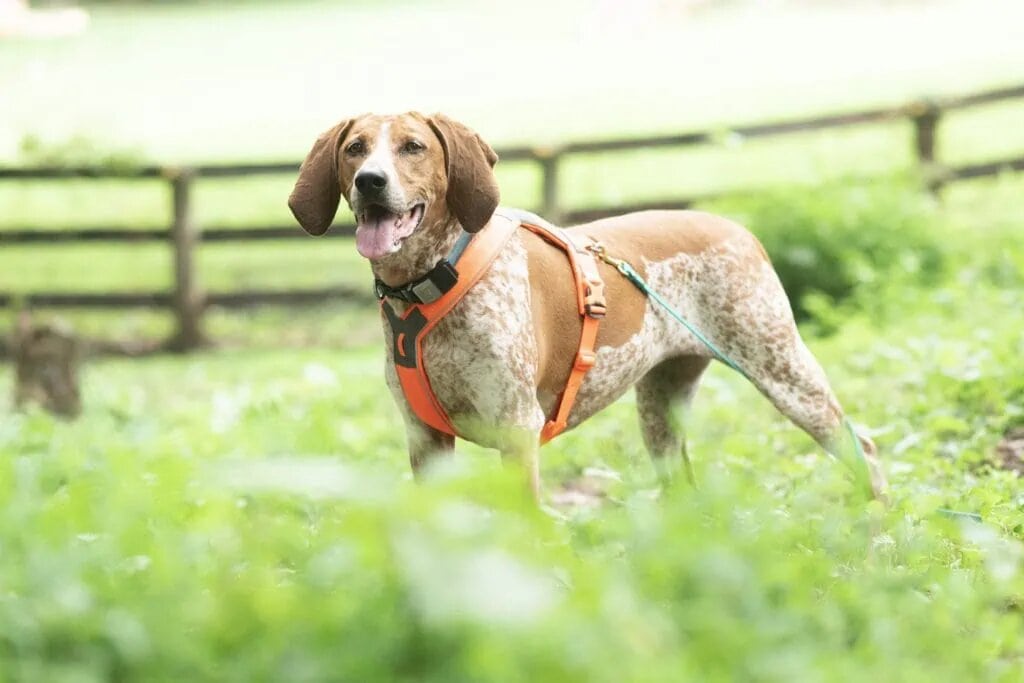
Redbones are American working hounds developed to follow scent across difficult terrain, pursue prey and hold it at a tree by baying until the hunter arrives. The American Kennel Club describes the breed as mellow at home but formidable on the trail, with vigorous activity followed by long periods of rest.
That working history explains almost everything about living with one.
They were not bred to remain beside a person and wait for constant direction. A good coonhound was expected to work at a considerable distance, solve problems independently and use their voice to tell the human where to find them.
So when a Redbone appears “stubborn,” it is worth remembering that independence was part of the original job description. You didn’t buy a broken Labrador. You brought home a dog whose ancestors were selected to believe their own nose.
Are Redbone Coonhounds Lazy?
They can be gloriously lazy—once their needs are met.
Shelby has a serious stop button. Give her a good opportunity to sniff, ideally something satisfying to chew, and a sofa, and she is very happy to commit to doing absolutely nothing.

That doesn’t mean Redbones are low-energy dogs. The breed was developed for endurance and can cover substantial distances when working. The laziness is better understood as an off-switch: many are capable of working hard and then resting hard. Problems usually arise when we confuse high drive with a need for nonstop physical exhaustion; I cover that distinction in my guide to common mistakes with high-drive dogs.
Lucy demonstrates why we shouldn’t turn a breed tendency into a guarantee. She is a busy bee who finds it much harder to remain still or regulate herself. Both dogs have the same broad mix, yet their individual needs and nervous systems are quite different.
If you want a dog who will enjoy a hike and then occupy the sofa for the rest of the day, a fulfilled Redbone may do exactly that. If you want to skip the sniffing and enrichment and go directly to the sofa, your hound may have other plans.
Redbone Coonhound Temperament: Is Everybody a Friend?
In our house, yes.
If a visitor isn’t put off by the Tigger impression and a hound howling directly into their face, everybody is a friend. Lucy and Shelby are equally enthusiastic members of the welcoming committee.
That friendliness can be physically overwhelming. A large, excited hound bouncing, baying and trying to greet at face height may frighten people even when the dog’s intentions are entirely social.
Teaching four paws on the floor, reinforcing calmer greetings and giving visitors clear instructions all help. But prospective guardians should know they may be getting a lot of extremely friendly dog delivered at extremely close range.
How Loud Are Redbone Coonhounds?
Loud loud.
I give our neighbors gifts during the holidays as a thank-you for putting up with the hounds. That is a more useful measure than saying the breed is “moderately vocal.”
A coonhound’s voice was designed to travel. Baying allowed hunters to locate a dog working far away through woods and over uneven ground. Inside a house—or six feet from you in the yard—that voice remains impressively effective.
Lucy and Shelby can howl for one or two hours continuously. That is not a joke or exaggeration. After one particularly rough night of fireworks, Shelby howled herself hoarse.

Noise can begin with prey, frustration, excitement, visitors, fear or apparently very little. Once a hound becomes highly activated, they may find it difficult to come back down even after the original trigger has disappeared.
Sniffing can help, but sleep is paramount. Sometimes there isn’t a clever training trick that instantly ends the arousal. The difficult part is helping an overstimulated, overtired hound settle enough to get the sleep they need.
If you have close neighbors, thin walls or a low tolerance for prolonged vocalization, I would think very carefully before getting a Redbone.
Prey Drive: Everything Is Game
The prey drive is serious.
For our hounds, everything from a vole to a bobcat potentially counts as quarry. Deer are a particularly significant distraction on our wooded property.
This is where people can make a dangerous mistake: a Redbone may be exceptionally friendly with humans and other dogs, but that does not automatically make them safe around smaller animals.
Our rabbits and hounds are kept very separate. The rabbits have learned that they don’t need to run, which means they are less likely to trigger an immediate chase response—but that does not make unsupervised contact safe. It means careful management has prevented the most obvious trigger from starting the sequence.
Our ducks and rabbits have secure areas of their own. I would not rely on goodwill, familiarity or one apparently peaceful interaction when the consequences of being wrong are so high.
Are Redbone Coonhounds Easy to Train?
They are intelligent, but they are not naturally biddable in the way many Labs or German Shepherds are.
The key is a long history of reward. You have to prove that listening to you is worthwhile—not once, not occasionally, but repeatedly across different environments and levels of distraction.
That is especially true around prey. I use ordinary cookies for easy repetitions, but chicken hearts and liver treats come out for the big moments, such as asking the hounds to disengage from deer.
If a one-cent cookie helps ensure my dog returns, I’m paying the cookie.
Recall was the hardest behavior for Lucy and Shelby. When prey is present, I first use the dog’s name to ask for attention. The moment I get it, I mark and praise—“Yes!” or “Good girl!”—then cue “Come,” become exciting and cheer them throughout the return.
The cheering matters because returning from prey may involve choosing you again with every step.
I cover the full process in How to Train a Coonhound When Their Nose Is More Interesting Than You.
Don’t Feed Them Into Submission
Coonhounds are often highly food motivated, and cupboard love is wonderful—but don’t be tempted to feed them into submission.
There is a difference between using food strategically to reinforce difficult behavior and responding to every soulful hound expression by opening the treat cupboard. Redbones are extraordinarily good at looking as though nobody has fed them since 1973, including immediately after dinner.
Training treats still count as food. Use small pieces, account for them within the dog’s overall intake and reserve the truly valuable rewards for moments that justify them. You can also reward with sniffing, access to an interesting trail, play, attention or whatever else that individual dog genuinely values.
Affection does not have to arrive in edible form. A long sniff, a satisfying chew, shared time outdoors and room on the sofa are all healthier ways to show your hound that you love them.
Food Manners Can Be Trained
That powerful nose does not switch off when your hound enters the kitchen, but food motivation does not mean you have to accept constant counter surfing.
We have almost no counter surfing now. Lucy has, however, stolen whole tuna steaks from directly behind my husband’s back. One successful theft can be spectacular because, from the dog’s perspective, checking the counter just produced an entire fish dinner.
Shelby has taken a more direct approach and chewed cookies out of my pockets—and I do not mean through the opening. She chewed straight through the fabric to reach them. Apparently both waiting for the reward and using the designated pocket entrance were unnecessary administrative steps.
Both stories demonstrate food motivation, not an inability to learn boundaries. Counter surfing can absolutely be trained. Prevent successful thefts while teaching and rewarding practical alternatives, such as settling on a mat outside the cooking area. Be consistent, because an occasional tuna-steak jackpot can keep the behavior worthwhile for a very long time.
I have a full guide to stopping counter surfing. Coonhounds are capable of excellent food manners; they simply make you earn them.
Exercise Isn’t Just About Miles
Redbones need physical exercise, but running them into the ground isn’t the complete answer. They are genuine long-distance running dogs, built to keep moving over difficult terrain when a scent takes them somewhere interesting. Their breed history includes cold-trailing and extended work across swamps, mountains and rough ground, which the AKC’s Redbone history explores in more detail.
Shelby once chased a deer for roughly two miles and arrived home pleased as punch. The recovery looked like a Benny Hill skit, complete with police and the whole nine yards—or, more accurately, two miles. She did not return looking regretful or suitably chastened. She looked like she had enjoyed an excellent outing.
That story is funny now because she came home safely, but it also demonstrates why exercise alone will not remove a coonhound’s desire to run and why secure fencing matters. A fit Redbone may simply become even more physically capable of following prey over distance.
Scent is the point.
A good sniff allows them to perform a version of the work their brain expects. Long-line walks, tracking games, searching for scattered food and being allowed to investigate the environment can be far more satisfying than marching quickly around the same block.
Chewing can then help bridge the gap between activity and rest. For Shelby, the ideal formula is straightforward: sniff, chew, sofa.
Lucy needs more deliberate help with regulation. More activity is not always the answer for a dog who is already struggling to come down. Exercise, decompression and sufficient sleep have to work together.
Do Redbone Coonhounds Smell?
They can have a noticeable hound smell, but I find it becomes stronger when mine are eating lower-quality food.
That doesn’t mean diet is the only possible cause of odor. Skin problems, ear infections and dental issues deserve veterinary attention, particularly if the smell changes suddenly. But in our dogs, food quality has made a real difference to their everyday houndiness.
Their long ears also need regular checking. Floppy ears can trap warmth and moisture, so unusual odor, redness, discharge or frequent head shaking shouldn’t be dismissed as “just the breed.”
Shedding, Drool and Grooming
Redbone coat care is relatively simple. The short coat doesn’t require elaborate grooming, and I don’t consider Lucy and Shelby extreme shedders.
The problem is where the hair goes.
Short hound hairs have an impressive ability to work themselves into upholstery, blankets and clothing. There may not be dramatic piles of fluff, but the individual hairs become part of the fabric’s long-term design.
Drool is manageable most of the day and considerably more enthusiastic around food. If dinner is being prepared, expect the face furniture to participate.
Then there are the claws. Coonhound claws are like iron. They are thick, strong and not remotely apologetic when attached to a large dog performing a Tigger impression. Regular nail care matters, but you should still expect those feet to be remarkably effective pieces of equipment.
Redbone Coonhounds Dig—Plan Accordingly
Redbones can dig, and they can be extremely efficient about it. Those iron claws were not designed merely to look decorative at the end of the leg.
Digging may be driven by scent, prey, boredom, temperature, escape motivation or the simple discovery that something interesting exists beneath the ground. A standard fence can therefore look secure while having a very obvious coonhound-sized weakness underneath it.
Check fence lines regularly, particularly around gates, corners and anywhere wildlife travels. Depending on the individual dog, you may need buried wire, inward-facing ground barriers or another physical anti-dig solution. Providing an approved digging area can satisfy dogs who genuinely enjoy excavating, but it does not remove the need to secure the perimeter.
Do You Need a Fence for a Redbone Coonhound?
In my opinion, a secure physical fence makes life with a coonhound substantially safer and less stressful.
A scent can carry them farther than expected, and prey drive can override otherwise useful training. Gates must latch properly, visitors need to understand the rules and the fence itself needs regular checks.
Honestly, if you are bringing home a coonhound, be prepared to lose them at least once.
I don’t mean you should shrug and treat escapes as inevitable or acceptable. I mean you should build your safety plan as though one will eventually happen. I do not personally know a coonhound guardian who hasn’t had an escapee-dog story. These dogs can dig, follow scent over distance and exploit the sort of tiny gate or fence failure that another dog might never notice.
That preparation should include current identification, reliable recall training, secure fencing, properly fitted escape-resistant equipment and a genuine GPS tracker fitted before you need it—not ordered after your hound has disappeared into the woods.
My recommendation is Fi GPS collars. Lucy and Shelby wear theirs around the clock because management layers sometimes fail. A guest can leave a gate semi-latched. A tree can damage a fence. A tired human can make a mistake.
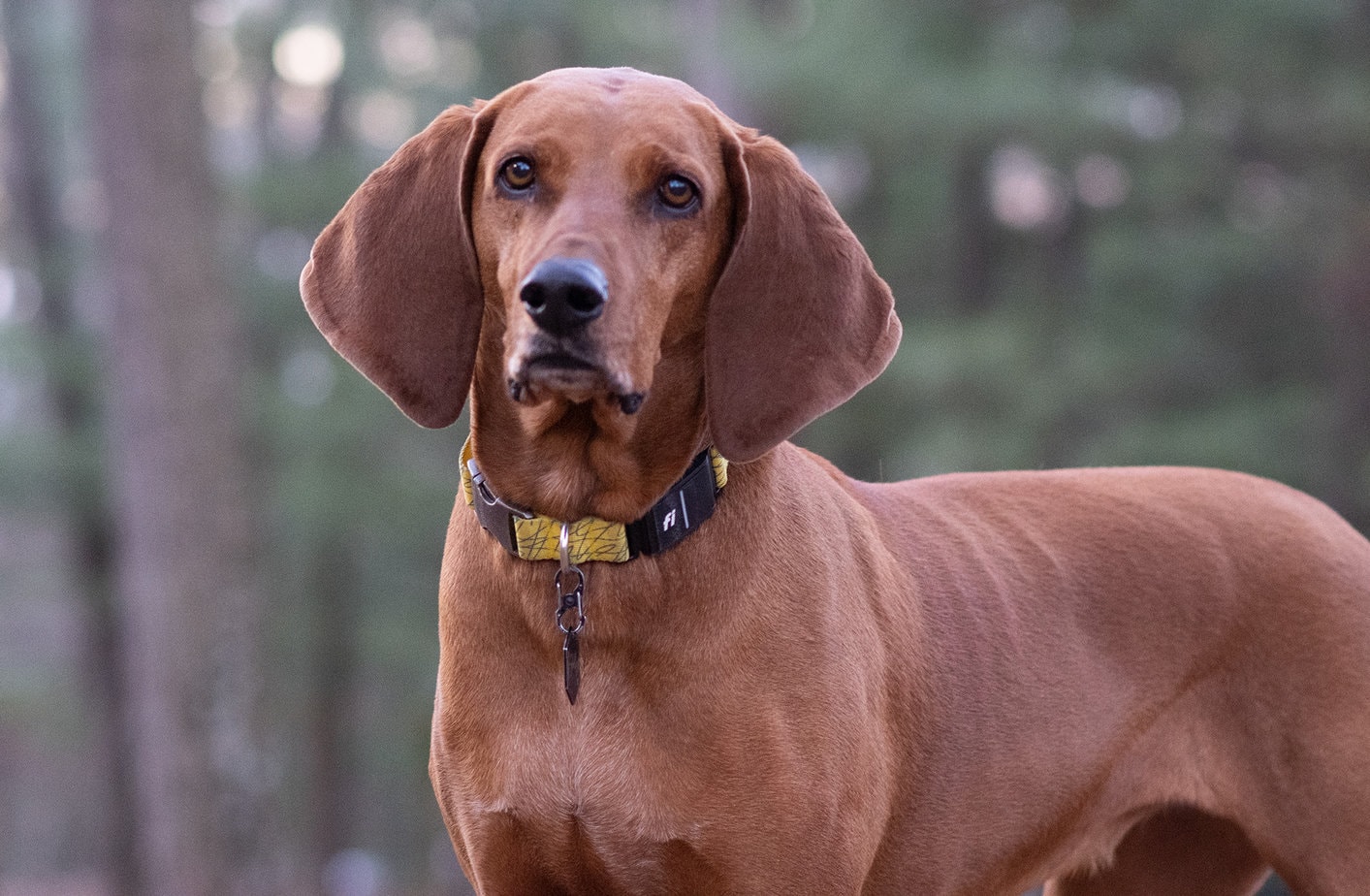
Fi has worked well for us on our remote, densely wooded property, where a crowdsourced Bluetooth tag such as an AirTag may not encounter enough nearby phones to provide useful location updates. A proper tracker gives me escape alerts and live location information rather than simply hoping somebody carrying the right phone passes close to my missing dog. I compare the available options in my guide to the best GPS trackers for dogs.
A tracker is not a substitute for fencing or training, and no device guarantees recovery. But it can turn a frightening escape into a traceable route home—which is an enormous difference when your dog is capable of following prey for miles.
Are Redbone Coonhounds Good for First-Time Guardians?
Not for 99% of them.
The rare exception would be someone who:
- Lives rurally or has access to suitable outdoor space
- Has a secure physical fence
- Is genuinely comfortable with a very loud dog
- Has enormous patience
- Wants to understand working-hound behavior rather than suppress it
- Is ready to provide substantial exercise, sniffing and enrichment
- Will use careful management around wildlife and smaller animals
A committed first-time guardian can absolutely learn. But wanting a friendly red dog is not enough. You have to want the nose, the voice, the independence and the working instincts too.
What Is Living With a Redbone Coonhound Really Like?
It is affectionate, noisy, funny and occasionally absurd.
You may get a dog who tackles the world and then sleeps like it is a competitive sport. You may get a Lucy, who is perpetually busy and needs considerably more help learning how to settle. Most likely, you will get an individual somewhere between the breed descriptions and their own unique nervous system.
The best Redbone home doesn’t merely tolerate the dog’s instincts. It plans for them.
Give them safe places to sniff. Reward them properly. Expect prey drive. Secure the property. Protect the small animals. Help them sleep. Warn the neighbors.
And perhaps add the neighbors to your holiday shopping list.


0 Comments