Yes, your puppy can meet other dogs now, even before the vaccine series is finished, as long as you choose the setting carefully. The safest first move is a short, controlled meeting with a fully vaccinated, known dog, or an instructor-led puppy class that checks vaccine records at the door. Keep it brief, keep it positive, and plan to repeat such meetings regularly rather than treating one big playdate as “done.”
TL;DR:
- Vaccination series typically finish after 16 weeks, making high-traffic areas risky until then, but early socialization with vaccinated dogs is advised.
- Controlled, brief meetings with known, vaccinated dogs in low-distraction settings build social confidence more effectively than prolonged playdates.
- Reading your puppy’s body language during meetings helps prevent escalation, with calm signals rewarded and signs of stress or aggression requiring immediate separation.
- Off-leash greetings are safer than on-leash introductions, as tension from leashes can trigger reactive behavior and hinder normal social signals.
- Regular, repeated socialization sessions during the critical 3 to 14 week window foster confidence, provided owners schedule these exposures consistently over time.
Table of Contents
- When is it safe to start puppy meeting dogs?
- What to prepare before your puppy’s first introduction
- The step-by-step method for a puppy’s first dog meeting
- Why leash greetings can backfire, and what to do instead
- How to read your puppy’s body language during a meeting
- Troubleshooting common puppy meeting problems
- How the research lines up and where structured training helps
- Our honest take on risk versus missed socialization
- Get ongoing support with Rebarkable’s 52-week program
- FAQ
- Sources
When is it safe to start puppy meeting dogs?
The honest answer is: it depends on where you meet, not just how old your puppy is. The AAHA 2022 canine vaccination guidelines recommend starting core vaccines at about 6 to 8 weeks, with boosters every few weeks and a final core dose sometime after 16 weeks. Full protection generally isn’t locked in until that series wraps up, which is exactly why high-traffic dog parks should be avoided until later in the puppy’s vaccination course.
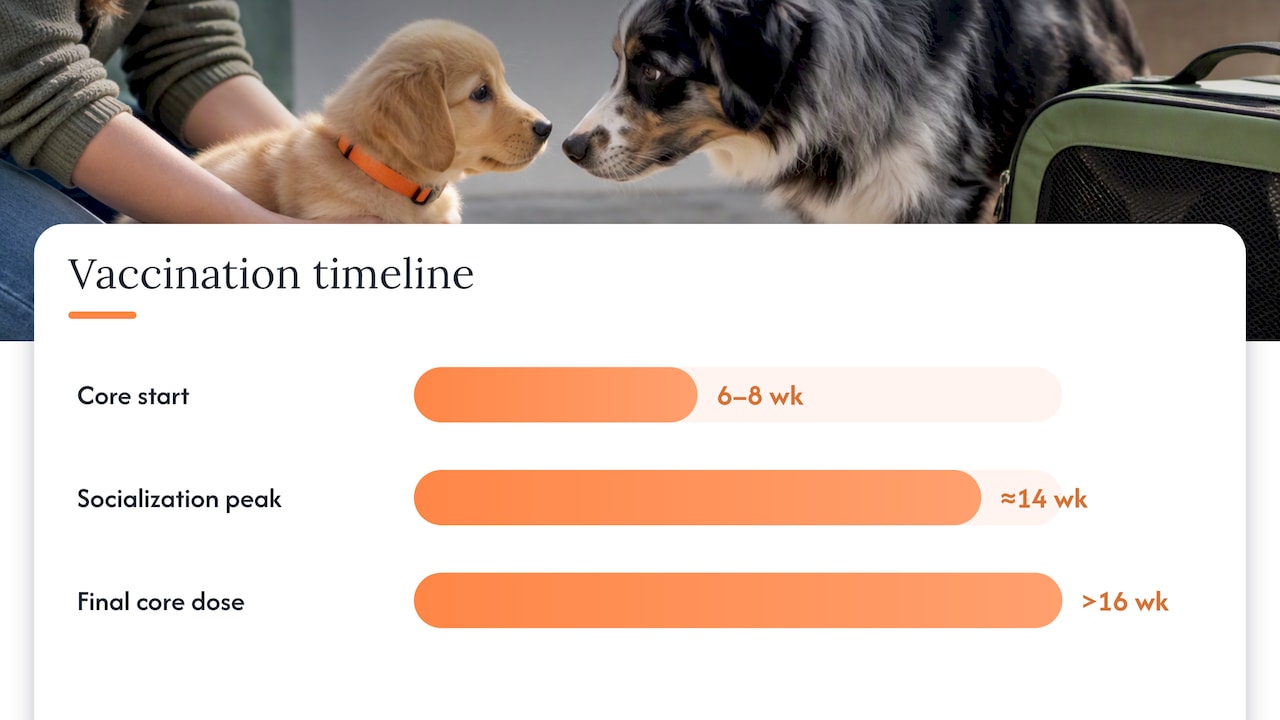
Here’s the catch: the AVSAB puppy socialization position statement identifies a critical socialization window lasting from early infancy through about 14 weeks, meaning the behavioral clock and the vaccine clock don’t line up. Waiting for full immunity before any socialization risks a fearful, poorly adjusted adult dog.
AVSAB’s answer is to socialize smart, not to skip it. Safer options while your puppy finishes the series include:
- Private playdates with dogs you know are fully vaccinated and healthy
- Instructor-run puppy classes that require proof of vaccination and parasite control
- Brief, supervised visits with a neighbor’s calm, vetted dog
AVSAB and AAHA guidance together suggest that controlled, vetted socialization during the early weeks up to around 14 weeks carries far less behavioral risk than waiting. We cover this balance in more detail in our guide to socializing a puppy before vaccinations and in our breakdown of why the critical socialization period matters.
What to prepare before your puppy’s first introduction
A little prep turns a risky free-for-all into a manageable, low-stress meeting. Before you head out the door, get these basics sorted.
- One handler per dog, never one person juggling two leashes
- A 4 to 6 foot flat or leather leash; skip the retractable ones, they give you zero real control
- A neutral, low-distraction location with a clear escape route if things go sideways
- High-value treats, sanitation wipes for shared toys or surfaces, and a mental note to ask about the other dog’s vaccination status
Text the other owner ahead of time to agree on expectations: how long you’ll stay, what to do if either dog seems stressed, and who’s calling it if the meeting needs to end early.
Pro Tip: Ask the other owner to bring their own water bowl and favorite toy rather than sharing yours, it cuts down on both mess and disease exposure.

The step-by-step method for a puppy’s first dog meeting
Treat the first meeting like a sequence, not a single event. Each stage gives both dogs a chance to settle before raising the stakes.
- Arrival: Keep the dogs separated at first and let them see each other from a distance without approaching.
- Parallel walk: Walk side by side, several feet apart, so both dogs can observe each other while moving instead of staring face to face.
- Controlled approach: Pause with leashes slack, and only let them sniff briefly if both dogs look loose and relaxed, not stiff or frozen.
- Short supervised play: Cap it at 3 to 10 minutes. Watch closely for escalating excitement and end the session while it’s still going well.
- Wrap-up: Separate the dogs, reward calm behavior with treats, and plan to repeat another short session soon rather than pushing for one long hangout.
That last step matters more than most owners realize. Research on exposure and habituation in puppy socialization suggests that several brief, positive meetings build comfort faster and more reliably than one marathon play session. If you’re introducing your puppy to an older resident dog rather than a visiting playmate, our guide to helping a puppy bond with an older dog walks through the added considerations.
Why leash greetings can backfire, and what to do instead
A tight leash changes everything about how a greeting goes. Leash tension pulls a dog’s head up and body stiff, which other dogs often read as a threat, and that mismatch can trigger barking, lunging, or outright reactive behavior. Guidance from Whole Dog Journal on leash greetings points out that on-leash meetings often create exactly this kind of frustration, since the leash removes a dog’s normal option to walk away.
Where possible, favor moving greetings or supervised off-leash meetings in a safely enclosed space. If an on-leash greeting is unavoidable, keep the actual face-to-face contact under 5 to 10 seconds.
- Keep leashes loose and keep walking rather than letting dogs plant and stare
- Add distance the moment you feel leash tension building
- Use simple owner cues like “let’s go” or “go say hi” to signal what happens next
Pro Tip: If tension keeps creeping back in, stop trying to force a greeting and switch to another parallel walk instead; some dogs just need more distance, longer.
How to read your puppy’s body language during a meeting
Dogs talk constantly, just not in words. Learning the short list of signals tells you whether to relax or step in immediately.
- Calm: relaxed mouth, play bows, soft eyes, loose wiggly body
- Mild stress: yawning, lip licking, turning away, tucked tail, freezing in place
- Escalation: hard stare, stiffening, growling, snapping
When you see calm signals, reward and let the meeting continue. Mild stress means give the dogs more space or redirect attention to you. Any sign of escalation means separate immediately, no exceptions. A partner resource on reactive dog behavior breaks down these stress signals in more depth if you want to get sharper at spotting them early.
Troubleshooting common puppy meeting problems
Not every introduction goes smoothly, and that’s normal. Here’s how to handle the situations that come up most.
- Shy puppy: use graded exposure, pair new dogs or people with treats, and let your puppy watch from behind a barrier before engaging
- Boisterous puppy: burn off energy with exercise first, keep meetups short, and practice a calm sit before any greeting
- Stressed resident dog: build in breaks, use a crate or gate for separation, and reward calm coexistence rather than forcing interaction
If escalation keeps happening, or you see severe fear, aggression, or resource guarding, that’s your cue to bring in a professional trainer rather than keep troubleshooting solo. Our piece on socializing a playful puppy has more on pacing these sessions for puppies who run hot.
How the research lines up and where structured training helps
Everything in this guide traces back to the same two anchors: the AVSAB puppy socialization position statement on the 3 to 14 week window, and the AAHA vaccination guidelines on vaccine timing. Add in the AVMA’s guidance on disease risk in social settings, which recommends vaccination and parasite control before group exposure, and the picture is consistent: socialize early, socialize smart.
What trips owners up isn’t the knowledge, it’s consistency. Short, repeated exposures only work if you actually schedule them week after week.
- Weekly structure keeps socialization from becoming a one-off event
- Repetition builds the owner management skills this guide describes, not just puppy comfort
- Our related guides on puppy dog park timing and bonding with an older dog extend this same approach to specific situations
Our honest take on risk versus missed socialization
We get why disease risk scares new owners, it’s a real concern and the AAHA and AVMA guidance above should be taken seriously. But treating every dog as a threat until 16 weeks has its own cost: fearful, undersocialized adults. Controlled, repeated exposures beat both extremes. Small wins, often, build the steadiest dogs.
— Ali
Get ongoing support with Rebarkable’s 52-week program
Following every step above consistently, for months, is where most owners lose steam, which is exactly what our structured training was built to fix. We deliver weekly guidance straight to your inbox, including modules on staged introductions, reading body language, and timing socialization against your puppy’s vaccine schedule.

- Weekly lessons that match the developmental stages covered in this guide
- Direct email delivery so you’re not hunting for the next step
- Ongoing community support from other new puppy owners
Explore Pupdates to see how the full program fits your puppy’s first year.
FAQ
Is it okay for my puppy to meet other dogs?
Yes, as long as the setting is controlled. A fully vaccinated, known dog or a vaccine-checked puppy class is far lower risk than an open dog park, per AVSAB guidance.
What is the 3-3-3 rule for introducing dogs?
The 3-3-3 rule is a general rule of thumb some trainers use for newly adopted dogs settling into a home: roughly 3 days to decompress, 3 weeks to learn a routine, and 3 months to feel fully settled. It isn’t a formal veterinary or behavioral standard, so treat it as a loose guideline rather than a fixed timeline.
What is the 7-7-7 rule for puppies?
The 7-7-7 rule is a popular checklist suggesting puppies be exposed to multiple surfaces, different types of people, various sounds, and similar categories by a certain age. It’s not an officially established veterinary standard; the AVSAB position statement focuses instead on the broader 3 to 14 week sensitive period for controlled, positive exposures.
What month is hardest with a puppy?
This varies by dog and household, and no single source tracks a universal “hardest month.” Many owners find the stretch around 4 to 6 months tough, as adolescence brings more independence and testing of boundaries alongside the tail end of core socialization.
Sources
- AVSAB puppy socialization position statement
- 2022 AAHA canine vaccination guidelines
- AVMA: Disease risks in dog social settings
- Whole Dog Journal — dog on-leash greetings guidance
Recommended
- What Age Should I Introduce My Puppy To My Other Dog?
- Bringing Harmony Home: Helping Your Puppy Bond with Your Older Dog
- 12 Socialization Questions To Set Your Puppy Up For Success
- How To Socialize Your Playful Puppy – Socialization Simplified!

0 Comments