Dog collars look simple until you actually try to buy one. Then suddenly you’re choosing between flat collars, martingales, leather, nylon, BioThane, tactical buckles, tracker attachments and widths ranging from tiny ribbon to something that looks like a weightlifting belt.
I’ve used a lot of collars over the years, both as a professional dog trainer and on my own dogs, and I don’t think there is one universally “best” collar. Indie, my German Shepherd, had a substantial neck and an even more substantial ruff. Lucy and Shelby are coonhounds: smooth-coated, long-necked, and blessed with the sort of nose that can make an incompletely latched gate everyone’s problem.
What I want from a collar is actually fairly boring: it needs to fit the dog, do the job I need it to do, use dependable hardware and not introduce unnecessary risk. Everything else is secondary.
What is a dog collar actually for?
For most dogs, the collar’s main job is carrying identification. It might also carry a tracker, and I’m perfectly happy using a collar as a leash attachment for a dog who walks nicely without loading their neck. What I don’t expect it to do is physically control a dog who spends the walk pulling.
If the dog is regularly putting significant tension through the leash, I would rather use a well-fitted harness and teach the walking skill. A bigger, stronger collar doesn’t teach loose-leash walking; it just gives you a bigger, stronger collar. My loose-leash walking equipment guide goes through the setups I prefer.
How should a dog collar fit?
The usual advice is that you should be able to get two fingers between the collar and the dog’s neck. That’s a reasonable starting check, but fingers and dogs come in inconveniently different sizes, so don’t turn it into a law.
I want the collar snug enough that it can’t simply slide over the dog’s head, without pressing into the neck or interfering with breathing and swallowing. It shouldn’t be rotating wildly, hanging so loose that a lower jaw can get underneath it, or leaving redness, hair loss or pressure marks.
And fit changes. Puppies grow, adult dogs gain and lose weight, and coats change through the year. Indie could look as though a collar was tight when a lot of what you were seeing was German Shepherd ruff. With Lucy and Shelby there is basically nowhere for a rough seam to hide. You have to put your hands on the dog and check.
How wide should a dog collar be?
This is one of the things I care about more than a lot of collar guides seem to. I like width to be proportionate to the dog.
A 1.5- or even 2-inch collar is not remotely ridiculous on a German Shepherd-sized dog. In fact, I’d much rather see a substantial dog in a properly broad collar than a tiny strip of webbing around a big neck. On a small dog, obviously, the exact same collar would be absurd.
As a rough starting point:
- Small dogs and puppies: keep the collar light, including the buckle and D-ring.
- Medium dogs: around one inch is a very common, practical width.
- Large dogs: 1.5 inches or more can be entirely appropriate if it fits comfortably.
- Sighthounds: their long necks and comparatively narrow heads deserve their own consideration; a broad collar or correctly fitted martingale may make much more sense.
Width isn’t a substitute for training, though. If a large dog is hauling into two inches of leather for an hour, I’m still changing the walking setup rather than congratulating myself on distributing the pressure slightly better.
The collar types I actually find useful
Flat collars
A normal flat collar is all most dogs need. For everyday use I generally like a dependable quick-release buckle because I can get it off quickly if something goes wrong. Traditional belt-style buckles can be very strong, and I like them on good leather collars, but they’re slower to release when the collar is under tension.
And quick-release doesn’t automatically mean flimsy. There are perfectly serviceable plastic buckles and very substantial metal ones. Judge the hardware in proportion to the dog rather than assuming more metal always means more safety.
Martingale or limited-slip collars
The reason I use a martingale is security, particularly on dogs whose heads aren’t much wider than their necks. It should tighten enough to prevent the collar slipping over the head, not keep tightening so you can “correct” the dog.
That distinction matters. A martingale used as an anti-escape collar and a slip collar used to deliver leash corrections may look superficially similar, but they’re doing very different jobs. I go into fitting and use in my martingale and part-check collar guide.
Breakaway collars
Breakaway collars solve a genuine problem: collars can snag. They’re particularly interesting for unsupervised wear and dogs playing together because the collar is designed to release under sufficient force.
The obvious compromise is that something designed to break away cannot also be your only secure leash attachment. Some have separate rings that bypass the breakaway mechanism for walking; if you’re using one, make sure you understand exactly how that particular collar works.
Collars with handles
I mostly find collar handles terribly redundant. The collar is already a handle. 😂
There are specialist situations where a handler in gloves might genuinely benefit from a large, immediately locatable grab handle, but for most pet dogs it adds bulk and another loop to catch on things. If I regularly need a handle to physically manage a dog, I’d rather have a properly positioned handle on a harness so I’m not steering them around by the neck.
Rolled leather collars
Rolled leather can be genuinely useful for long coats because there is less flat material sitting against the fur and encouraging that collar-shaped ridge or matting. The flip side is that the narrow contact area is exactly why I don’t like it as walking equipment for a dog who pulls. ID collar? Absolutely. Something I’d let a hard puller lean into? No.
Light-up collars
I used a robust LED collar with Indie for years and loved it for dark walks because I could actually see where the giant black-and-silver dog had gone. I treat these as visibility equipment rather than the dog’s primary collar. They’re an extra layer alongside normal road safety, not a replacement for it.
GPS trackers
This is one category where my opinion comes with rather more real-life enthusiasm than I’d ideally like. Lucy and Shelby wear 1.5-inch TactiPup collars with their Fi trackers, and Fi has genuinely helped us recover them after an escape.
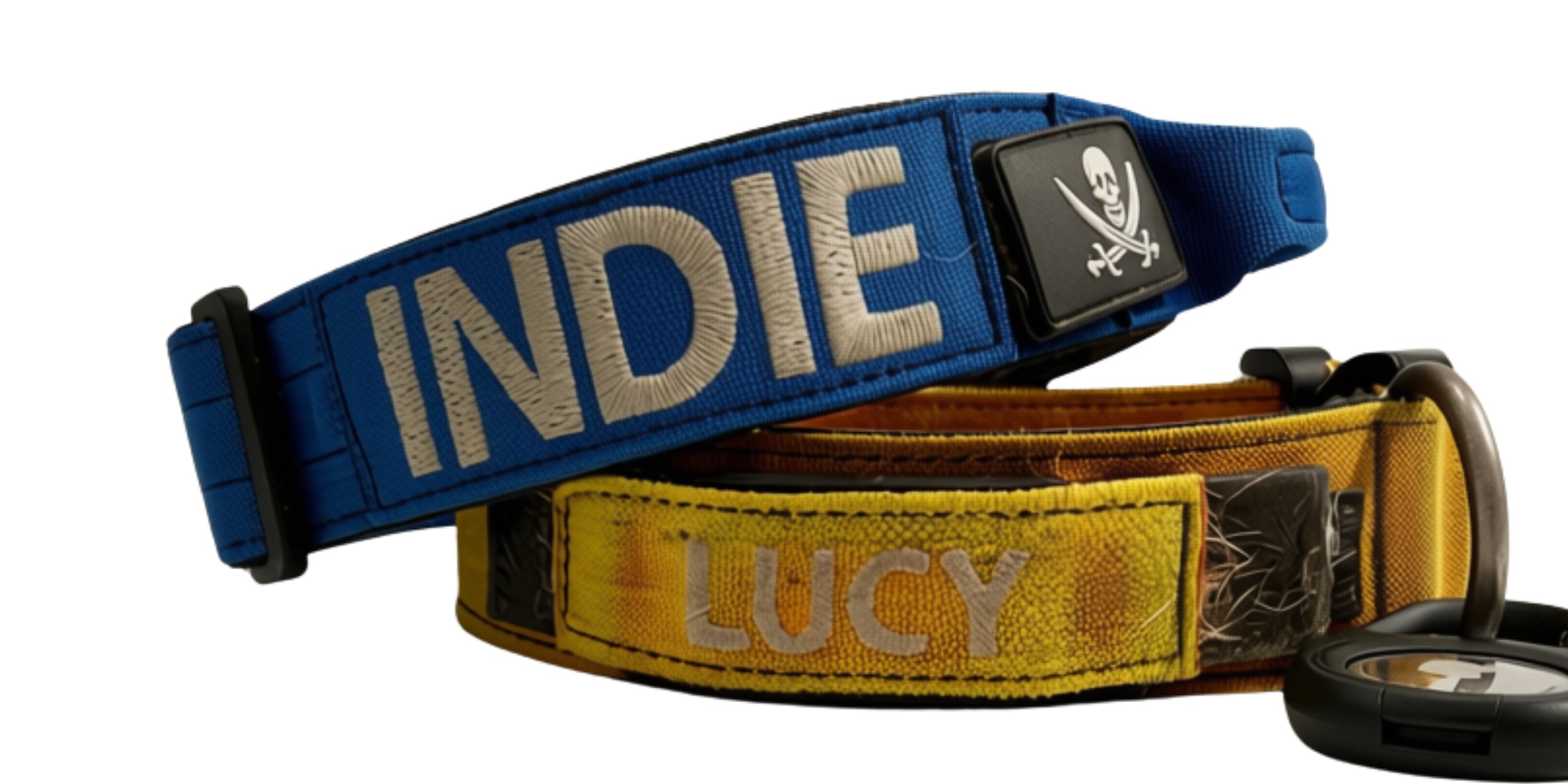
A GPS tracker doesn’t replace a microchip or visible identification. It’s another layer, and for a genuine flight risk it can be an extremely useful one. I’ve compared the systems I’ve used and researched in my dog GPS tracker guide.
Nylon, leather or BioThane?
I own and use plenty of nylon collars, including the TactiPup collars above, and nylon is probably the least glamorous answer to this question because it’s just very practical. It’s light, strong, relatively inexpensive and usually easy to wash. Check the webbing edges, stitching and hardware; a good material can still be turned into a rubbish collar.

I like leather too, but for different reasons. A well-made leather collar can feel lovely, soften with age and look better as it develops a patina. I’ve owned wide leather collars for Indie, and on a substantial dog I really like that combination of width and structure. But leather isn’t automatically “better” because it costs more. It needs maintenance, and if your dog’s greatest joy is becoming one with a swamp, there are easier materials to live with.

I’ve gone much further into leather quality, width, hardware and the specific collars I’d choose in my guide to the best leather dog collars.
BioThane and other coated webbing is the answer when I want something waterproof and wipe-clean. Again, look at the whole collar rather than getting hypnotised by the material name: rivets, joins, buckle, D-ring and edge finishing still matter.
Neoprene padding can be nice, especially against a short coat, but it also adds bulk and can hold moisture and grit. If a padded collar gets soaked, take it off, dry it properly and check the skin underneath.
Collar or harness for walking?
For routine walking, particularly with puppies and dogs who pull, I prefer a well-fitted Y-shaped harness. Harnesses don’t magically teach dogs to pull; dogs repeat behaviour that works. I’ve covered that particular myth in Do Harnesses Make Dogs Pull?, and my tested dog harness guide covers the designs I actually like.
That doesn’t make collars bad. The collar can carry ID while the leash goes on the harness. If I’ve got an escape-prone dog, I can also use a safety connector between the two so one equipment failure doesn’t immediately equal a loose dog.
Head collars are a different category again. They sit around the muzzle and behind the head, and I don’t consider them a benign shortcut to loose-leash walking. If someone is going to use one, I want gradual positive conditioning, gentle handling and a backup attachment; never leash corrections or an unsupervised dog wearing one.
Collars I don’t recommend for training
I don’t recommend prong collars, choke chains or electronic collars used to deliver shock, vibration or startling tones as consequences.
My issue isn’t simply that I personally prefer nicer equipment. Punishment can suppress the behaviour you’re looking at without teaching the dog what you actually want, and adding pain or discomfort around a trigger can create associations I absolutely don’t want. If walking has become unmanageable, I would rather change the environment and equipment, create enough distance for the dog to learn, and reinforce the behaviour I want.
I cover those separately in my guides to prong collars and e-collars.
Should dogs wear collars all day?
There’s a real trade-off here, and I don’t think a blanket rule helps.
Collars can snag on crates, furniture, branches or another dog’s jaw during play, so taking them off for crating, rough play and unsupervised indoor time can reduce that risk. On the other hand, a genuine flight-risk dog may be at greater risk without visible identification and tracking.
Lucy and Shelby wear theirs continuously because, frankly, they’re hounds. They can turn an incompletely latched gate into a field trip before you’ve finished saying their names. For them I accept the collar risk and try to minimise it: as little dangling hardware as possible, secure tracker attachments, frequent hardware checks, and regular checks of the skin and coat underneath.
I still want every dog microchipped because collars can come off. The AVMA’s microchipping guidance is worth reading, and the important bit people forget is keeping the registration details current.
My quick collar check
When I pick up a collar, this is basically what I’m checking:
- Fit: secure without digging in, and appropriate for this individual dog’s neck and head.
- Width and weight: proportionate to the dog. I don’t want tiny hardware on a large dog or half a hardware store hanging from a puppy.
- Construction: smooth webbing or sound leather, tidy stitching or rivets, and a D-ring and buckle I trust.
- Job: ID, tracker, ordinary leash attachment, escape prevention? Know what you’re asking the collar to do.
- Lifestyle: swimming, mud, coat type, rough play and how willing you are to maintain the material all matter.
- Snag risk: fewer dangling bits is generally better.
And I check collars again after buying them. Hardware wears. Puppies grow. Leather changes. Webbing gets chewed. A collar being safe when it came out of the packet doesn’t make it safe forever.
Choose the collar for the dog in front of you
Most dogs don’t need a complicated collar. A simple, well-fitted flat collar carrying current identification is perfectly adequate, and I can attach the leash to a harness when that’s the more appropriate walking setup.
My hounds are a good example of why I don’t like universal rules: their 1.5-inch TactiPup collars, streamlined ID and Fi trackers are more equipment than plenty of dogs need, but their escape risk makes that setup worthwhile. Indie could comfortably wear a gorgeous wide leather collar because he had the neck for it. A puppy needs something lighter and cheaper because they’re going to grow out of the thing anyway.
Fit the dog. Decide what job the collar actually needs to do. Then buy enough collar for that job — not the one with the most impressive marketing copy.




0 Comments