If you want the short version: for most puppies, I would buy a lightweight, adjustable Y-front harness that fits properly and not spend a fortune on it. Puppies grow ridiculously quickly, particularly larger breeds, and I hate spending a lot on something they may only wear for a couple of months.
That is why my puppy recommendations are a little different from my adult-dog harness recommendations. If you have the budget, I really like the Ruffwear Front Range (Amazon). For a smaller puppy, the Ruffwear Hi & Light is another lovely option. But for the average growing puppy? Rabbitgoo and Truelove’s Front Range-style harnesses are genuinely great choices. They’re affordable, adjustable, give the shoulders room to move, and I don’t mind replacing one when the puppy inevitably grows out of it.
The most important thing here isn’t the logo on the harness. It’s the shape and fit.
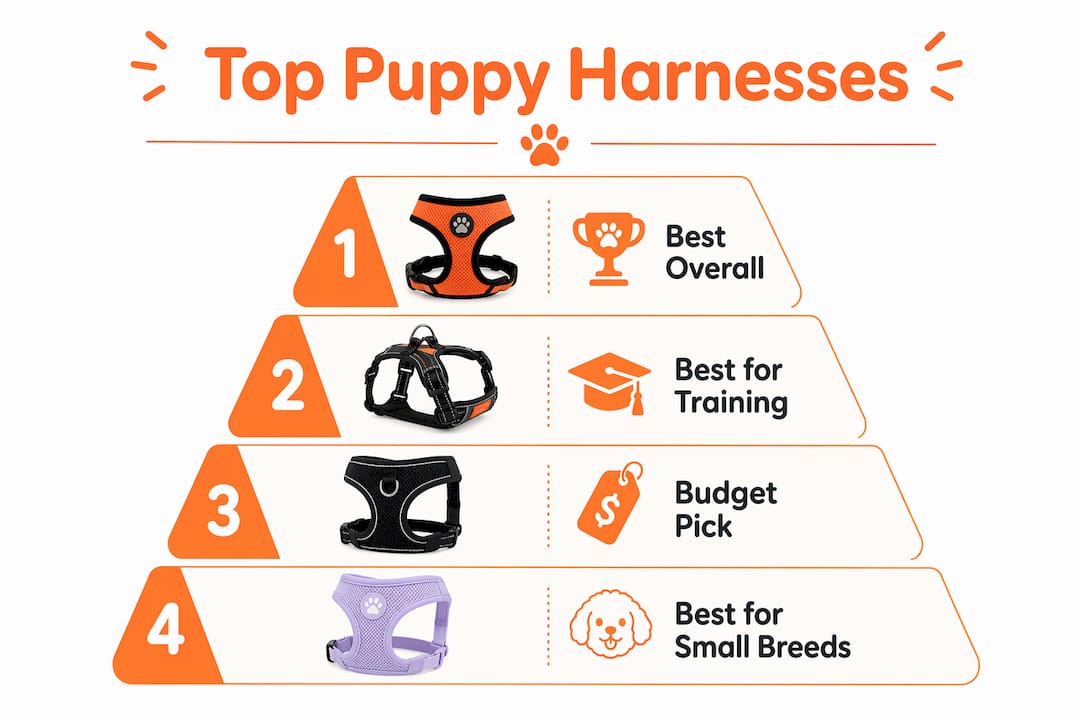
My quick puppy harness picks
| Harness | I’d choose it for | Why |
|---|---|---|
| Rabbitgoo adjustable Y-front harness | Most growing puppies / best value | Affordable, lightweight enough, adjustable and easy to replace as your puppy grows |
| Truelove Y-front harness | Most growing puppies / alternative budget pick | Similar practical Front Range-style design without spending premium-harness money |
| Ruffwear Front Range | If you have the budget | Excellent Y-front shape, good adjustment and a really nice everyday harness |
| Ruffwear Hi & Light | Smaller puppies | Light and low-profile, which I particularly like on a little body |
What I actually look for in a puppy harness
I’ve tested an awful lot of dog harnesses over the years, and puppy harness shopping really doesn’t need to become as complicated as the internet makes it. My priorities are pretty simple.
1. Freedom of movement comes first
Y-front. Always Y-front.
I want the front of the harness to sit in a way that leaves the shoulder free to move rather than putting a horizontal band across it. Puppies are busy learning how their bodies work; I don’t want their everyday walking equipment unnecessarily interfering with that movement.
This matters more to me than thick padding, handles, fancy buckles or whether the harness has seventeen different leash attachment points.
2. I want adjustment basically everywhere
For an adult dog I can be a little more forgiving about adjustability if a harness happens to fit that dog’s proportions beautifully. Puppies are different. They’re changing shape constantly.
Ideally I want adjustment at the neck, chest and girth. That’s not just so you can make the harness physically bigger and squeeze another month out of it. The point is being able to keep the harness sitting in the right place as the puppy’s proportions change.
Check it frequently. A harness that fitted beautifully surprisingly recently can suddenly be sitting too close to an armpit or looking distinctly undersized.
3. Keep the girth strap out of the armpits
I like the belly/girth strap sitting nicely back from the puppy’s armpit. If it’s tucked right up behind the front leg, you’ve got much more opportunity for rubbing and it can interfere with comfortable movement.
Don’t just look at whether you can get two fingers under the straps. Look at the whole geometry of the harness: where the Y sits on the chest, whether the shoulders can move, and where that girth strap lands.
4. Lightweight is a good thing
I don’t need a puppy harness to be built like climbing equipment. For medium and larger puppies, roughly one-inch webbing is plenty substantial for me. Aluminium hardware is more than sufficient and I’m perfectly happy with decent plastic pinch clips too.
Steel fixtures, Cobra buckles and seriously overbuilt hardware have their place in dog equipment. A normal puppy learning to go for a walk usually isn’t it.
5. I don’t want a handle
This is one feature I would actually rather not have on a puppy harness. Puppies are clumsy. They crawl under things, through things and into things with absolutely no regard for the loop sticking out of their back. I don’t want an unnecessary handle giving them something else to get hung up on.
6. An opening neck is useful, but not essential
I like harnesses that can buckle open around the neck because you don’t have to pull the whole thing over the dog’s head. For most puppies, though, this is fairly low on my priority list.
Where I care much more is with a sensitive puppy — perhaps a poorly socialised farm-bred puppy, a puppy-mill puppy, or simply an individual who finds things passing over their head worrying. In that situation, an extra neck buckle can make putting the harness on considerably less stressful.
For everybody else, I’d happily choose the better-fitting harness without that buckle and teach the puppy that putting their head through it predicts good things.
7. Reflective material depends on where you walk
If you’re street walking or walking after dark, visibility matters and reflective details become something I’d actively want. If your puppy’s current walks are primarily daylight training sessions, the yard or similar environments, it isn’t something I’d sacrifice fit or movement for.
It’s a case-by-case feature, not a universal requirement.
8. Padding barely enters into my decision
Padding is fine. I’m not anti-padding. I just wouldn’t choose a worse-shaped harness because it has more of it. If two harnesses fit equally well and one is nicely padded, lovely. But freedom of movement and fit are doing the real work here.
Why I don’t spend a fortune on puppy harnesses
This is probably the biggest difference between shopping for a puppy and shopping for an adult dog.
I hate spending a lot on puppy equipment, particularly for larger breeds, because they can be in a harness for a couple of months and then suddenly it doesn’t fit. There is nothing wrong with buying a good affordable harness, getting the fit right, and replacing it when your puppy grows.
That’s exactly where Rabbitgoo and Truelove come in for me. They’re the sort of Front Range-style Y harnesses I genuinely reach for during the growing stage. They’re good, practical harnesses without making me wince when the puppy needs the next size.
If money isn’t really a consideration, absolutely go for the Ruffwear Front Range. I like it. And for smaller puppies, I’d seriously consider the Ruffwear Hi & Light because I like how little bulk it puts on a small dog.
But I don’t think somebody needs to buy the premium option to do right by their puppy.
Do puppies need a front-clip harness?
No. A front attachment point isn’t one of my criteria for a puppy harness.
This is one of the things I disagree with in a lot of harness buying advice. You should not need a front attachment point to contain a puppy and teach them to walk on a loose leash.
A front clip can be a useful management tool in particular circumstances, especially with an adult dog where the handler needs some additional mechanical help. But that’s different from teaching loose-leash walking. Equipment can make a dog easier to manage; it doesn’t teach the behaviour for you.
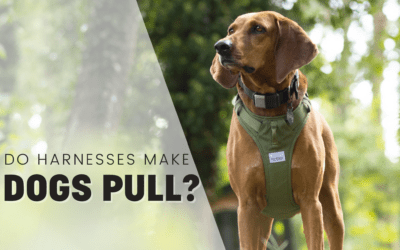
With a puppy, I’d much rather put the emphasis on reinforcement, engagement and actually teaching them what we want when they’re on a leash. You can read more about that distinction in my guide to loose-leash walking gear and whether harnesses make dogs pull.
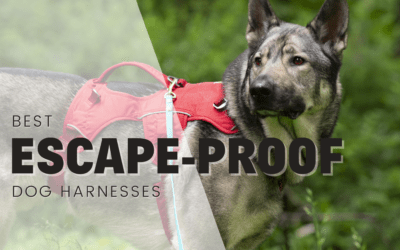
Does a puppy harness need to be escape-proof?
For the average puppy, this isn’t high on my list either.
Of course the harness needs to fit securely. I don’t want a puppy casually stepping backwards and leaving their harness behind. But I also don’t think we should routinely need a huge three-strap escape-proof setup for a baby dog.
If a puppy is desperately wriggling, panicking or trying to back out of their harness, I’d be asking why. Are they overwhelmed by the environment? Are they frightened? Is the harness uncomfortable? Have we moved too quickly?
More containment isn’t always the answer to a puppy telling us they’re struggling.
How should a puppy harness fit?
Start with the manufacturer’s size chart and your puppy’s current measurements rather than buying according to breed or expected adult weight.
- The Y should sit neatly on the front of the chest rather than cutting across the shoulder.
- The shoulder should be able to move freely.
- The girth strap should sit comfortably behind the front legs rather than tucked into the armpit.
- You should be able to fit your fingers comfortably beneath the straps without the harness being loose enough to rotate around the body.
- Use the neck, chest and girth adjustment to keep the shape of the harness correct as your puppy grows.
- Check the fit regularly. Growing puppies are spectacularly inconsiderate about remaining the same dimensions.
Getting your puppy used to their harness
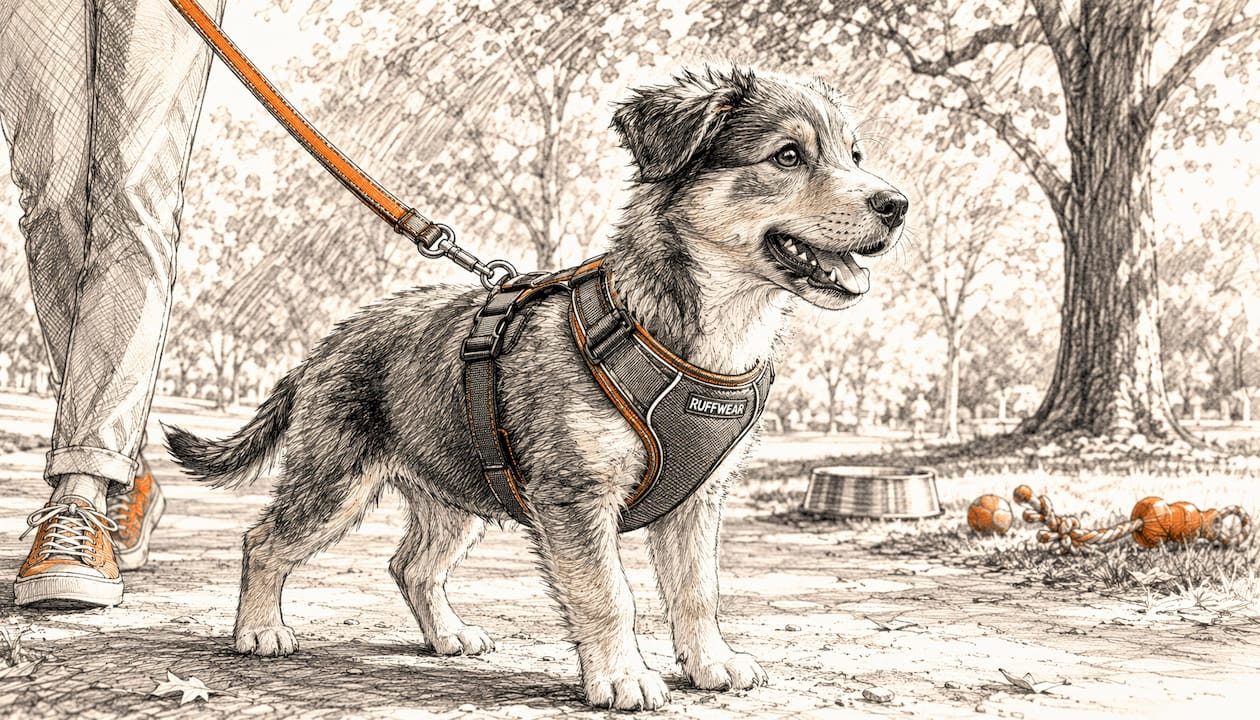
I’m completely happy for a puppy to wear their harness around the house for short, supervised periods while they’re getting used to it. In fact, I think it can be really useful.
One of my favourite ways to build that association is play. Harness goes on, something fun happens. Play with them, train with them, let them move naturally in it. The harness becomes part of a good experience rather than a weird piece of equipment that only appears immediately before they’re dragged into an overwhelming environment.
For a normal confident puppy, you can also make putting an over-the-head harness on part of the game: reward them for choosing to put their nose through the opening and build from there. If you’ve got a genuinely head-shy puppy, that’s where I’d be more inclined to choose a harness with a buckle at the neck rather than insisting they tolerate something we can easily avoid.
And because puppies are puppies, supervise this. I’m happy with acclimation around the house; I’m not suggesting leaving a harness on an unattended puppy who is liable to attach themselves to the furniture.
Things I wouldn’t make a priority
There are a few features that sound impressive on a product page but just aren’t what determines whether I’d buy a harness for a puppy:
- Front attachment points: nice if they’re there, but not necessary for teaching loose-leash walking.
- Heavy-duty hardware: unnecessary for the vast majority of puppies.
- Handles: I’d actually rather avoid them because puppies are clumsy and can snag them.
- Maximum padding: much less important than shape and freedom of movement.
- Extreme escape resistance: secure fit matters; turning every puppy into Houdini before they’ve done anything to earn the title doesn’t.
- A huge price tag: your puppy does not care, and they’re probably about to outgrow it anyway.
So, which puppy harness would I buy?
If I were bringing home a puppy tomorrow, I’d start by looking at Rabbitgoo or Truelove. I’d find the Y-front model that fitted that particular puppy best, make sure I had plenty of adjustment at the neck/chest/girth, check that the girth strap sat clear of the armpit, and get on with training.
If I had the budget and didn’t mind potentially replacing a more expensive harness fairly quickly, I’d go Ruffwear Front Range. For a smaller puppy, I’d also look hard at the Hi & Light.
That’s really it. Puppy harness shopping doesn’t need to become an engineering project.
A good puppy harness should be Y-shaped, light, adjustable, comfortable and correctly fitted. Then spend your energy on teaching your puppy to enjoy wearing it and learning how to walk with you. That’s going to matter much more than whether you bought the fanciest harness on the shelf.
More on harnesses and puppy walking
- Best Dog Harnesses — Tried & Tested by a Professional Trainer
- Ruffwear Front Range Harness Review
- Rabbitgoo Harness Review
- Comparing the Market-Leading Dog Harnesses
- Do Harnesses Make Dogs Pull More?



0 Comments