Can You Use an Apple AirTag to Track Your Dog? My Honest Experience
I love Apple’s Find My network.
I use it constantly for my phone, which apparently has ambitions of becoming one of Andy’s toys in Toy Story. I swear I can put it down for 30 seconds and somehow it has migrated into an entirely different room.
So, when people started attaching Apple AirTags to their dogs’ collars, I could see the logic.
An AirTag is small, relatively inexpensive and has no monthly subscription. There are also countless collars and holders designed to keep one securely attached to a dog.
If Find My can locate my apparently sentient phone, surely an AirTag can locate my dog too?
Well, yes.
And no.
I’ve tested an AirTag on my own dogs, and because we live in a fairly remote area, it was pretty much useless. Its greatest achievement was reliably notifying me that I had left my dog at home.
That doesn’t mean AirTags are bad products or that they cannot help you find a lost dog. They absolutely can, especially in densely populated areas.
The problem is that an AirTag is not a GPS dog tracker.
It was designed to help you find inanimate objects that generally stay wherever they were dropped. Dogs have free will, functional legs and, in the case of my coonhounds, a deeply inconvenient commitment to following interesting smells.
Whether an AirTag is suitable for your dog therefore depends heavily on where you live, where you walk and what you need the tracker to do.
Can You Put an AirTag on a Dog?
Yes, you can physically attach an AirTag to a dog’s collar.
Apple doesn’t include a hole, clip or collar attachment on the AirTag itself, but there is a huge range of third-party hardware available, including:
- Silicone AirTag holders
- Screw-fastened collar mounts
- Leather AirTag cases
- Protective hard-shell cases
- Collars with integrated AirTag pockets
- Waterproof or impact-resistant holders
Some slide directly onto the collar, while others hang from the collar like an identification tag.
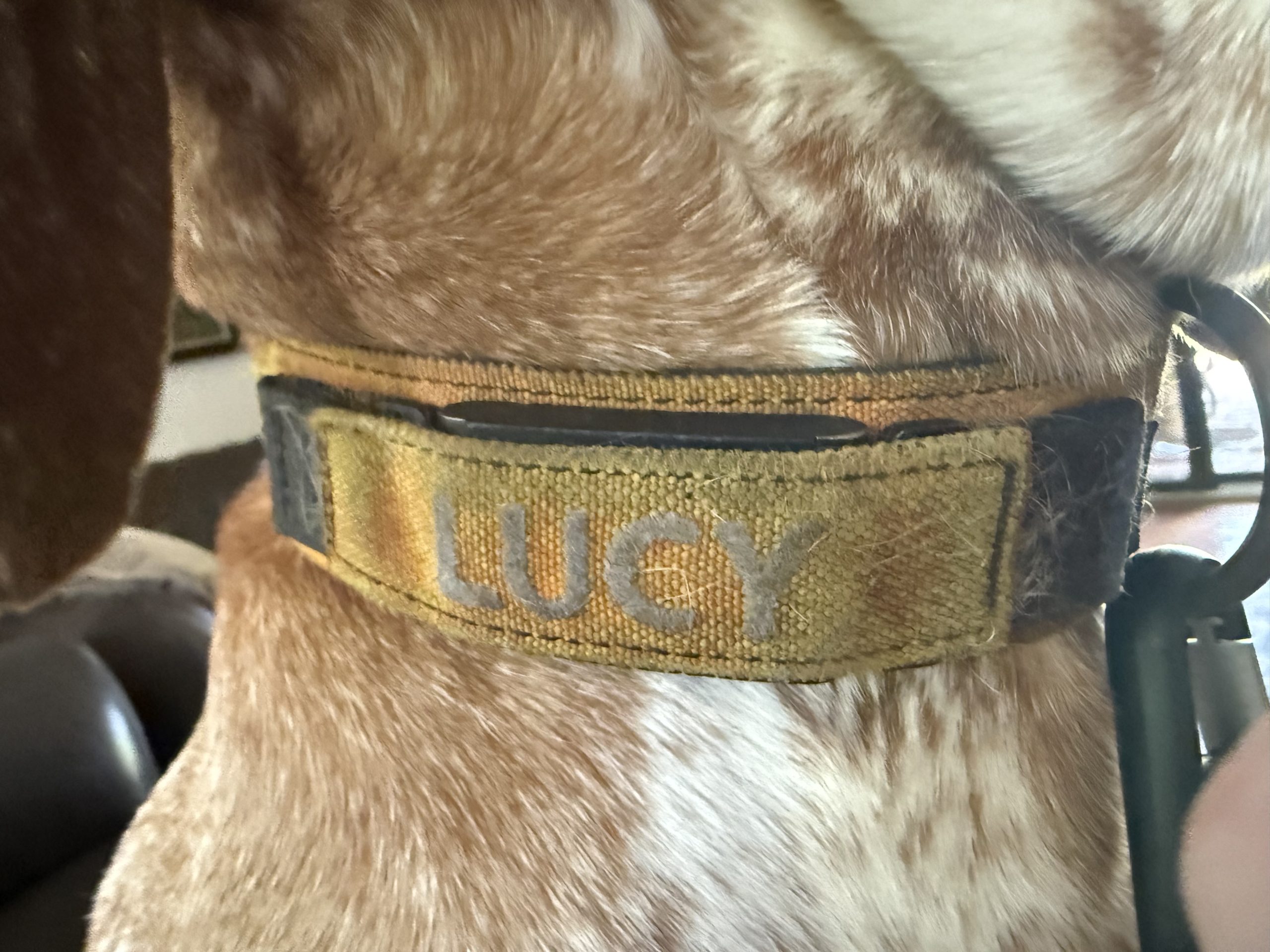
I would generally choose a holder that sits flush against the collar rather than one that dangles. A hanging AirTag is more likely to catch on branches, strike the dog’s food bowl or get chewed by another dog.
However, remember that an expensive holder only makes the AirTag more secure.
It does not improve the signal, increase the tracking range or turn the AirTag into a GPS device.
Is an AirTag a GPS Tracker?
No. An AirTag does not contain a conventional GPS receiver, and it does not have its own cellular connection.
Instead, it primarily uses Bluetooth and Apple’s Find My network.
The AirTag transmits a secure Bluetooth signal. When a participating Apple device comes close enough to detect it, that device can relay the AirTag’s approximate location through the Find My network. You can then view the reported location in the Find My app.
The nearby Apple user does not need to actively search for the AirTag or open the Find My app. Their device can contribute to the network in the background, while the AirTag’s rotating identifiers and Apple’s encryption systems are intended to protect the privacy of the people involved.
The easiest way to picture it is:
Your dog’s AirTag → nearby Apple device → Apple Find My network → your phone
A dedicated GPS dog tracker works differently:
Your dog’s tracker → GPS satellites and cellular network → tracker’s app on your phone

That difference is the entire crux of this article.
How Far Can an AirTag Track a Dog?
There isn’t one simple distance.
When your dog is close to you, your iPhone may be able to communicate directly with the AirTag using Bluetooth. Compatible iPhones can also use Ultra Wideband technology and Precision Finding to show the direction and distance to a nearby AirTag. Environmental obstacles, including walls and objects between the phone and AirTag, can affect that performance.
Once your dog moves beyond direct range, the AirTag depends on other devices in Apple’s Find My network detecting it.
This means an AirTag can theoretically be located from hundreds or thousands of miles away, but only if a compatible device passes close enough to detect it.
The effective tracking distance is therefore not really determined by the distance between you and your dog.
It is determined by the distance between your dog and the nearest participating Apple device.
In a busy city, that might be a matter of seconds.
In woodland, on farmland or along a remote hiking trail, another Apple device might not pass nearby at all.
AirTags Are Crowdsourced Trackers
This is why I would describe an AirTag as a crowdsourced location device rather than a true dog tracker.
It borrows connectivity from the surrounding population.
In a population-dense area, that can work surprisingly well. Your dog may pass apartment buildings, pedestrians, parked cars, cafés, stores and homes containing Apple devices.
That creates frequent opportunities for the AirTag’s location to be reported.
Outside a populated area, the system becomes much less reliable.
The AirTag does not suddenly stop functioning. It is still emitting its signal. There is simply nobody nearby to hear it and pass the information along.
That was exactly what happened during my own test.
We live remotely, so there weren’t enough passing Apple devices to make the AirTag useful as an escape tracker. It could tell me when I had left the dog at home, but that wasn’t exactly the pressing safety information I had bought it for.
If one of my hounds headed through the woods, the likelihood of her conveniently passing somebody carrying an iPhone was pretty slim.
An AirTag Tells You Where Your Dog Was
This is the other major limitation.
An AirTag’s map location may be the last place another Apple device detected it.
That location could be recent and incredibly helpful.
It could also be stale.
Imagine your dog gets out at 10:00 a.m.
At 10:05, your dog passes someone walking through the neighborhood. That person’s iPhone detects the AirTag and updates its location.
By 10:20, your dog has followed a scent another mile down the road.
The AirTag hasn’t necessarily failed. It accurately showed you where the dog was detected at 10:05.
The problem is that dogs keep moving.
A suitcase usually remains where an airline leaves it. Your keys stay under the sofa. A backpack stays in the coffee shop.
A loose dog can cross roads, enter woodland, double back, follow another animal or cover several miles while you are still working from an old location.
That gives us the simplest distinction between these devices:
An AirTag can tell you where your dog was. A GPS tracker is designed to tell you where your dog is.
Even a GPS tracker is not literally continuous or infallible, but it is built to provide repeated location updates from a moving animal. An AirTag was not.
My Experience Using an AirTag on My Dog
I originally tested an AirTag because the proposition made sense.
The hardware is inexpensive, the battery lasts a long time and I already use Find My regularly. I wasn’t unfamiliar with the ecosystem or struggling to understand the app.
The issue was simply our location.
We live somewhere rural and wooded. That is already a challenging environment for tracking technology, but it is particularly unsuitable for a system that depends on passing members of the public carrying compatible devices.
In practice, the AirTag mostly alerted us that we had left the dog behind when we went somewhere.
Technically accurate?
Yes.
Useful for finding an escaped hound?
Not particularly.
Had I tested it in central London, Baltimore or New York City, I could have reached a very different conclusion.
That is why I don’t think it is accurate to say that AirTags cannot track dogs.
They can.
They just don’t track them in the same way as a dedicated GPS device, and their usefulness is highly dependent on the environment around the dog.
Are AirTags Good for Dogs in Cities?
Potentially, yes.
For a dog living in a busy urban or suburban area, an AirTag can be a reasonable low-cost backup.
There are likely to be more iPhones and other participating Apple devices nearby, which increases the chance of the AirTag being detected as the dog moves through the area.
For roughly $30 for the AirTag, plus the cost of a secure collar holder, you can create a basic tracking setup with no monthly subscription.
Depending on the holder you choose, the total one-off cost will commonly land somewhere around $30 to $50.
That isn’t horrid value at all.
I would still view it as a recovery aid rather than a substitute for secure identification, training and management.
Your dog should still have:
- A registered microchip
- A visible identification tag
- Secure doors, gates and fencing
- A properly fitted collar or harness
- Recall training appropriate to the dog
- A current photograph available in case the dog goes missing
An AirTag can add another layer.
I just wouldn’t mistake that layer for live GPS tracking.
Are AirTags Good for Rural Dogs?
I would not rely on one.
If your dog gets loose on acreage, farmland, woodland or a remote trail, the Find My network may have very few nearby devices available to update the AirTag’s location.
This is exactly the environment in which I most want a tracker to work.
A rural dog may also cover a considerable distance before passing a home, road or person. Even when the AirTag eventually updates, you may be looking at a location the dog has already left.
For rural dogs, hunting breeds, escape artists and dogs regularly walked off the beaten path, a dedicated GPS tracker is the more appropriate tool.
That doesn’t mean you can’t add an AirTag as a backup.
I just would not make it my primary method of finding the dog.
Could an AirTag Work for an Indoor Cat?
Yes, and indoor cats may actually be one of the more sensible pet-related uses for an AirTag.
An indoor cat that slips outside often remains fairly close to home, especially initially. The cat may hide underneath a porch, behind a shed, inside a neighboring garage or close to surrounding houses.
In a suburban or urban neighborhood, nearby Apple devices may help report the AirTag’s location. Once you get close, Precision Finding or the AirTag’s built-in speaker may help you narrow down where the cat is hiding. Apple describes Precision Finding as a nearby-location feature available on compatible iPhones.
There are still limitations.
The collar must be appropriately fitted and safe for a cat, and no tracker guarantees recovery. A cat could also move beyond the last reported position or enter an area with no nearby devices.
However, I would be far more comfortable using an AirTag as a backup for an indoor cat in a populated neighborhood than as the main tracker for one of my coonhounds in rural woodland.
Different animal, different environment and very different risk.
Is an AirTag Waterproof?
The AirTag has an IP67 rating under the IEC 60529 standard. Apple states that it was tested at a maximum depth of one meter for up to 30 minutes. Apple also warns that water and dust resistance are not permanent and can decrease through ordinary wear.
But what does IP67 actually mean?
The first number relates to protection against solid particles.
A rating of 6 means the device is rated as dust-tight.
The second number relates to water resistance.
A rating of 7 means the device has been tested against temporary immersion in water under specified laboratory conditions.
In practical dog terms, an AirTag should generally cope with:
- Rain
- Muddy walks
- Wet grass
- Splashes
- Brief accidental submersion
I would not treat that rating as permission for:
- Regular swimming
- Extended submersion
- Repeated exposure to salt water
- High-pressure washing
- Assuming the device will remain waterproof forever
A protective collar holder may help reduce direct impacts and exposure, but it does not change Apple’s official rating for the AirTag itself.
How Long Does an AirTag Battery Last?
AirTag uses a user-replaceable CR2032 coin-cell battery. Apple’s specifications state that battery life is based on more than a year of typical use, although actual life varies with usage, environmental conditions and the replacement battery used.
That battery life is one of the AirTag’s biggest advantages over a GPS dog tracker.
GPS and cellular communication require much more power, so dedicated trackers normally need to be charged regularly.
An AirTag consumes far less energy because it is transmitting a small Bluetooth signal rather than constantly calculating and sending its own location.
The tradeoff is straightforward:
- AirTag offers very long battery life but relies on nearby devices.
- GPS trackers require charging but are designed to report a moving dog’s location.
You are not getting the same service without a subscription.
You are getting a different service.
Can an AirTag Send an Escape Alert?
Not in the same way as a dedicated GPS dog tracker.
Find My can send separation-related notifications, which is why mine was very good at informing me that I had left the dog at home.
However, that is different from a tracker recognizing that your dog has left a designated safe area and immediately starting a live-tracking mode.
A dedicated dog tracker may allow you to define a virtual safe zone around your home. When the tracker detects that the dog has left that area, it can alert you and begin providing more frequent updates.
An AirTag’s separation features were designed around personal belongings, not a dog slipping through a gate.
Again, it may still help.
It simply lacks the pet-specific monitoring and recovery features available from a purpose-built product.
What About AirTag Anti-Stalking Alerts?
Apple has anti-stalking protections built into the AirTag and the wider Find My network.
When a compatible Bluetooth tracker is separated from its owner and detected moving with another person over time, that person may receive an unwanted-tracking notification. The tracker may also emit a sound. Apple and Google have worked on a shared industry specification so compatible unwanted-tracking alerts can operate across iOS and Android.
Those protections are important.
They are also another indication that AirTags were created for belongings rather than animals.
In some lost-dog scenarios, an alert could help someone realize that the dog is wearing a tracker. However, the system is not specifically designed to distinguish between a dog moving with a stranger and an AirTag being used to follow that person.
I wouldn’t consider this the main reason not to use one, but owners should understand that privacy and anti-stalking behavior is part of how AirTags operate.
AirTag vs GPS Dog Tracker
| Feature | Apple AirTag | GPS dog tracker |
|---|---|---|
| Tracking method | Bluetooth and Find My network | GPS and usually cellular data |
| Live location tracking | No true continuous live GPS | Usually available |
| Depends on nearby phones | Yes | No, but cellular coverage is normally required |
| Best environment | Cities and populated suburbs | Urban, suburban and many rural areas |
| Rural performance | Often poor | Usually much stronger |
| Monthly subscription | No | Usually yes |
| Typical battery life | Around a year or more | Days or weeks, depending on device and settings |
| Replaceable battery | Yes, CR2032 | Usually rechargeable |
| Nearby precision finding | Yes, with compatible iPhones | Varies by tracker |
| Pet-specific escape alerts | No | Often included |
| Activity or health tracking | No | Sometimes included |
| Purchase cost | Low | Usually higher |
When I Would Consider an AirTag for a Dog
I think an AirTag makes sense when:
- The dog lives in a densely populated area.
- You want an inexpensive backup recovery tool.
- You already use an iPhone and Find My.
- You understand that location updates may be delayed.
- The dog is unlikely to enter remote areas.
- A GPS subscription is genuinely outside your budget.
- You are adding it alongside a microchip and identification tag.
At a one-off cost of roughly $30 to $50 once you include a holder, it can offer meaningful extra protection.
That is particularly true when the alternative is having no electronic tracking aid at all.
When I Would Choose a GPS Tracker Instead
I would choose a proper GPS dog tracker when:
- The dog lives in a rural area.
- The dog regularly hikes or explores woodland.
- The dog has a history of escaping.
- The dog is a scent hound or hunting breed.
- You need rapid escape notifications.
- You want to follow the dog’s route.
- You need repeated location updates.
- Finding the dog quickly is more important than avoiding a subscription.
- You want activity, sleep or other pet-specific data.
My own hounds wear Fi trackers because our physical fence can still be compromised by a fallen tree, a guest can leave a gate partially latched and coonhounds are coonhounds.
When a dog is actively moving through remote woodland, I don’t want to wait and hope she passes someone carrying an iPhone.
I want a product designed to track a moving dog.
Is an AirTag Worth Putting on Your Dog?
For the right dog in the right location, yes.
An AirTag can help locate a lost dog. In a densely populated city, it may work remarkably well because the dog is likely to pass numerous devices connected to Apple’s Find My network.
For around $30 to $50 as a one-off purchase, with no monthly fee and a replaceable battery that can last around a year, it is not a bad budget solution.
However, it is not equivalent to a GPS dog tracker.
The AirTag relies on your pet coming within range of somebody else’s Apple device. It may show you the last place your dog was detected rather than where the dog is now.
That distinction is manageable when you are looking for keys.
It becomes much more important when the thing you are tracking has legs, a nose and absolutely no intention of remaining where you last saw it.
I like AirTags.
I love Find My.
I use it constantly to recover my phone from whichever Toy Story-style adventure it has embarked upon that day.
I just wouldn’t rely on an AirTag as the main tracker for my dogs where we live.
In a city, I would consider one a useful and affordable backup.
In a rural area, I would skip it and buy a genuine GPS dog tracker.
The AirTag isn’t bad at its job.
Finding a fast-moving dog in the middle of nowhere simply isn’t the job it was designed to do.



0 Comments