If your new puppy is crying in their crate tonight, my first thought is not “they’re manipulating you” or “you need to ignore it.” My first thought is: what does this puppy need?
They may need the toilet. They may be uncomfortable. They may be overtired. They may have been introduced to the crate too quickly. Or they may simply be an eight-week-old baby dog who has just gone from sleeping with their mother and littermates to being alone in a strange house.
Yes, puppies can learn that making noise gets a response. Behaviour still works like behaviour. But I think we’ve gone a bit too far when every sound from a crate gets labelled “attention seeking” before we’ve even looked at the puppy.
What To Do If Your Puppy Is Crying In The Crate Tonight
First, check the obvious things. When did they last toilet? Are they too hot or cold? Are they physically comfortable? Have they been asleep for a decent stretch already?
At 8–10 weeks, around four hours can be a really good longest overnight stretch. Some puppies sleep right through almost immediately, but they’re unusual. I would absolutely expect many young puppies to need at least one nighttime toilet trip.
If toilet is likely, take them out. Keep it calm and boring-ish — we’re not starting a 2am party — give them a genuine chance to toilet, then head back to bed.
If they’ve toileted and they’re still genuinely distressed, I would rather reduce the difficulty than sit there listening to distress escalate because someone on the internet told me responding would “reward crying.” Move the crate closer. Sit beside it. Sleep nearby if that’s what gets everybody through the first night.
You can teach independence. You don’t have to prove it at 2am.
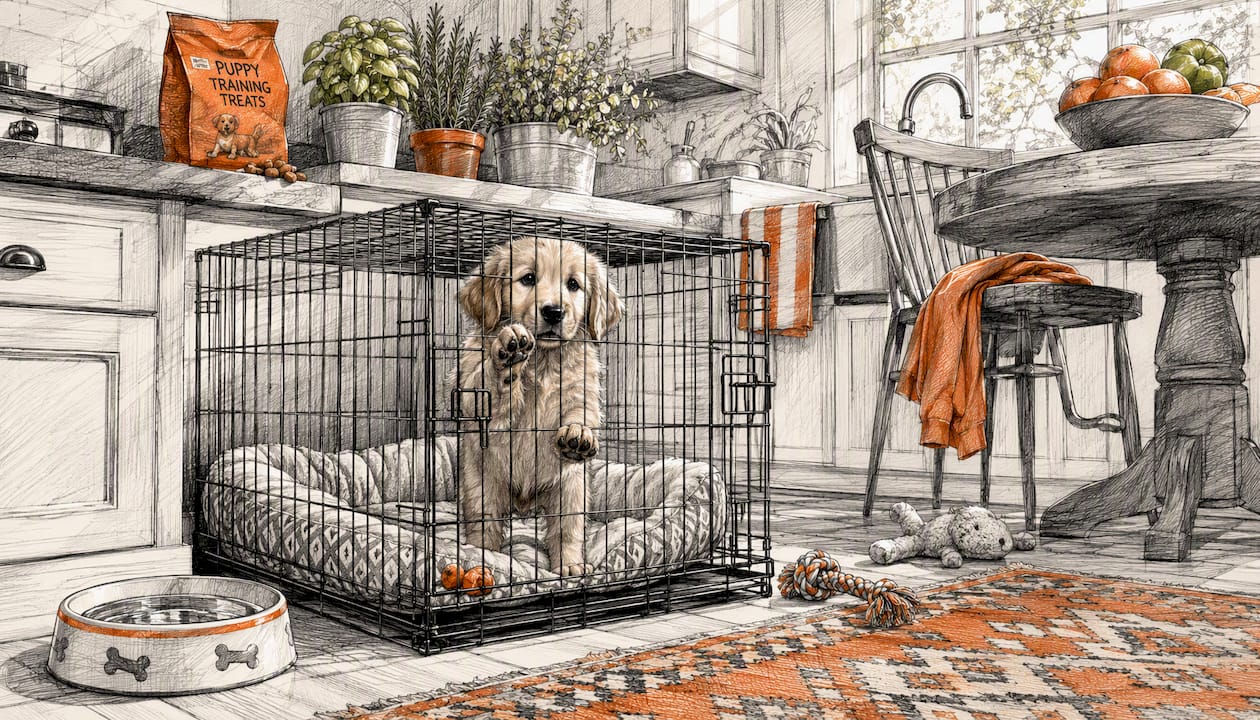
Why Puppies Cry In Crates
There isn’t one reason, which is exactly why I dislike one-size-fits-all advice about ignoring crying.
They need the toilet. Young puppies have small bladders. You cannot train physiology out of them.
The crate is too difficult right now. Crate training is something we teach. Closing a puppy behind a door doesn’t mean the teaching has happened.
They’re struggling with separation. Being comfortable in a crate and being comfortable alone are related, but they aren’t the same skill. If the puppy only panics when you disappear, look at your home-alone training as well as the crate.
They’re overtired. This one catches people constantly. Tired puppies don’t necessarily look sleepy. They can get bitey, zoomy, frantic, noisy and almost incapable of switching off.
Something is physically wrong. Pain, digestive upset, illness, temperature and discomfort all belong on the list before we decide the puppy is simply protesting.
Protest Versus Distress Isn’t Always A Neat Little Table
The original version of this article tried to give you a tidy diagnostic table where cyclical crying meant protest and relentless crying meant panic. Real puppies aren’t always that obliging.
I do care about escalation and body language. A puppy who is frantic, drooling, throwing themselves at the crate, biting bars hard enough to hurt themselves or unable to come down at all is giving me very different information from a puppy who grumbles for 20 seconds, rearranges their blanket and falls asleep.
But I wouldn’t diagnose the emotional state of every puppy from whether their crying has pauses. Look at the whole dog and the context.
If you’re unsure, err on the side of making things easier and then do more crate training during the day.
Crate Training Happens During The Day
The worst possible time to discover that your puppy isn’t comfortable in a crate is when you’re exhausted, they’re exhausted and everyone needs to sleep.
Do the teaching when nobody desperately needs the outcome.
I introduce the crate positively and gradually. Let the puppy explore it. Feed in there if that helps. Toss treats in. Let them take chews in. Close the door for tiny periods while you’re right there. Open it again. Build duration. Build distance. Let boring, ordinary naps happen there.

And I don’t particularly like rigid “Day 1 do X, Day 4 do Y, Day 9 leave for an hour” plans. Dogs don’t read calendars. Move forward when your puppy is comfortable at the current stage. If they’re struggling, make it easier.
My full crate training information centre goes through the process in much more detail.
Please Don’t Cry-It-Out A Panicking Puppy
I’m very comfortable allowing a little frustration in dog training. I don’t think dogs need to live in a bubble where they never experience it.
But frustration and panic aren’t the same thing.
If your puppy is genuinely escalating, I don’t want you waiting for an arbitrary 20 or 30 minutes because a timer says you’re allowed to help them after that. And I definitely don’t want them practising full-blown panic in the place we’re supposedly trying to teach them is safe.
Make it easier. Close the distance. Get them settled. Then revisit the training tomorrow.
The First Few Nights: Keep The Crate Close
I really don’t understand the rush to put an eight-week-old puppy downstairs alone on night one unless that’s genuinely where they settle best.
Keeping the crate beside your bed initially is practical. You can hear when the puppy wakes, distinguish a little sleepy grumbling from a puppy who’s properly awake, and get them outside before they have an accident.
Your presence can also make an enormous transition less enormous.
If the long-term goal is for them to sleep elsewhere, brilliant. Move towards that gradually. Sleeping near you for the first few nights doesn’t sentence you to sharing a bedroom with the dog for the next 14 years.
Don’t Try To Exhaust Them Into The Crate
Another common strategy is to absolutely knacker the puppy before bedtime so they’ll have no choice but to sleep.
I wouldn’t.
An overtired puppy can become harder to settle. If your evening consists of huge play, frantic zoomies, loads of interaction and then suddenly “right, crate, goodnight,” you’ve created a massive peak followed by a cliff edge.
I like a puppy’s day to look more like a nice easy curve than a spiky graph. Regulation comes from good transitions, not constantly bouncing between feast and famine.
Give Them A Runway Into Sleep
Instead of going from full-send play straight into the crate, give them a runway.
Sniff. Lick. Chew. Sleep.
That might be a gentle sniff outside alongside the final toilet trip, then something suitable to lick or chew while the household winds down. We’re not adding another massive enrichment session. We’re helping the puppy come down a gear.
This is useful outside crate training too. Any behaviour adjustment I do usually starts with looking at sleep — even with adult dogs — because asking an exhausted nervous system to regulate better is an uphill battle.
Should You Wait For Quiet Before Opening The Crate?
If the puppy is simply fussing and I know their needs are met, yes, catching a tiny moment of quiet before opening the door can be useful. We don’t need to teach that screaming is the door-release button.
But context matters.
If the puppy desperately needs the toilet, take them out. If they’re panicking, help them. I’m not going to stand beside a puppy who’s genuinely distressed waiting for a ceremonial two seconds of silence so I can technically avoid reinforcing something.
Training principles matter. So does common sense.
What To Expect Overnight By Age
8–10 weeks: nighttime waking is completely normal. Around four hours can be a good longest stretch, though individuals vary.
10–12 weeks: you may start getting longer stretches, but I still wouldn’t demand an uninterrupted eight hours.
3–4 months: many puppies are becoming physically capable of 6–8 hours overnight.
After four months: lots of puppies sleep through, but teething, illness, digestive upset, routine changes and individual development can all temporarily disrupt things.
Bladder capacity gets a vote here. I let it dictate a lot with young puppies rather than forcing them into a rigid schedule.
Should You Set An Alarm For Puppy Toilet Breaks?
Sometimes.
If your puppy reliably wakes or has an accident after roughly four hours, setting an alarm a little before that point can be useful. You get them out calmly, they toilet, everybody goes back to bed.
But if your puppy is sleeping beautifully and their overnight stretch is naturally increasing, I’m not particularly interested in waking them just because a generic chart says they should pee at 2:13am.
Let the puppy give you information.
Crate Or Playpen For Longer Periods?
I like crates and I think crate training is an incredibly useful life skill. But for longer periods, I prefer a playpen or larger dog-safe space where practical.
The dog gets more choice: they can move, change sleeping position, access water and decide where in the space they want to settle. That’s valuable.
A crate is a tool, not the place a puppy needs to spend every minute they’re not directly supervised.
Things That Make Crate Crying Worse
Moving too quickly. Going from “puppy ate one Kong in here yesterday” to “see you in four hours” isn’t gradual crate training.
Using the crate only when you leave. That’s a very efficient way to make the crate predict separation.
Punishing the crying. Shouting, banging the crate or using aversives may suppress noise, but that’s not remotely the same as teaching the puppy to feel safe.
Massive feast-and-famine days. Huge intensity followed by sudden isolation makes regulation unnecessarily difficult.
Assuming every cry is manipulation. Please look at the dog before applying the theory.
When I’d Get More Help
If your puppy is repeatedly panicking in the crate despite you reducing the difficulty and working through gradual crate training, I’d bring in a good reward-based trainer or behaviour professional rather than continuing to push through it.
If the crying changes suddenly, or comes alongside vomiting, diarrhoea, pain, unusual thirst or urination, lethargy, appetite changes or other physical symptoms, talk to your vet.
And if the crate is fine until you leave the house, I’d look specifically at home-alone training. The crate may not actually be the problem.
Frequently Asked Questions
Should I ignore my puppy crying in their crate?
No blanket rule. Check what they need first. Mild fussing from a puppy whose needs are met is different from escalating distress.
Will comforting my puppy teach them to cry?
You can reinforce behaviour, yes. But helping a frightened or distressed puppy is not automatically a training disaster. Meet genuine needs, then make the next training repetition easier.
How long should I let my puppy cry?
I don’t use a universal timer. I care about what the puppy is doing, why they’re crying and whether the behaviour is escalating. See my full guide to how long to let a puppy cry in a crate.
Should the crate be in my bedroom?
For a new puppy, I generally like it close initially. It makes nighttime toilet trips easier and gives the puppy support while everything is new.
Can my puppy sleep in a playpen instead?
Absolutely, assuming it’s safe and your puppy settles there. I particularly prefer pens for longer periods because they give the dog more space and choice.
What if my puppy was fine and suddenly starts crying?
Look for what changed. Teething, illness, digestive upset, a different routine, a new crate location or suddenly increasing separation can all matter.
The Goal Isn’t Silence. It’s A Puppy Who Feels Safe.
I don’t want a puppy who has simply learned that nobody comes when they cry. I want a puppy who can genuinely settle because the crate is familiar, their needs are met and we’ve taught the skill at a pace they can cope with.
That usually means less drama, not more: meet the bladder need, make the crate positive, practise during the day, support the first few nights, keep the puppy’s whole day less spiky and give them a runway into sleep.
Then build from there.
If you want the full process, start with my crate training resources, or use the Rebarkable Puppy Bundle for broader puppy support.



0 Comments